OpenCode vs Claude Code and Codex in 2026: the open-source terminal agent, Go plans, Console credits and your own login
OpenCode is the most starred open-source coding agent, and version 2 changed a lot: Go plans at $10 and $40, a Console gateway at cost plus a processing fee, sign-in with ChatGPT, Copilot or your Claude Code login, and no more share links or GitHub Action. We read its docs, pricing and changelog to show who pays for each run, and where the brief and design states should live.
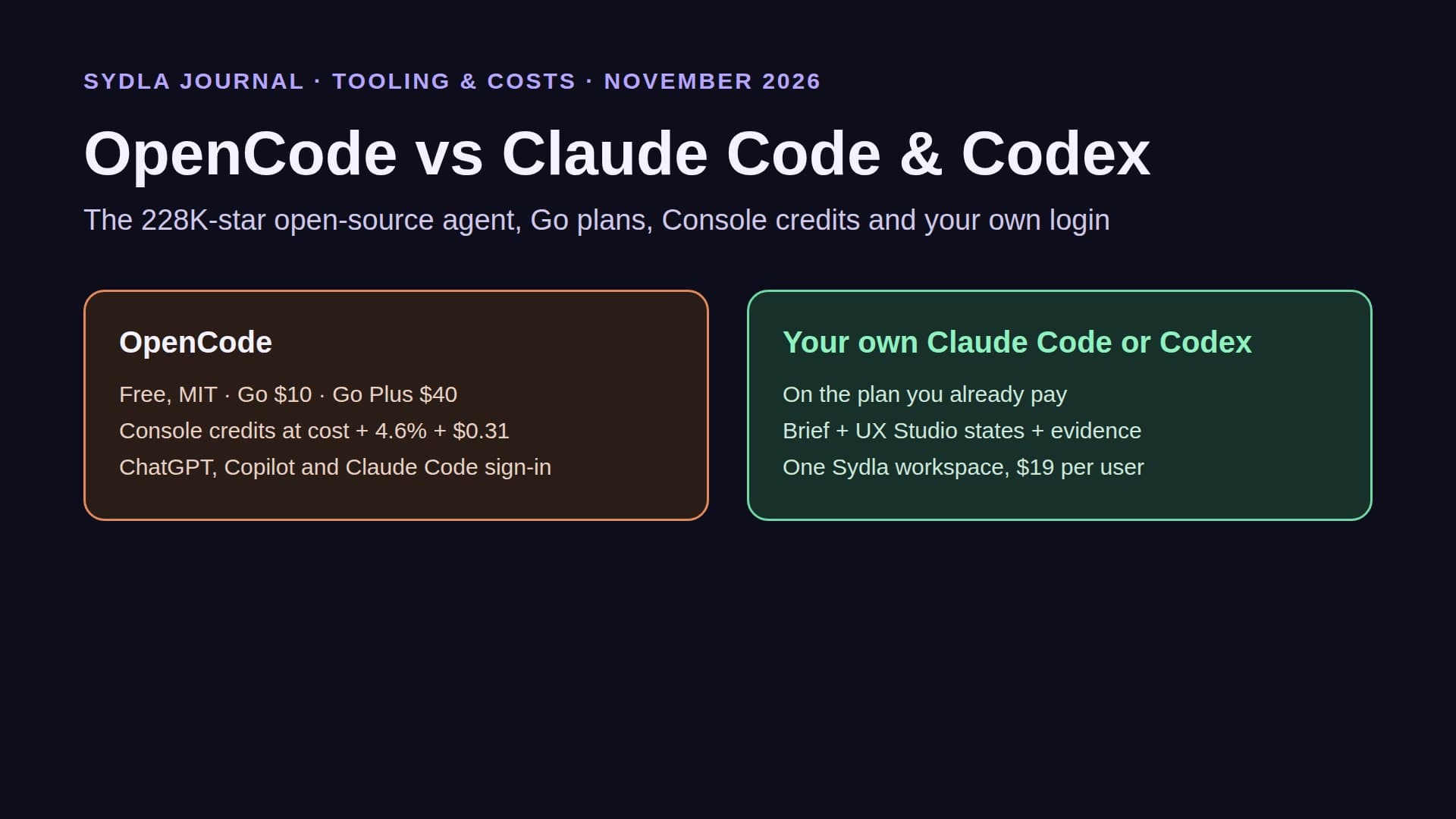
The most starred coding agent is free, and the meters moved around it
OpenCode passed 228,000 GitHub stars this month, more than any other coding agent, with over a thousand contributors. It is MIT licensed, runs in the terminal, as a desktop app in beta, in the browser and on a phone, and talks to more than 200 model providers. Kilo Code even rebuilt its version 7 on the OpenCode server.
Version 2 also changed how you pay. There are now two OpenCode Go plans with request allowances, a Console gateway that sells models at cost plus a fee on each top-up, and sign-in with ChatGPT, GitHub Copilot or your Claude Code login. At the same time two team features went away: session share links in October and the GitHub Action a few weeks later.
For a small product team, the real question is not which terminal agent feels best. It is who pays for each run, how many AI meters you are running at once, and where the brief, the states and the decisions live while the agent works. This guide compares OpenCode with Claude Code and Codex from docs, pricing pages and changelogs checked on 22 November 2026.
How OpenCode charges in November 2026
The OpenCode client is free. You pay for models in one of four ways, and you can mix them in one session.
- Your own key, free. Add a key from Anthropic, OpenAI, Google, OpenRouter, a cloud provider or a local model server such as Ollama. OpenCode reads its list of models from Models.dev.
- Console credits, pay as you go. OpenCode's gateway, earlier called Zen, sells tested models at cost, with markup only to cover processing fees. A fee of 4.6% plus $0.31 is added to each credit purchase. Claude Opus 5.5 is listed at $4 per million input tokens and $20 per million output, Sonnet 5.5 at $2 and $10, and GPT 5.3 Codex at $1.75 and $14. Workspaces can set budgets per member.
- OpenCode Go, $10 a month, or Go Plus, $40. A flat plan with request allowances per model that reset every five hours, plus a monthly limit. Of the Claude models, only Haiku 5.5 is on the visible list; most of the 32 models are open ones such as Kimi. Extra Usage lets you top up credit once the allowance runs out.
- Your existing plan. Sign in with ChatGPT Plus or Pro and runs spend your plan's Codex allowance. Sign in with GitHub Copilot, including Enterprise, through a device login. Since version 2.2.3 on 30 October 2026, a Claude Agent connector uses the login of the Claude Code CLI installed on your machine.
Be careful with the last one. Anthropic's legal page says third parties may not offer Claude.ai login or route requests through Free, Pro, Max or Ultra plans, and in January 2026 Anthropic restricted plan credentials to its own clients. The Claude Agent connector goes through the official Claude Code CLI rather than a copied token, but check Anthropic's current terms and your plan's usage rules before a whole team relies on it.
What changed in OpenCode 2
Upgrading from version 1 is offered inside the app since 17 November. These are the changes that matter to a team, from the changelog.
- Share links ended. Version 1.19.1 on 15 October 2026 discontinued session sharing. Existing links and the share commands stopped working, and importing a session from a share URL is no longer supported.
- GitHub Action removed. Version 2.2.0 on 27 October 2026 says the OpenCode GitHub Action is no longer published and should be removed from workflows. The version 1 docs that describe mentioning /opencode in an issue still exist, so check which version a guide is about.
- Background subagents. Version 2.3.0 on 13 November made subagents run in the background by default and report back when they finish.
- Agents and permissions. Four built-in agents: build with full access, plan which cannot edit files, general and explore as subagents. Custom agents are Markdown files in .opencode/agents, with permission rules that allow, ask or deny actions such as shell, edit or webfetch. The last matching rule wins, so a rule can ask before any git push.
- Rules and MCP. OpenCode reads AGENTS.md first and falls back to CLAUDE.md where no AGENTS.md exists. MCP servers can be local commands or remote URLs, and remote servers get OAuth with PKCE by default.
OpenCode, Claude Code and Codex side by side
All three read a repository, plan, edit files, run commands and use MCP servers. They differ in who sells the model access, which plans you can sign in with, and what is left for the team around the run.
| Agent | Plans | How a run is paid | Rules file and context |
|---|---|---|---|
| OpenCode | Free, MIT; Go $10; Go Plus $40 | Own key, Console credits plus 4.6% and $0.31 per top-up, Go allowance, or ChatGPT, Copilot or Claude Code sign-in | AGENTS.md, CLAUDE.md fallback, local and remote MCP |
| Claude Code | Claude Pro $20, Max $100, Ultra $200 | Your Claude plan's usage limits; API key billed per token | CLAUDE.md, any MCP server you add |
| Codex | ChatGPT Plus, Pro, Business plans | Your ChatGPT plan's Codex allowance; API key billed separately | AGENTS.md, MCP servers in config.toml |
| Sydla workspace | $19 per user | No AI credits: drives your own Claude Code or Codex, zero token markup | Brief, criteria, UX Studio states and evidence in one MCP connection |
Read the table by the plan you already pay. With a ChatGPT plan, Codex and OpenCode can both spend it. With a Claude plan, Claude Code is the supported client, and OpenCode reaches it only through the installed Claude Code CLI. With neither, OpenCode Go is the cheapest way in, but mostly on open models. Our bring your own coding agent guide explains the three ways to pay for a run, and the Claude Code vs Codex guide compares the two plans.
The six-tool stack around any agent
Whichever agent runs in the terminal, it still needs a ticket, a brief, designed states, decisions and a launch visual. In a typical 2026 stack those sit in six tools, each with its own seat and AI meter, and each one an MCP hop away from the run.
| Tool | Seat price | Bundled AI and its limit | Handoff to a coding agent |
|---|---|---|---|
| Jira Standard | $9.70 | Rovo: 25 credits per user per month, pooled; PAYG $0.01 per credit from 3 Dec 2026 | Atlassian MCP or a pasted ticket |
| Confluence Standard | $7.15 | Same Rovo pool, 25 credits per user | Atlassian MCP; enriched calls 1 to 10 credits |
| Notion Plus | $12.00 | Custom Agents on Business and Enterprise; extra credits $10 per 1,000 | Notion MCP server |
| Figma Professional Full | $20.00 | 3,000 AI credits per Full seat, no rollover | Figma MCP: 200 calls a day on Full or Dev |
| Miro Starter | $10.00 | 25 AI credits per license, pooled per team | Miro MCP: daily call limits by plan |
| Canva Business | $25.00 | Personal AI allowance per member | Outside the build loop |
| Sydla workspace | $19.00 | No AI credits: bring your own Claude Code or Codex | One MCP connection or a Sydla Desktop thread |
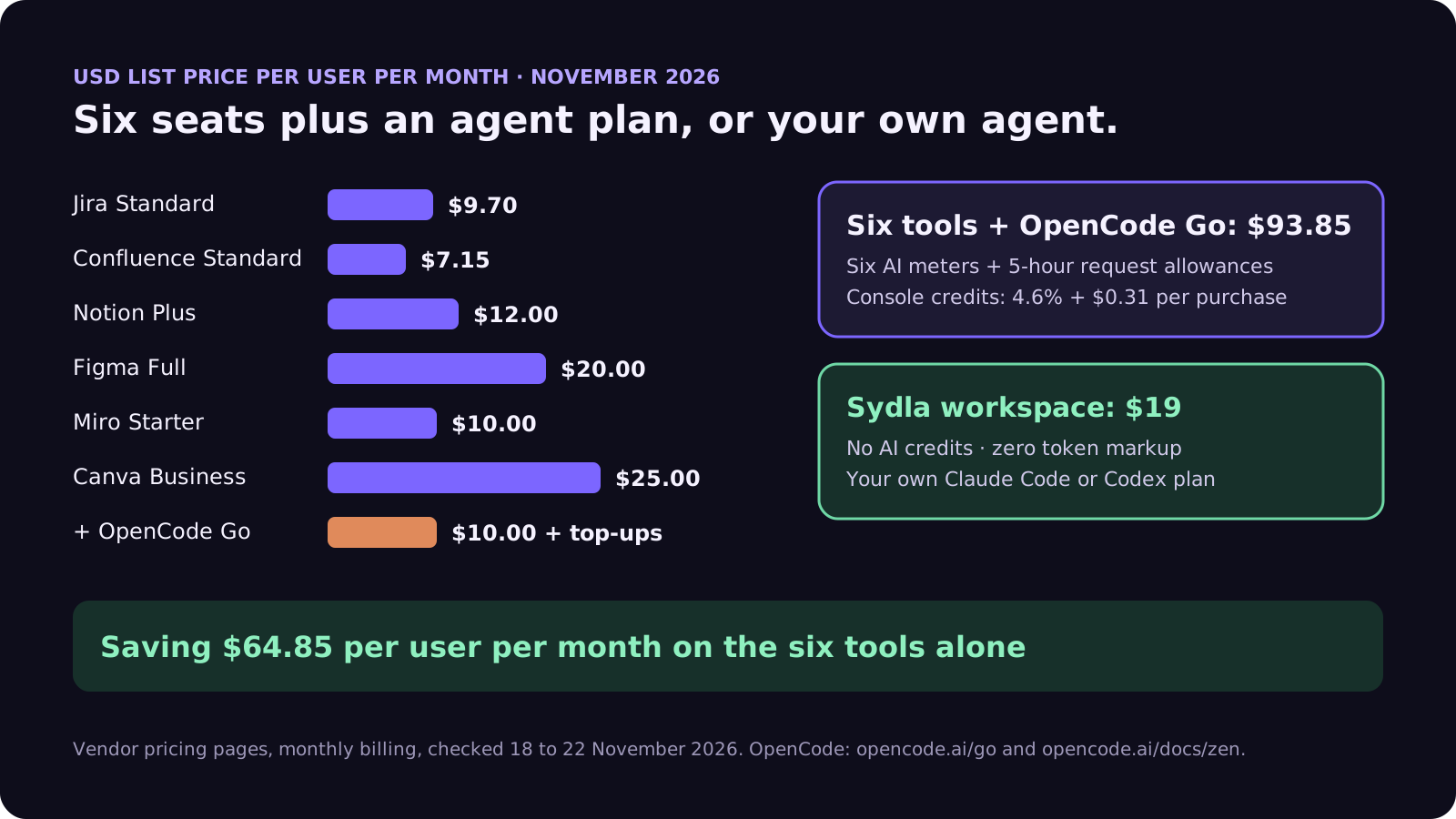
The six tools come to $83.85 per user per month before any overage, against $19 for Sydla, a saving of $64.85. Add OpenCode Go for the agent and the stack is $93.85 per person, with seven separate allowances to watch. The stack cost guide works through 5, 10 and 25 people, and the comparison overview covers each tool.
Technical walkthrough: your own agent on a shared brief and UX Studio states
Sydla does not add another agent or another gateway. The context lives in one workspace, and the agent you already pay for reads it on your machine.
- Brief. Each ticket sits in an initiative with a versioned brief, numbered acceptance criteria and a done-means line. Every save is signed by its author, a person or an agent.
- UX Studio. Screens and their states, empty, loading, error and success, are designed next to the ticket and published as a handoff with tokens and a URL per state.
- Run. In Sydla Desktop you open the ticket, start a thread and choose claude or codex. Desktop drives the CLI you are already signed in to, so the model, the limits and the bill stay on your Claude or ChatGPT plan. Each thread has an access level, Read only, Edit files or Full access, with a Preview panel and a Changes view.
- Review. The agent records evidence against each criterion: test output, screenshots of each state and the diff. A person reviews it and decides the merge and release gates. An agent can request a gate but never approve one. This also covers what OpenCode's share links used to do: the run, its evidence and the decision stay with the ticket, not in a link that can be switched off.
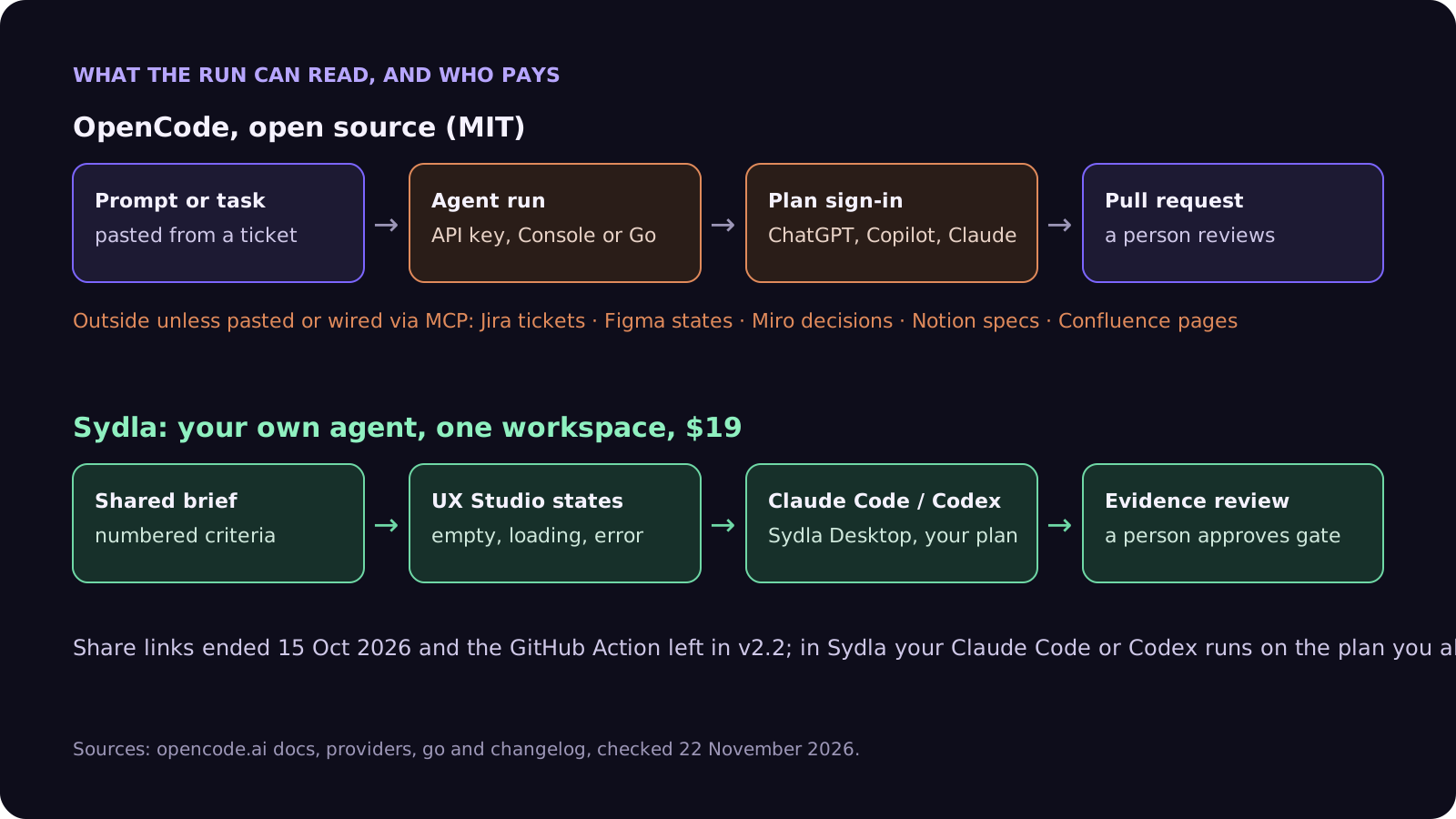
Outside Desktop, the same context is one MCP connection away. For Claude Code, run claude mcp add with the HTTP transport and the sydla.com/mcp URL. For Codex, add an mcp_servers.sydla table to config.toml with the same URL and your key in the headers. OpenCode works too: add a remote server under mcp.servers in opencode.jsonc, or run opencode mcp add sydla with the URL, and an engineer who prefers OpenCode's plan agent or a custom reviewer agent reads the same brief and states. Keep the first prompt short: read the work item, follow the criteria, record evidence. The brief to pull request walkthrough shows one feature end to end, and the Sydla Desktop setup guide covers the install.
Five checks before you standardise on OpenCode
OpenCode suits teams that like to tune their tools. Before you roll it out to everyone, check these five things.
- Which plan pays. List the plan each engineer already has. ChatGPT and Copilot plans sign in directly. A Claude plan goes through the Claude Code CLI, so read Anthropic's terms first. Anything else means Console credits, Go or a new API bill.
- Fees and allowances. At cost is not free: each Console top-up adds 4.6% plus $0.31, so a $20 top-up costs about $21.23. Go allowances reset every five hours and stop at a monthly limit.
- Spend caps. With your own key, set a monthly limit at the provider before the first long run. Console budgets per member and plan sign-ins that stop at the limit are safer defaults.
- One rules file. OpenCode and Codex read AGENTS.md; Claude Code reads CLAUDE.md. Keep one shared file and import it, as our CLAUDE.md vs AGENTS.md guide explains. OpenCode's CLAUDE.md fallback can be turned off with an environment variable if it picks up the wrong file.
- Features you lean on. Share links and the GitHub Action are gone in version 2. If your review flow used them, move the record of the run to where the ticket lives before you upgrade.
When OpenCode is the right choice
Be fair to it. OpenCode is the most flexible agent on this list: MIT licensed, any of 200 providers including local models, a plan agent that cannot edit files, custom agents with fine-grained permissions, and a polished terminal interface with a desktop app on the way. Go at $10 is the cheapest paid way into agentic coding with open models, and engineers who already pay for ChatGPT or Copilot can use those plans on day one.
It is a weaker fit if the whole team is on Claude plans and wants the supported path, or if you relied on share links and the GitHub Action for review. It is also not the fix when the problem is not the agent at all but a brief that lives in five places. Our Cline and Kilo Code comparison, the Claude Code vs built-in AI agents guide and the AI credit fatigue guide look at the same question from other sides.
Try it on your next ticket
Sydla is $19 per user per month with every feature included and no AI credits to buy. Your Claude Code or Codex plan does the coding, and the brief, the states and the evidence live with the ticket. See the pricing section, read how Sydla works, then start your workspace and keep your Claude Code and Codex accounts.
Frequently asked questions
Is OpenCode free?
Yes. OpenCode is open source under the MIT license, and the terminal app, desktop app and SDK are free. You pay for models with your own API key, with Console credits sold at cost plus a 4.6% and $0.31 processing fee per purchase, with an OpenCode Go plan, or with a ChatGPT, GitHub Copilot or Claude Code sign-in.
How much does OpenCode Go cost?
OpenCode Go costs $10 a month and Go Plus $40 a month, as of November 2026. Both give request allowances per model that reset every five hours, with a monthly limit and optional Extra Usage credit after that. Most of the 32 models are open models such as Kimi; Claude Haiku 5.5 is the only Claude model on the visible list.
Can I use my Claude Pro or Max subscription in OpenCode?
Only through the Claude Code CLI. Since version 2.2.3 on 30 October 2026, OpenCode's Claude Agent connector uses the login of the Claude Code CLI on your machine. Anthropic's terms say third parties may not offer Claude.ai login or route requests through Pro, Max or Ultra plans, so check the current rules before a team relies on it. Claude Code itself is the supported way to use a Claude plan.
Can I use my ChatGPT or GitHub Copilot subscription in OpenCode?
Yes. OpenCode supports Sign in with ChatGPT for Plus and Pro, which spends your plan's Codex allowance, and a GitHub Copilot device login, including GitHub Enterprise. Usage counts against those plans, so OpenCode shows no per-token cost for those models.
Is OpenCode better than Claude Code or Codex?
It depends on what you pay for. OpenCode wins on model choice, open source, local models and custom agent permissions. Claude Code is the supported client for a Claude plan, and Codex is the native client for a ChatGPT plan. Either way, the agent works best when it reads one brief, one set of criteria and the designed states from one place. Sydla holds those for $19 per user and runs your own Claude Code or Codex with zero token markup.