GitLab Duo Agent Platform vs Claude Code and Codex in 2026: GitLab Credits, external agents and the January cut
GitLab now runs Claude Code and Codex inside its own Duo Agent Platform, billed in GitLab Credits at $1 each, and the credits included with Premium and Ultimate drop from 12 and 24 to 8 and 16 per user on 1 January 2027. We read the pricing page, the credits docs and the external agents docs to show what a run costs, who pays for it and where the brief should live.
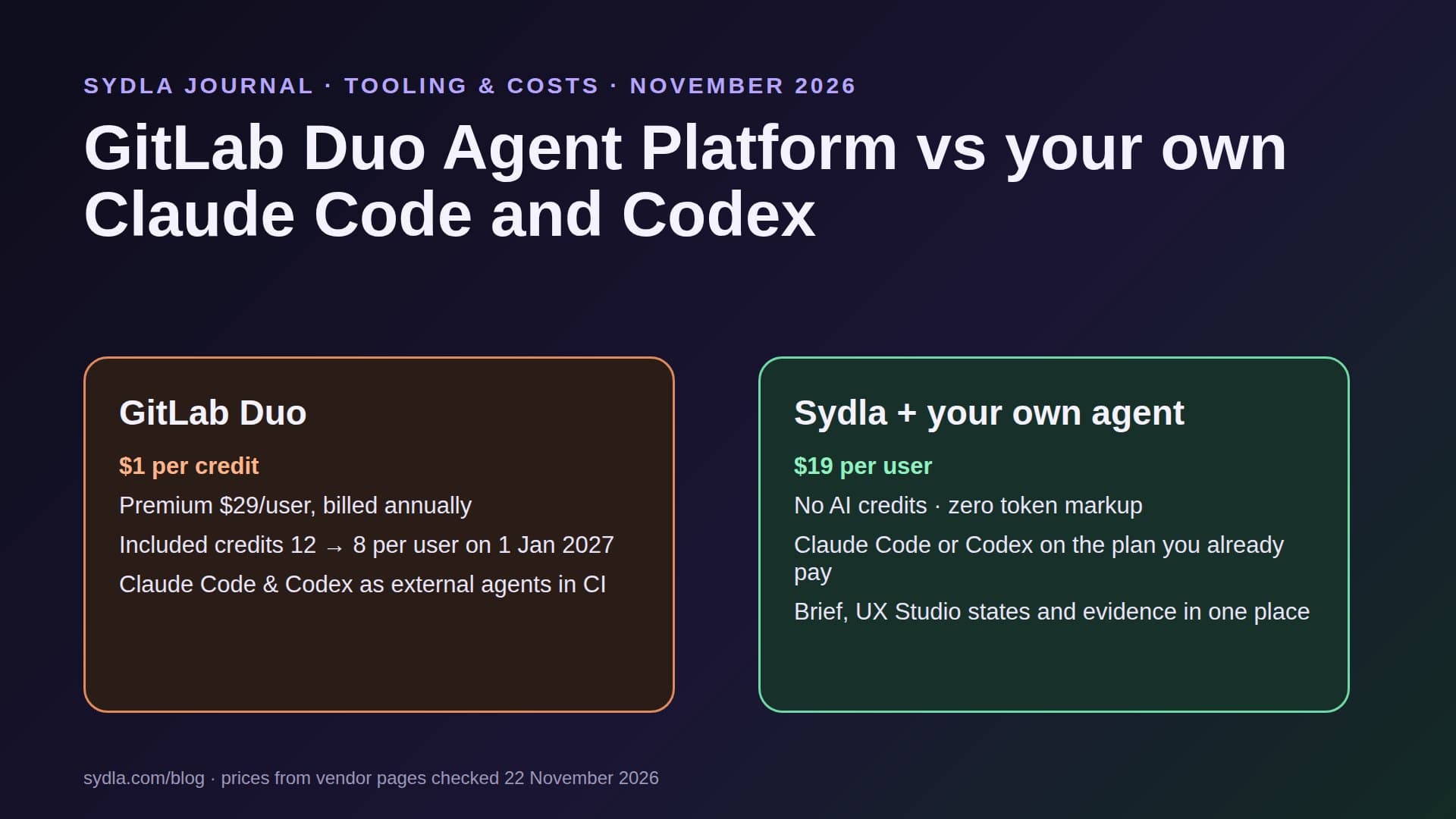
Your Git host now sells you the coding agent
In January 2026 GitLab made its Duo Agent Platform generally available for Premium and Ultimate. It does more than add a chat box to the merge request. It runs agents and flows inside GitLab, a code review flow, a vulnerability fix flow, agentic chat, and, as external agents, Claude Code from Anthropic and Codex from OpenAI.
All of it is paid in a new currency, GitLab Credits, at a list price of $1 each. Premium and Ultimate seats come with a monthly allowance, and that allowance is about to shrink: from 1 January 2027 it falls from 12 to 8 credits per Premium user and from 24 to 16 per Ultimate user.
If your team already pays for Claude or ChatGPT plans, the result can be a second bill for the same agent. This guide reads GitLab's pricing page, the GitLab Credits docs and the external agents docs as of 22 November 2026. It shows what a run costs, what the agent can see, and where the product context that lives outside the repository should go.
How GitLab charges for AI in November 2026
GitLab now sells seats and credits separately. The Duo Pro and Duo Enterprise add-ons no longer appear on the pricing page; the AI line is now GitLab Credits.
| Item | Price | AI allowance | Notes |
|---|---|---|---|
| Free | $0 | None; buy GitLab Credits | On-demand use capped at $25,000 a month per namespace |
| Premium | $29 per user per month, billed annually | 8 credits per user per month (12 until 31 Dec 2026) | No monthly price published |
| Ultimate | Custom | 16 credits per user per month (24 until 31 Dec 2026) | Sales-led pricing |
| GitLab Credits | $1 per credit, on demand | Included first, then a commitment pool, then on demand | Billed monthly; once accepted you cannot opt out for the term |
| Compute minutes | $10 per 1,000 | Shared runners on GitLab.com | Your own runners use no minutes |
Three details matter more than the headline price. Included credits are per user and cannot be shared, so a heavy user cannot borrow a quiet colleague's allowance. Nothing rolls over, neither included credits nor the prepaid commitment pool. And on-demand billing, once switched on, stays on for the rest of the subscription, so per-user usage caps in the credits dashboard are the only brake.
The new allowances already apply to subscriptions that start after 19 November 2026. Existing subscriptions keep 12 and 24 credits until 31 December. Our December 2026 AI pricing changes round-up covers the other renewals that land the same month.
What a run costs in GitLab Credits
GitLab publishes how many executions or model calls one credit buys. Turned into dollars at the $1 list price, a few common actions look like this.
- Code review flow, Lite. 4 reviews per credit, so about $0.25 a review on a GitLab-managed model. Standard reviews use variable pricing instead.
- Code suggestions. 50 per credit, about 2 cents each.
- Vulnerability fix flow. 0.25 executions per credit, so 4 credits, about $4, for each SAST finding it tries to fix.
- Agentic chat. Billed per model call. One credit buys 8 calls on Claude Haiku 5.5, 3.2 on Claude Sonnet 5, 3.3 on GPT-5 and 1.1 on Claude Opus 4.6, which is roughly $0.12, $0.31, $0.30 and $0.91 a call. A long agentic task makes many calls.
- Failed runs. A flow that fails before it completes deducts nothing on GitLab-managed models. Chat bills to the user who asked; flows that run as a service account, such as code review, bill to the namespace.
Eight included credits buy a Premium user about 32 Lite reviews, or 25 Sonnet-class chat calls, a month. A team that leans on the agent will reach on-demand billing in the first week. The AI credit cost per action guide puts these numbers next to Rovo, Notion, Figma and Copilot, and the Copilot credits guide shows GitHub's equivalent meter.
Claude Code and Codex as GitLab external agents
The most interesting part for a Claude Code or Codex user is that GitLab does not try to replace them. It runs them. You mention the agent in an issue or merge request and GitLab starts a CI/CD pipeline that runs Claude Code or Codex against the repository.
- Who can use it. Premium and Ultimate. The docs say the feature sits behind a feature flag, is enabled for verified customers, and that you contact GitLab support to turn it on.
- Whose credentials. The Claude Code and Codex agents use GitLab-managed credentials and need no configuration. GitLab-managed credentials exist only for Anthropic and OpenAI; Amazon Q and Gemini need your own.
- Who pays. External agents are listed among the features that consume GitLab Credits. We found no documented way to point them at your own Claude or ChatGPT subscription, and no published credit price per run.
- Where it runs. In a pipeline, so on GitLab.com shared runners compute minutes may apply on top; on your own runners they do not. The docs do not say which applies per run.
- What is missing. The docs warn that third-party prompt scanning is not available for external agents. Issue text the agent reads is untrusted input, as our prompt injection guide explains.
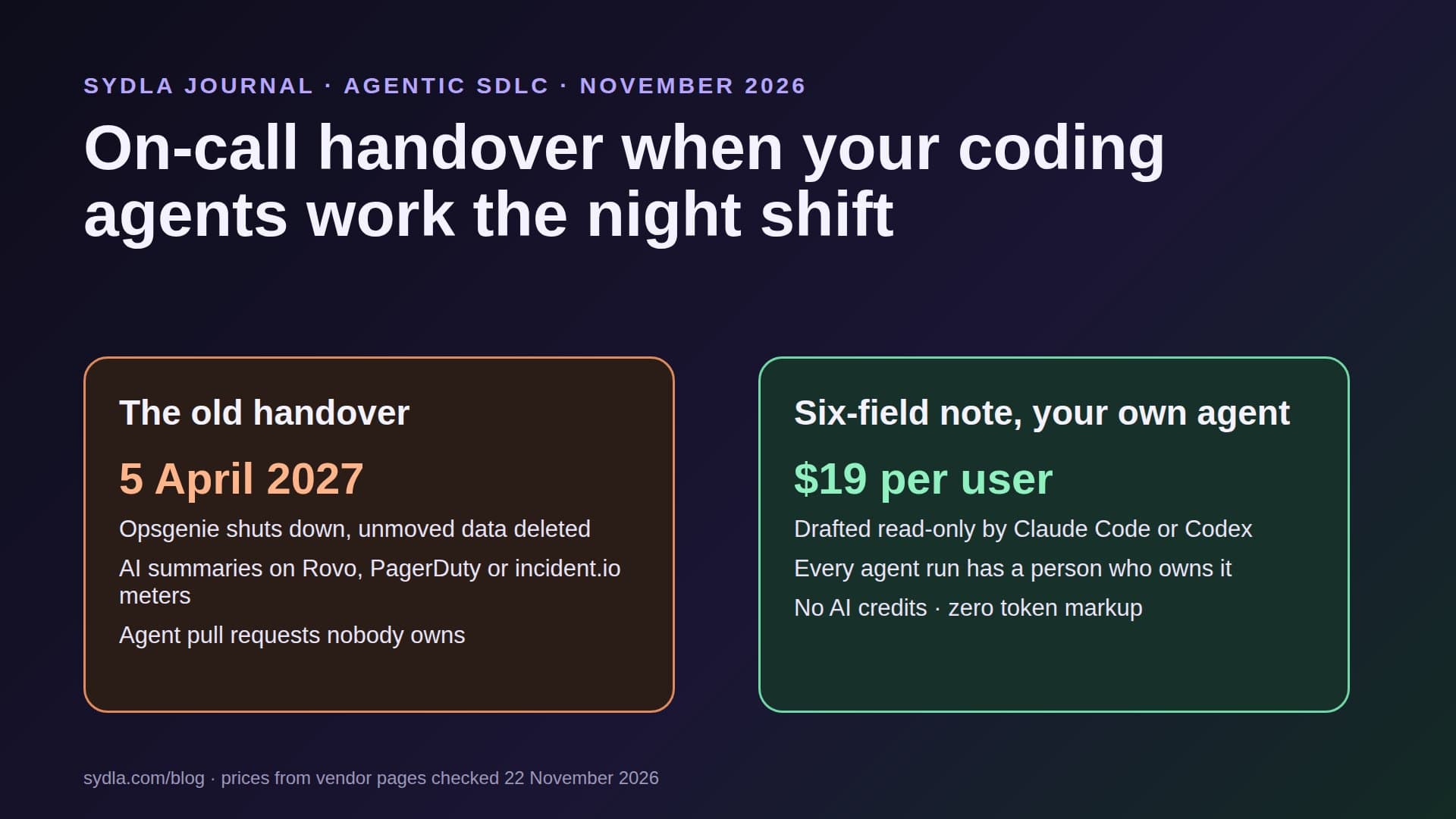
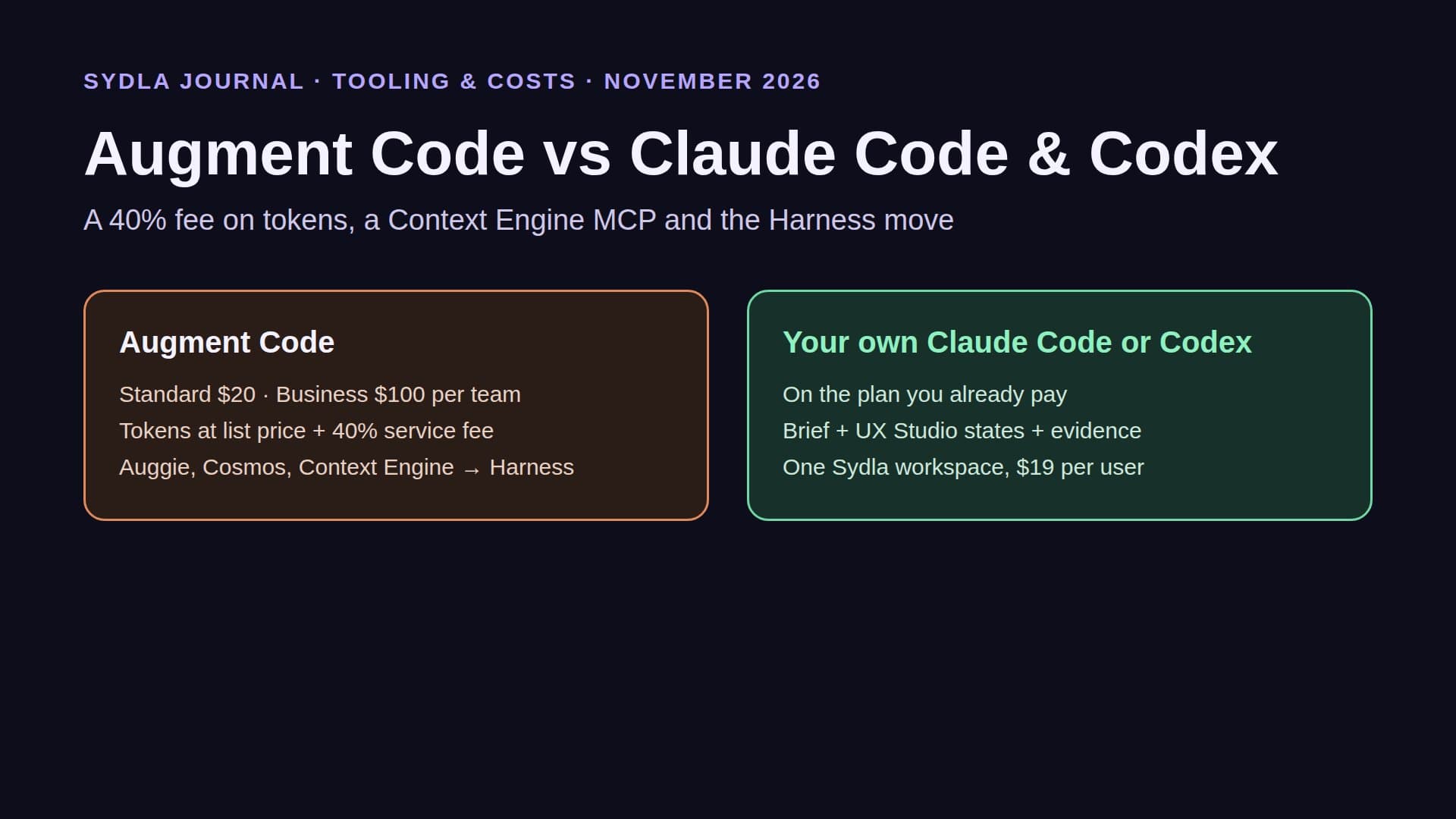
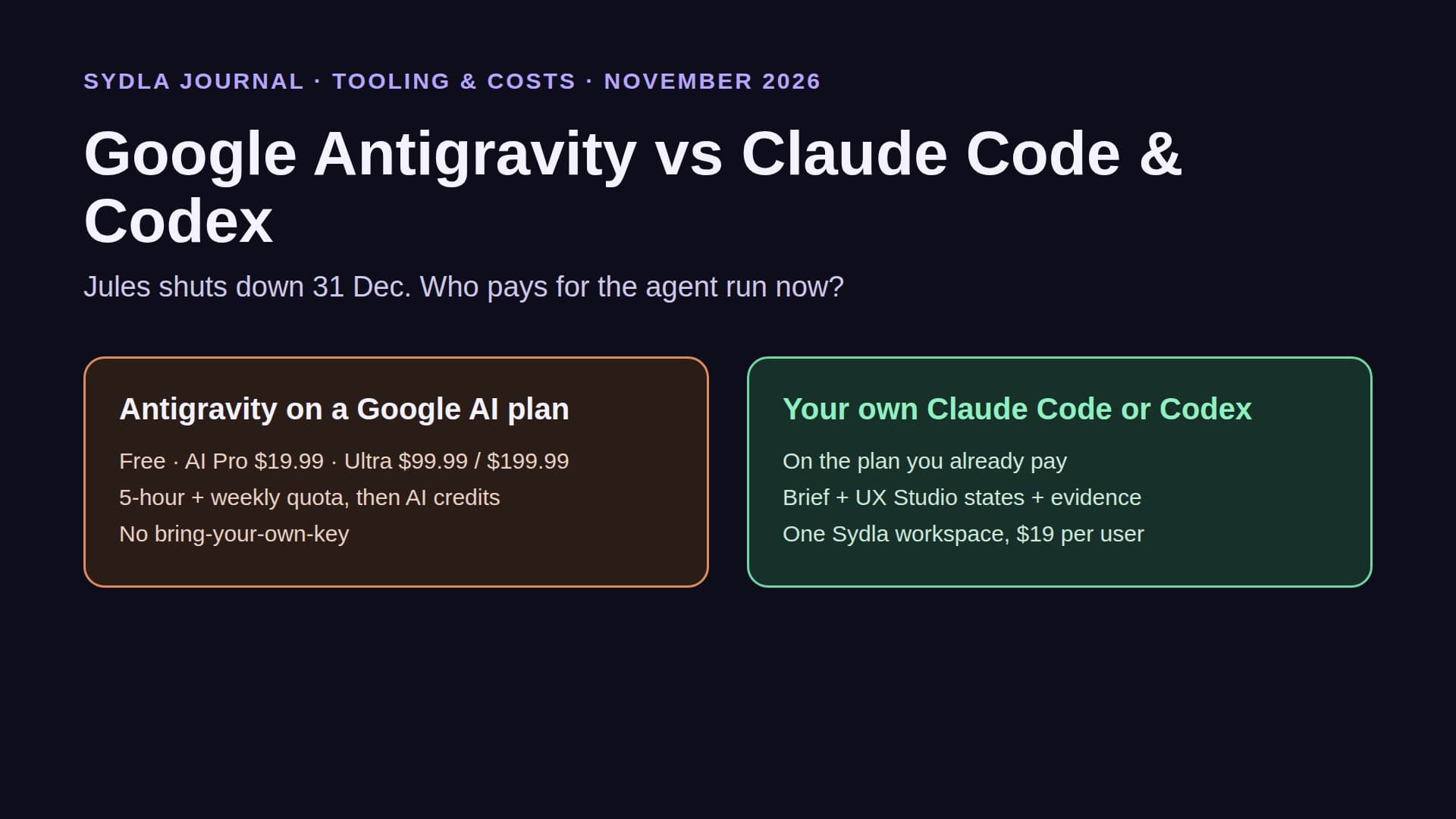
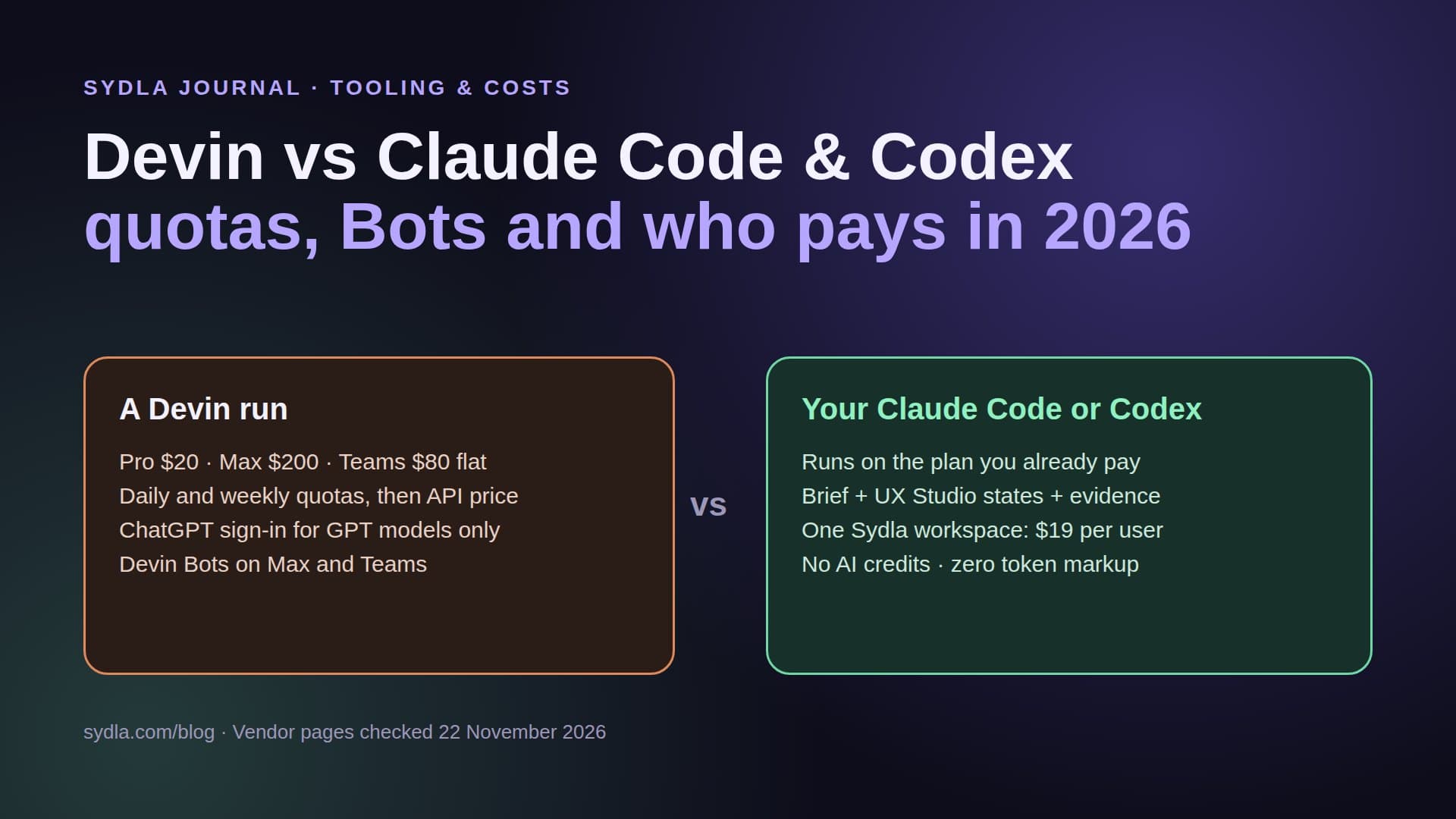
This is a fair design for a team that wants one vendor and one invoice. It is an odd one for a team where every engineer already has Claude Max or ChatGPT Pro, because the same agent then bills twice: once on the plan, once in GitLab Credits.
GitLab Duo, Claude Code and Codex side by side
All of these can read a repository, plan, edit files, run commands and use MCP servers. They differ in where the agent runs and whose meter it spends.
| Option | Plans | How a run is paid | What it adds |
|---|---|---|---|
| GitLab Duo agents and flows | Premium $29 annual, Ultimate custom, + credits | GitLab Credits at $1, 8 or 16 included per user | Code review, vulnerability fixes, agentic chat in GitLab |
| Claude Code or Codex as GitLab external agent | Premium or Ultimate, on request | GitLab Credits; CI compute may apply | Runs from an issue or merge request mention |
| Claude Code on your own plan | Claude Pro $20, Max $100, Ultra $200 | Your Claude plan | CLAUDE.md, subagents, hooks, MCP |
| Codex on your own plan | ChatGPT Plus $20, Pro $100 to $500, Business $25 | Your ChatGPT plan's Codex allowance | AGENTS.md, cloud tasks, code review |
| Sydla workspace | $19 per user | No AI credits: drives your own Claude Code or Codex, zero token markup | Brief, criteria, UX Studio states and evidence in one MCP connection |
Read the table by what you already pay. If the agent is covered by a Claude or ChatGPT plan, the GitLab MCP server, generally available on every tier since GitLab 19.5 with 600 requests a minute on paid plans, lets that agent read issues, merge requests and pipelines without spending a GitLab Credit on the agent itself. The bring your own coding agent guide covers the three ways to pay for a run.
The repository is not where the brief lives
GitLab holds the code, the issues and the pipelines well. It does not hold the designed states, the decision behind a scope cut or the launch visuals, so most GitLab teams still pay for a wiki, a design tool and a whiteboard, each with its own seat, AI meter and MCP hop.
| Tool | Seat price | Bundled AI and its limit | Handoff to a coding agent |
|---|---|---|---|
| Jira Standard | $9.70 | Rovo: 25 credits per user per month, pooled; PAYG $0.01 per credit from 3 Dec 2026 | Atlassian MCP or a pasted ticket |
| Confluence Standard | $7.15 | Same Rovo pool, 25 credits per user (70 on Premium) | Atlassian MCP; enriched calls 1 to 10 credits |
| Notion Plus | $12.00 | Custom Agents on Business and Enterprise; extra credits $10 per 1,000 | Notion MCP server |
| Figma Professional Full | $20.00 | 3,000 AI credits per Full seat, no rollover | Figma MCP: 200 calls a day on Full or Dev |
| Miro Starter | $10.00 | 25 AI credits per license, pooled per team | Miro MCP: daily call limits by plan |
| Canva Business | $25.00 | Personal AI allowance per member | Outside the build loop |
| Sydla workspace | $19.00 | No AI credits: bring your own Claude Code or Codex | One MCP connection or a Sydla Desktop thread |
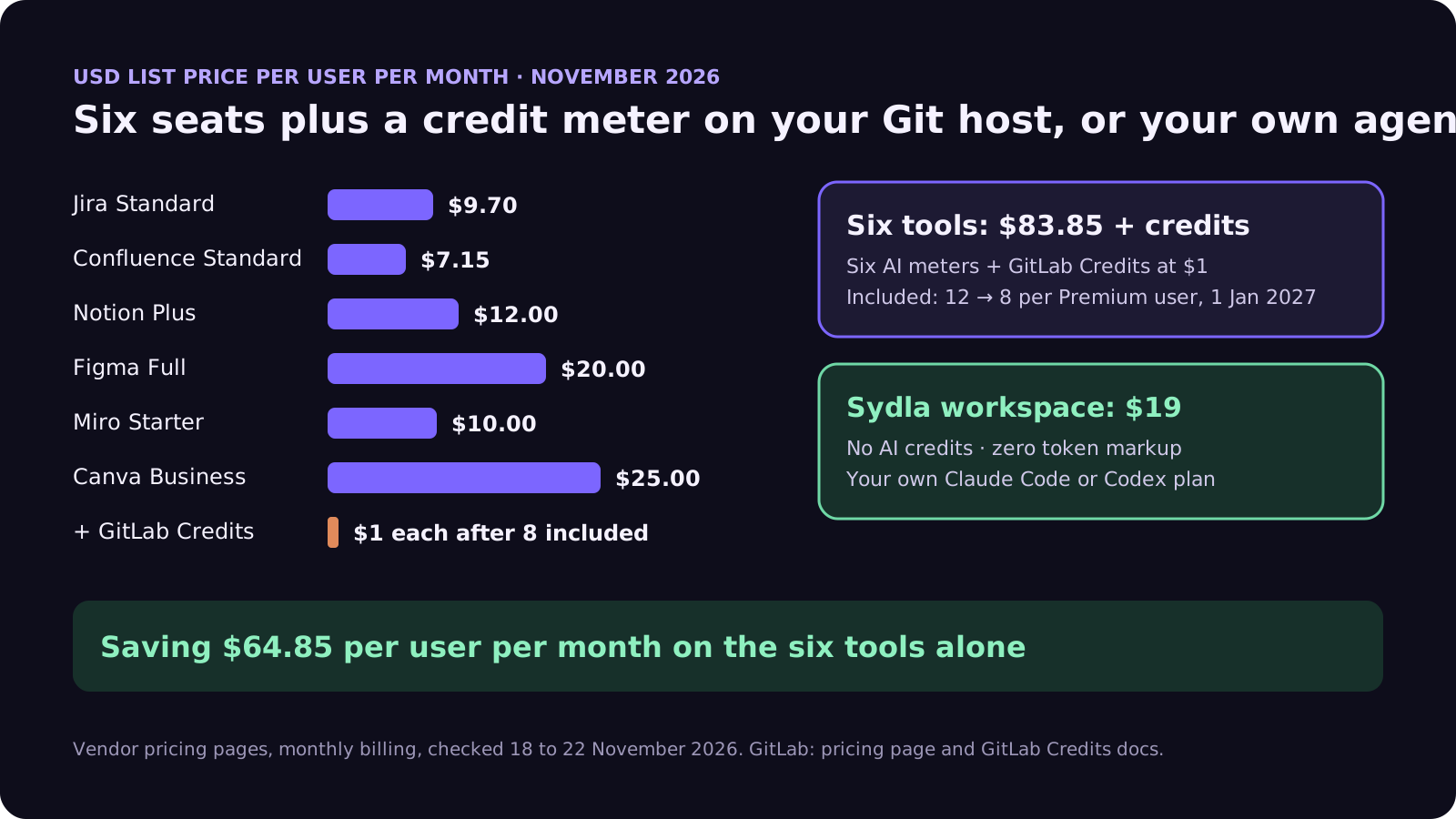
The six tools come to $83.85 per user per month before any overage, against $19 for Sydla, a saving of $64.85. GitLab Premium at $29 sits on top of either, because you still need a Git host. What changes is the number of meters: seven with GitLab Credits and the six tools, or one Git host and one workspace with your own agent. The stack cost guide works through 5, 10 and 25 people, and the comparison overview covers each tool.
Technical walkthrough: GitLab for code, Sydla for the brief, your own agent
Sydla is built on GitLab itself and keeps GitLab as the code host. It does not run a second agent and does not add a meter. It holds the product context, and the agent you already pay for reads it next to the repository.
- Brief. Each ticket sits in an initiative with a versioned brief, numbered acceptance criteria and a done-means line. A Sydla ticket can be linked to a GitLab issue, and the Sydla board mirrors into GitLab labels, so engineers who live in merge requests still see the work.
- UX Studio. Screens and their states, empty, loading, error and success, are designed next to the ticket and published as a handoff with tokens and a URL per state.
- Wire MCP once. Register Sydla in the CLI: claude mcp add with the HTTP transport and the sydla.com/mcp URL for Claude Code, or an mcp_servers.sydla table in config.toml for Codex. Add the GitLab MCP server beside it if the agent should read pipelines and merge request comments.
- Run in Sydla Desktop. Open the ticket, start a thread and choose claude or codex. Desktop drives the CLI you are already signed in to, so the model, limits and bill stay on your plan. Each thread has an access level, Read only, Edit files or Full access, with a Preview panel and a Changes view; pushing and opening the merge request use your own glab or git login.
- Review. The agent records evidence against each criterion: test output, screenshots of each state and the diff, and the merge request pipeline still runs in GitLab. A person reviews and decides the merge and release gates. An agent can request a gate but never approve one.
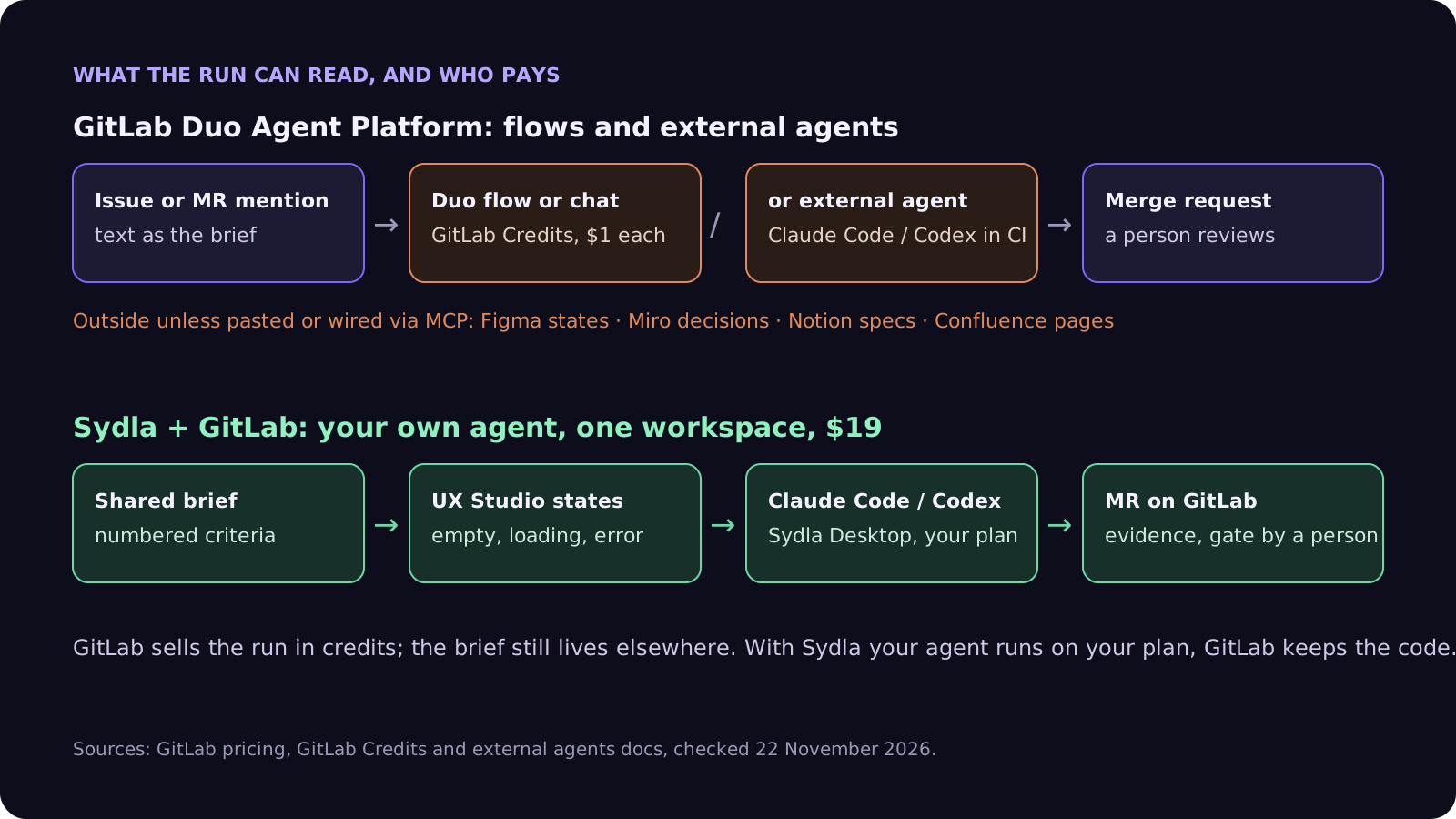
The brief to pull request walkthrough shows one feature end to end, the context engineering guide explains the four layers of context a run needs, and the Sydla Desktop setup guide covers the install and sign-in for both CLIs.
Five checks before you turn on GitLab Credits
GitLab's agent platform is serious, and its credit tables are more open than most. Before you switch on on-demand billing, check five things.
- Who already pays for the model. If engineers have Claude or ChatGPT plans, external agents on GitLab Credits pay for the same model twice.
- The January allowance. Budget for 8 and 16 included credits per user, not 12 and 24. For a 20-person Premium team that is 80 fewer included credits, $80 a month, from 1 January 2027.
- No opt-out. On-demand billing stays on for the rest of the term once accepted. Set per-user usage caps on the first day.
- Compute on top. External agents run in pipelines. On shared runners, check whether runs spend compute minutes; on your own runners they do not.
- Where product context lives. An issue description is not a brief with criteria and designed states. Decide where those live before you decide which agent reads them.
When GitLab Duo Agent Platform is the right choice
Be fair to GitLab. Duo Agent Platform is the right choice for a regulated team that wants every agent run inside its own GitLab, on its own runners, with one vendor contract, self-hosted models at a 20 percent credit discount on flat-priced flows, and a code review flow that bills the namespace rather than individuals.
It is a weaker fit if everyone already pays for Claude or ChatGPT, if your team is small enough that 8 credits a head disappear in days, or if the real problem is a brief spread across five tools. The Jira Automation coding agents guide, the Rovo Dev comparison and the AI credit fatigue guide look at the same question from the Atlassian side.
Try it on your next ticket
Sydla is $19 per user per month with every feature included and no AI credits to buy. Keep GitLab for code and pipelines, keep your Claude Code or Codex plan for the coding, and put the brief, the states and the evidence next to the ticket. See the pricing section, read how Sydla works, then start your workspace and keep your Claude Code and Codex accounts.
Frequently asked questions
How much does GitLab Duo Agent Platform cost in 2026?
It is paid in GitLab Credits at a list price of $1 each. Premium, $29 per user per month billed annually, includes 8 credits per user per month and Ultimate 16, from 1 January 2027; subscriptions that started before 19 November 2026 keep 12 and 24 until 31 December 2026. Unused credits do not roll over.
Can GitLab run Claude Code and Codex?
Yes. On Premium and Ultimate, Claude Code and Codex are available as external agents that run in a CI/CD pipeline when you mention them in an issue or merge request. They use GitLab-managed credentials, consume GitLab Credits, and are enabled for verified customers through GitLab support.
Can I use my own Claude or ChatGPT subscription with GitLab external agents?
GitLab's docs do not document it as of November 2026: the Claude Code and Codex external agents use GitLab-managed credentials. To spend your own plan, run Claude Code or Codex yourself and connect GitLab's MCP server, which is generally available on every tier.
How many GitLab Credits does a code review use?
A Lite code review flow on a GitLab-managed model costs a quarter of a credit, four reviews per credit, about $0.25 each at list price. Standard reviews use variable pricing, and review flows bill to the namespace rather than to a user.
Do I still need Jira, Confluence and Figma if I use GitLab Duo?
GitLab covers code, issues and pipelines, not designed states, specs and decisions. Most teams keep a wiki, design tool and whiteboard, which in a six-tool stack cost $83.85 per user a month with six AI meters. Sydla holds them for $19 per user and runs your own Claude Code or Codex with zero token markup.