Augment Code vs Claude Code and Codex in 2026: a 40% fee on tokens, a Context Engine MCP and the Harness move
Augment Code dropped credits for tokens at list price plus a 40% service fee, ships a Context Engine MCP that plugs into Claude Code and Codex, and announced in October that Auggie, Cosmos and the Context Engine are joining Harness. We read the pricing page, the token pricing docs, the MCP quickstarts and the changelog to show who pays for each run and where the brief should live.
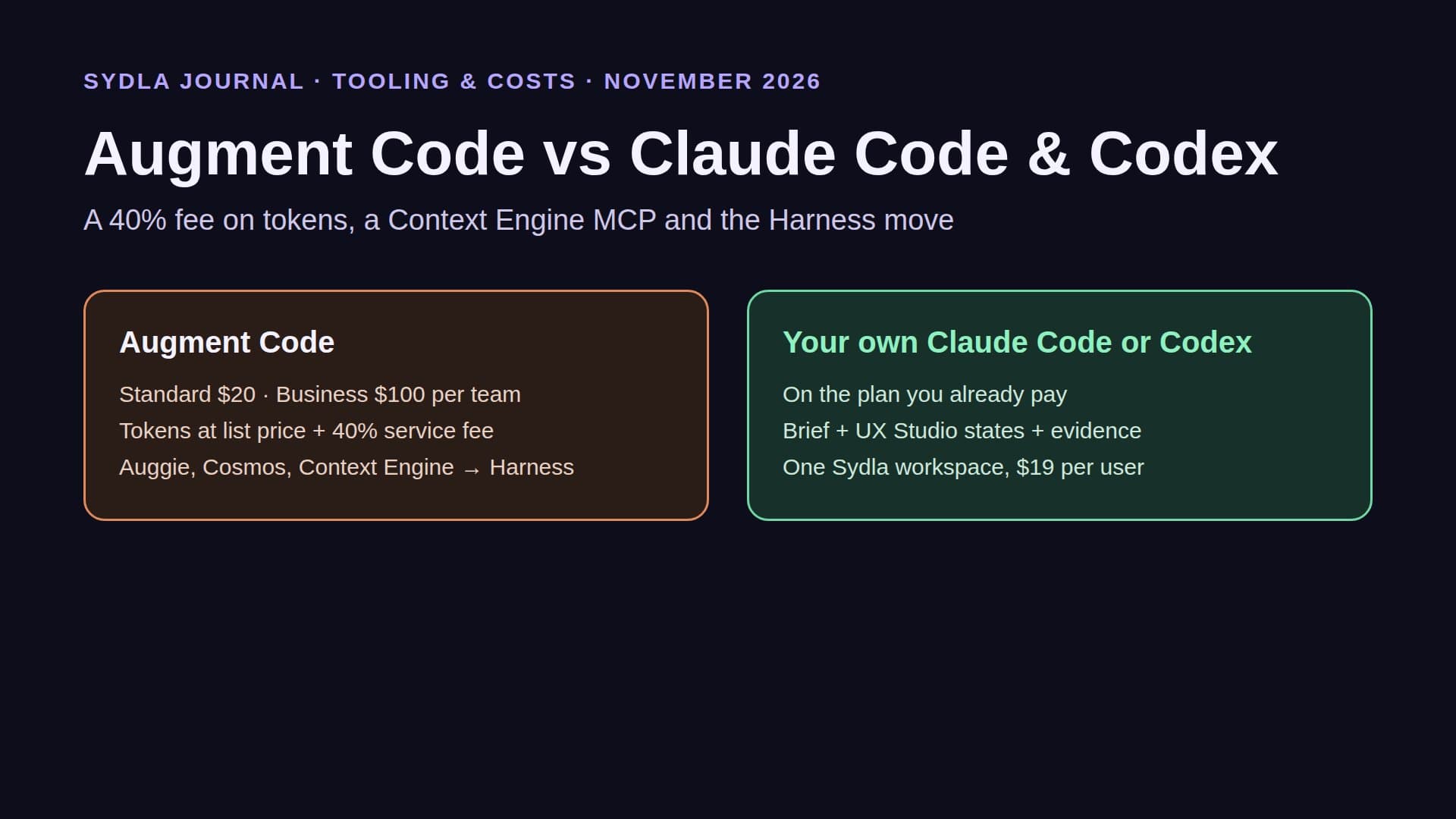
The agent is not the expensive part any more
Augment Code made its name on one idea: a coding agent is only as good as the context it gets. Its Context Engine indexes a whole codebase, live, and hands the agent the right files, so the model does not have to grep its way around a large repository.
In 2026 that idea became a business model. Augment no longer sells credits. It bills the model's tokens at the provider's list price and adds a flat 40 percent service fee that pays for the Context Engine and its cloud agent platform, Cosmos. And it now sells the Context Engine on its own, as an MCP server that Claude Code and Codex can call.
Then, on 8 October 2026, Augment announced that Cosmos, the Auggie CLI and the Context Engine are joining Harness, along with the team behind them. This guide reads Augment's pricing page, docs and changelog as of 22 November 2026, compares it with running Claude Code and Codex on the plans you already pay, and shows where the context that is not in the repository should live.
How Augment Code charges in November 2026
Augment has three plans. Unusually, the two self-serve ones are priced per team, not per seat: one flat monthly price, up to 50 people, with the included usage pooled across everyone.
| Plan | Price | Included usage | Notes |
|---|---|---|---|
| Standard | $20 per month, flat | $20 of usage, pooled | Up to 50 seats; CLI, MCP and native tools, Cosmos, code review |
| Business | $100 per month, flat | $100 of usage, pooled | Up to 50 seats; same features, more included usage |
| Enterprise | Custom | Custom usage and top-ups | Unlimited users, SSO and SCIM, CMEK, ISO 42001 |
| Pay as you go | Model list price + 40% | No minimum top-up | Top-ups valid 12 months; included usage does not roll over |
| Cosmos compute | $0.19 per hour | 5-minute increments | No service fee on compute |
The docs give real numbers. A Sonnet-class task such as fixing a 500 error costs about $0.25 including the fee, an Opus-class design task about $0.85, and a sample Business month splits into $70 of model tokens, $28 of service fee and $2 of compute. At list rates of $4 and $20 per million tokens for Claude Opus 5.5, the 40 percent fee makes them $5.60 and $28.
Code review on GitHub pull requests is included on every plan. Unused included usage resets every billing cycle. We found no documented way to bring your own Claude or ChatGPT subscription or API key: in Augment, Augment sells the model access.
The Context Engine as an MCP server
The most interesting product for a Claude Code or Codex user is not Augment's agent at all. It is the Context Engine MCP, which lets your own agent ask Augment for the relevant code instead of searching for it.
- Local server. Install the Auggie CLI with npm, sign in with auggie login, then register it in Claude Code with claude mcp add-json auggie and a stdio command that runs auggie with the mcp flags. It indexes your working copy in real time. Augment has quickstarts for Codex, Cursor, Zed, Copilot and Gemini CLI too.
- Remote server. Connects through Augment's GitHub App and indexes default branches, configured from the Augment dashboard.
- Price per query. There is no separate plan. Queries bill under token pricing, and Augment puts the average at roughly 3 to 6 cents per query.
- What it does not change. Your Claude Code or Codex run still bills to your Claude or ChatGPT plan. The MCP adds an Augment bill for retrieval on top, which is worth it on a very large monorepo and rarely on a small one.
This is a clean example of what our MCP servers for product teams guide calls a metered read: useful context, with a small meter attached to every call. The AI credit cost per action guide puts it next to Rovo, Notion and Figma reads.
Auggie 1.x, Cosmos and the Harness move
Augment shipped a lot in 2026, and then changed owners for its core products.
- Auggie 1.2.0 on 10 November. The first stable 1.x release is a rewrite built on the open-source pi agent, with breaking changes: new tool names, the persona command removed and old sessions needing an import. 1.2.1 and 1.2.2 followed on 17 November, and the stable 0.x line auto-upgrades.
- Cosmos. Augment's cloud agent platform runs sessions in the cloud with model access controls, Azure DevOps support and service accounts added in September.
- Cost claims. An August Augment blog post says the rebuilt Auggie completes a SWE-bench Pro task for $1.27 where Claude Code spends $2.70, 53 percent cheaper at the same pass rate, and a May post says its Prism model router cuts cost while keeping quality. Those are vendor benchmarks; test them on your own tickets.
- Harness. On 8 October Augment's CEO wrote that Cosmos, Auggie, the Code Context Engine and related technology are joining Harness, and the team is moving with them. The post gives no closing date and says nothing about the Standard and Business plans. The pricing page and changelog still describe Augment running the products in November.
If you are about to standardise on Augment, ask in writing what happens to your plan, your index and your data after the move. Our buyer's checklist for AI SDLC platforms lists the questions, and the December 2026 AI pricing changes cover the other renewals to watch.
Augment Code, Claude Code and Codex side by side
All of these can read a repository, plan, edit files, run commands and use MCP servers. They differ in who sells the model access and who sells the context.
| Option | Plans | How a run is paid | What it adds |
|---|---|---|---|
| Auggie CLI or IDE extension | Standard $20, Business $100 per team | Augment usage: list price + 40% fee, pooled | Context Engine, code review, VS Code and JetBrains |
| Augment Cosmos | Same plans | Tokens + 40% fee + $0.19 per compute hour | Cloud sessions, model controls, service accounts |
| Claude Code + Context Engine MCP | Claude Pro $20, Max $100, Ultra $200 + any Augment plan | Your Claude plan; about 3 to 6 cents per Augment query | Semantic retrieval on large repos |
| Codex on its own | ChatGPT Plus $20, Pro $100 to $500, Business $25 | Your ChatGPT plan's Codex allowance | AGENTS.md, cloud tasks, code review |
| Sydla workspace | $19 per user | No AI credits: drives your own Claude Code or Codex, zero token markup | Brief, criteria, UX Studio states and evidence in one MCP connection |
Read the table by what you already pay. With a Claude or ChatGPT plan, the agent is covered; Augment is worth adding only for retrieval on a codebase too big for the agent to search well. The bring your own coding agent guide covers the three ways to pay for a run, and the Claude Code vs Codex comparison helps you pick the agent.
Code context is not product context
A context engine answers one question well: which code matters for this change. It cannot answer what the change should do, what the empty and error states look like, which criteria prove it works, or who decided that. In a typical 2026 stack those answers live in six tools, each with a seat, an AI meter and an MCP hop.
| Tool | Seat price | Bundled AI and its limit | Handoff to a coding agent |
|---|---|---|---|
| Jira Standard | $9.70 | Rovo: 25 credits per user per month, pooled; PAYG $0.01 per credit from 3 Dec 2026 | Atlassian MCP or a pasted ticket |
| Confluence Standard | $7.15 | Same Rovo pool, 25 credits per user (70 on Premium) | Atlassian MCP; enriched calls 1 to 10 credits |
| Notion Plus | $12.00 | Custom Agents on Business and Enterprise; extra credits $10 per 1,000 | Notion MCP server |
| Figma Professional Full | $20.00 | 3,000 AI credits per Full seat, no rollover | Figma MCP: 200 calls a day on Full or Dev |
| Miro Starter | $10.00 | 25 AI credits per license, pooled per team | Miro MCP: daily call limits by plan |
| Canva Business | $25.00 | Personal AI allowance per member | Outside the build loop |
| Sydla workspace | $19.00 | No AI credits: bring your own Claude Code or Codex | One MCP connection or a Sydla Desktop thread |
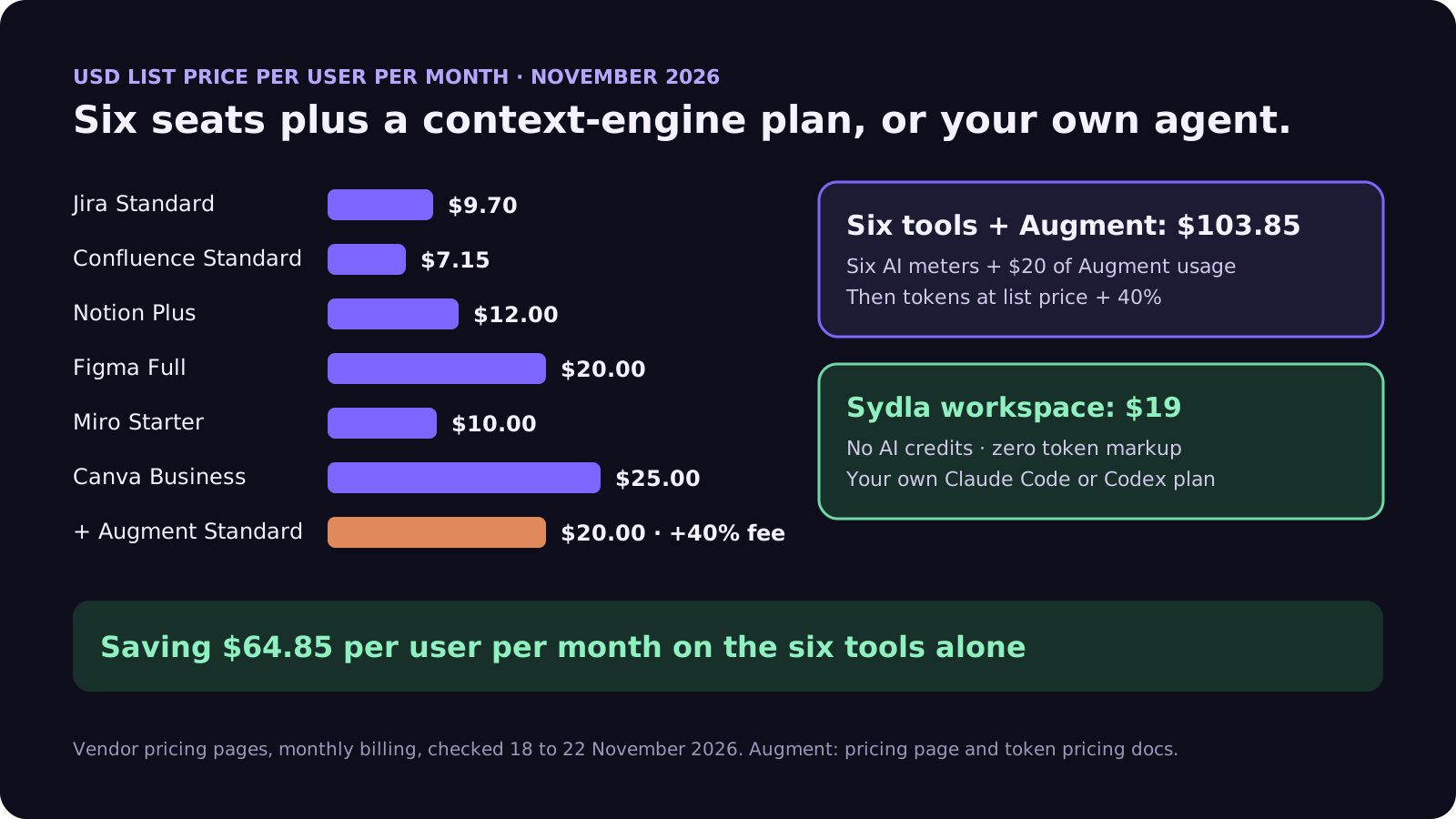
The six tools come to $83.85 per user per month before any overage, against $19 for Sydla, a saving of $64.85. Add Augment Standard for a solo builder and the bill is $103.85 a month with seven meters to watch. The stack cost guide works through 5, 10 and 25 people, and the comparison overview covers each tool.
Technical walkthrough: your agent, a code index and a shared brief
Sydla does not index your code and does not add a meter. It holds the product context, and the agent you already pay for reads it next to whatever code context you choose, Augment's included.
- Brief. Each ticket sits in an initiative with a versioned brief, numbered acceptance criteria and a done-means line. Every save is signed by its author, a person or an agent.
- UX Studio. Screens and their states, empty, loading, error and success, are designed next to the ticket and published as a handoff with tokens and a URL per state.
- Wire MCP once. Register Sydla in the CLI: claude mcp add with the HTTP transport and the sydla.com/mcp URL for Claude Code, or an mcp_servers.sydla table in config.toml for Codex. If your repository is large, add Augment's Context Engine MCP beside it; the agent then reads the brief from Sydla and the relevant code from Augment in the same run.
- Run in Sydla Desktop. Open the ticket, start a thread and choose claude or codex. Desktop drives the CLI you are already signed in to, so the model, limits and bill stay on your plan. Each thread has an access level, Read only, Edit files or Full access, with a Preview panel and a Changes view.
- Review. The agent records evidence against each criterion: test output, screenshots of each state and the diff. A person reviews it and decides the merge and release gates. An agent can request a gate but never approve one, and the record stays with the ticket.
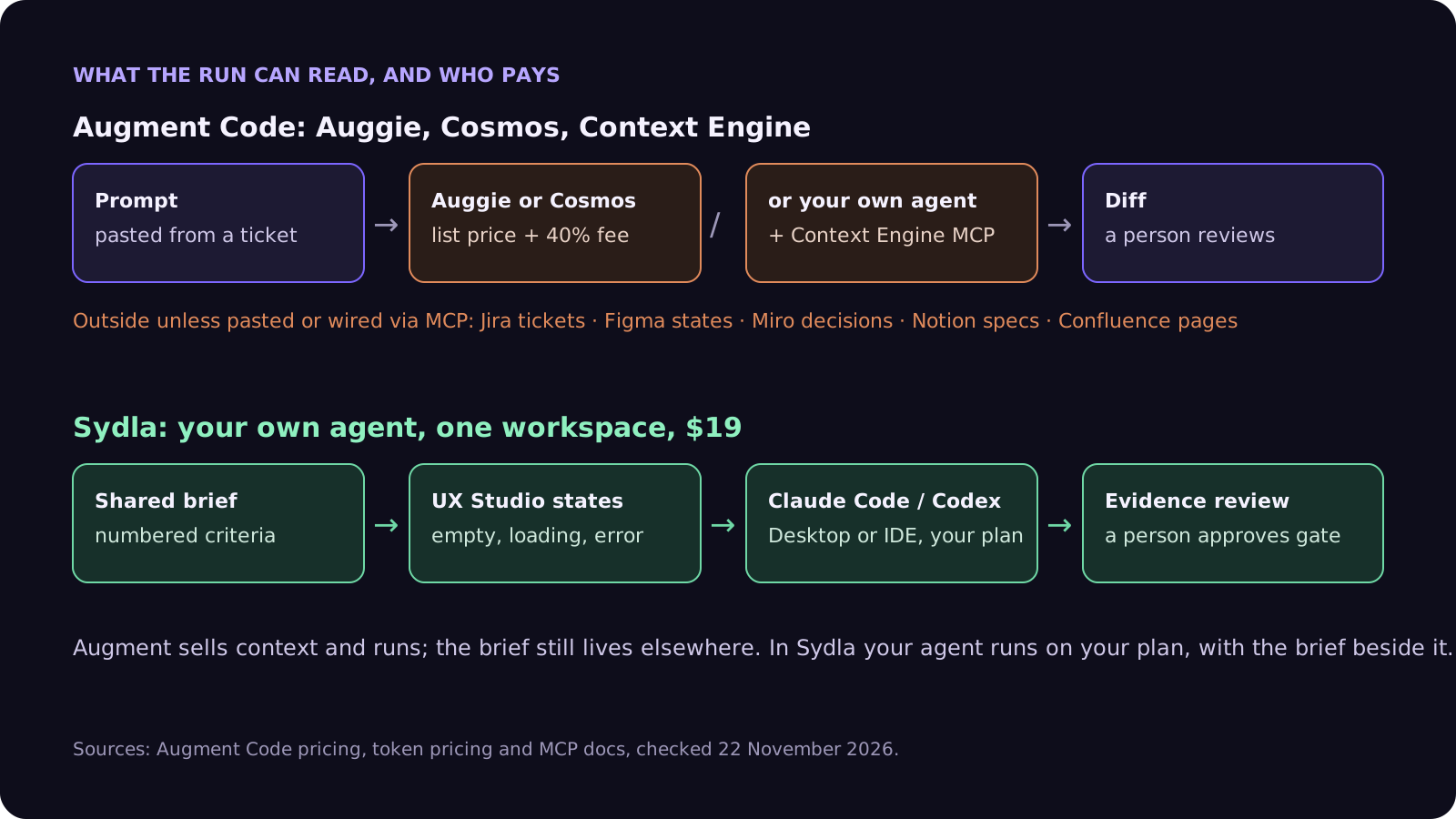
The brief to pull request walkthrough shows one feature end to end, the context engineering guide explains the four layers of context a run needs, and the Sydla Desktop setup guide covers the install and sign-in for both CLIs.
Five checks before you buy Augment Code
Augment's retrieval is good, and its pricing is more transparent than most. Before you put the team on it, check five things.
- Who sells the model. Augment bills the tokens itself with a 40 percent fee. If your team already pays for Claude or ChatGPT plans, you would pay for model access twice.
- Team math. Standard and Business are flat for up to 50 people, so the included usage per person shrinks as the team grows. $20 shared by ten people is $2 of usage each before pay as you go.
- Repository size. The Context Engine pays off on large, old or multi-repo codebases. On a small repository, Claude Code and Codex search well enough alone.
- The Harness move. Get the roadmap, data handling and plan terms after the transfer in writing before a yearly commitment.
- Where product context lives. A code index does not hold the brief, the criteria or the designed states. Decide where those live before you decide which index the agent uses.
When Augment Code is the right choice
Be fair to Augment. It is the right choice for a team on a large, sprawling codebase that wants one bill for model access, retrieval, cloud runs and pull-request review, with usage pooled across up to 50 people and no per-seat price. The Context Engine MCP is also a rare thing: a context product that works with the agent you already use instead of replacing it.
It is a weaker fit if everyone already pays for Claude or ChatGPT, if the repository is small, or if the real problem is a brief spread across five tools. The Cline and Kilo Code comparison, the Factory Droid comparison and the AI credit fatigue guide look at the same question from other sides.
Try it on your next ticket
Sydla is $19 per user per month with every feature included and no AI credits to buy. Your Claude Code or Codex plan does the coding, with whatever code index you like, and the brief, the states and the evidence live with the ticket. See the pricing section, read how Sydla works, then start your workspace and keep your Claude Code and Codex accounts.
Frequently asked questions
How much does Augment Code cost in 2026?
Standard is $20 a month and Business $100 a month, flat for a team of up to 50 people, with the same dollar amount of usage included and pooled. After that, model tokens bill at the provider's list price plus a 40 percent service fee, and Cosmos compute costs $0.19 an hour, as of November 2026.
Can I use Augment's Context Engine with Claude Code or Codex?
Yes. The Context Engine MCP runs locally through the Auggie CLI or remotely through Augment's GitHub App, with quickstarts for Claude Code, Codex, Cursor, Zed and others. Your agent still bills to your own plan, and Augment charges roughly 3 to 6 cents per retrieval query.
Can I bring my own Claude or ChatGPT subscription to Augment Code?
Augment's pricing page and docs do not document it as of November 2026. Augment bills model access itself at list price plus a 40 percent fee. To use your own Claude or ChatGPT plan, run Claude Code or Codex directly and add the Context Engine MCP if you need it.
Is Augment Code being acquired by Harness?
On 8 October 2026 Augment announced that Cosmos, the Auggie CLI, the Code Context Engine and related technology are joining Harness, with the team behind them. The post gives no closing date or plan changes, and Augment's pricing page still listed its plans in November.
Do I still need Jira, Figma and Notion if my agent has a context engine?
A context engine finds the right code; it does not hold the brief, criteria or designed states. In a six-tool stack those cost $83.85 per user a month with six AI meters. Sydla holds them for $19 per user and runs your own Claude Code or Codex with zero token markup.