Zed vs Claude Code and Codex in 2026: a $10 editor, ACP external agents and who pays for each run
Zed reached 1.0 this year, sells Pro at $10 with $5 of tokens, and runs Claude Code and Codex as external agents it does not charge for. We read Zed's pricing, docs, blog and the Agent Client Protocol updates to show who pays for each run, where the plan limits sit, and where the brief and design states should live while the agent edits.
The editor got cheaper, the context did not
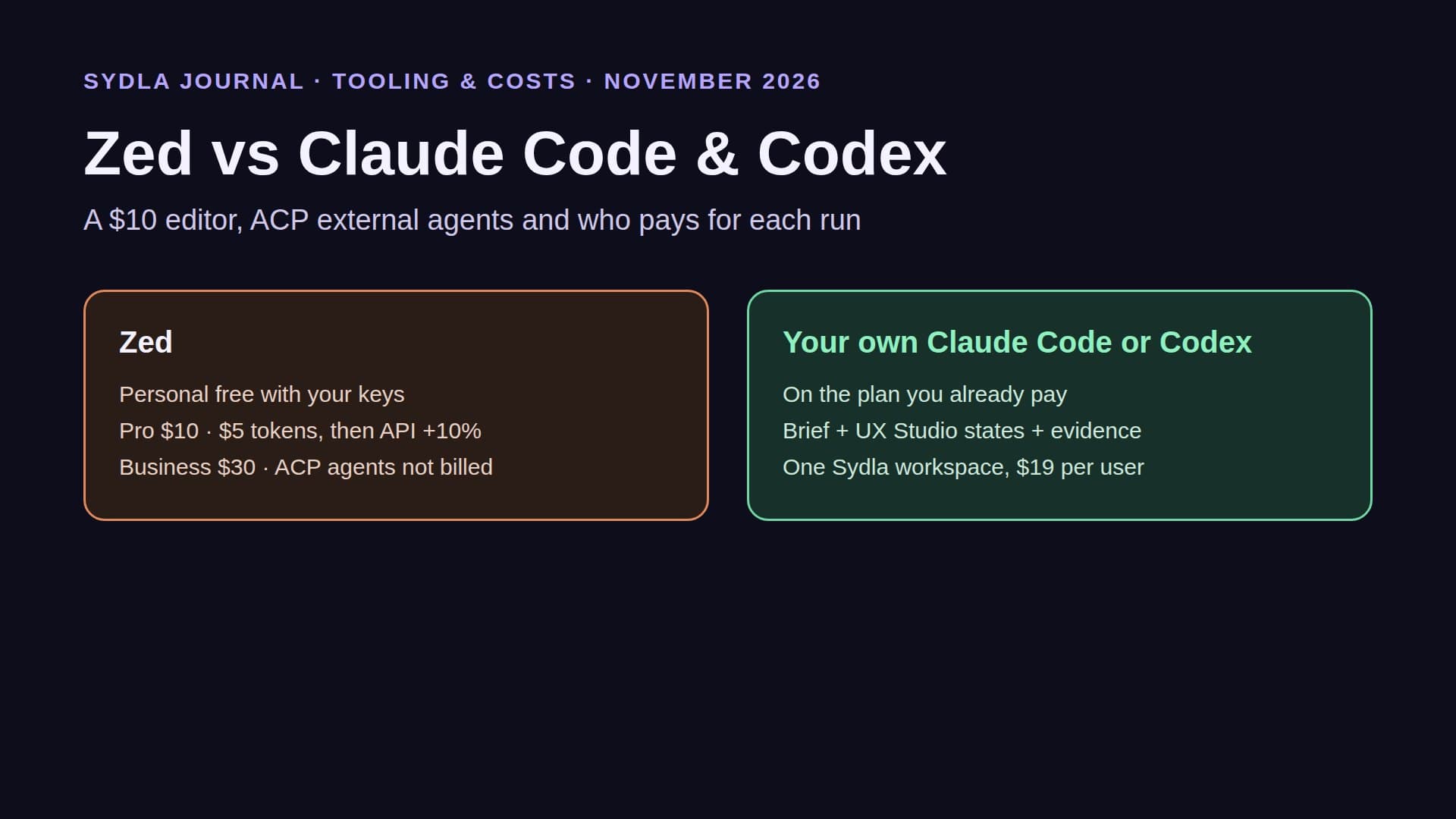
Zed shipped 1.0 on 29 April 2026 on Mac, Windows and Linux. Its Personal plan is free with your own API keys, its Pro plan is $10 a month, and since the ACP Registry went live in January it runs Claude Code, Codex, Gemini CLI, OpenCode and a growing list of other agents inside the editor without charging for them.
That is good news for anyone tired of paying twice for the same model. But the editor was never the expensive part. The ticket, the spec, the designed states, the whiteboard decisions and the launch visual still sit in six tools, each with a seat price and its own AI meter. Before the agent writes a line in Zed, someone has to carry that context across five MCP servers or paste it in.
That is the 2026 shape of AI credit fatigue: many small allowances, none of them shared, and context that hops between tools. This guide compares Zed with running Claude Code and Codex directly, from pricing pages, docs and changelogs checked on 22 November 2026, and shows where the shared context should live.
How Zed charges in November 2026
Zed has three plans, and the important line is the one between Zed-hosted models and everything else.
- Personal, free. Unlimited use with your own API keys or with external agents such as Claude Agent and Codex. Zed-hosted models and Zed's own edit predictions are not included, though you can still pick Copilot or a local model for predictions.
- Pro, $10 a month. Includes $5 of tokens on Zed-hosted models each month and unlimited edit predictions. Past the $5, usage is billed at the provider's API list price plus 10 percent, charged at month end or every extra $10, whichever comes first. The default spend limit is $10 on top of the included $5; set it to $0 and your bill stops at exactly $10.
- Pro trial, 14 days. $5 of hosted usage and unlimited predictions, no card. It ends when either runs out.
- Business, $30 per seat. No bundled LLM credit. Hosted AI is billed at standard usage rates, your own keys bill straight to your provider, and existing AI contracts can be routed through Zed. Order forms start at 25 seats and there is no free trial.
Zed also sells nothing on top of an external agent: its docs say plainly that Zed does not charge for external agents and that billing, terms and data handling are between you and the agent provider. On the native side, a ChatGPT Plus or Pro plan can sign in directly to Zed's own agent since May, without an API key.
What ACP actually does
The Agent Client Protocol is to coding agents what the Language Server Protocol was to compilers: one protocol so any editor can drive any agent. Zed started it, and it now has clients in JetBrains IDEs, Neovim, Emacs, VS Code, Visual Studio and Sublime Text.
- Registry, not extensions. Since 28 January 2026 agents install from the ACP Registry. Zed lists Claude Agent, Codex, OpenCode, Copilot, Cursor, Pi, Gemini CLI and Poolside, and the protocol site lists about forty more, including Junie, Cline, Goose, Kiro CLI and Factory Droid.
- Adapters where needed. Claude Agent runs through an adapter built on the Claude Agent SDK, and Codex through an ACP adapter. Native ACP agents speak the protocol directly.
- Versions. v1 is the stable line; subagent sessions and plan operations were stabilised on 20 November. ACP v2 moved from Draft to Preview the same day. Full support for remote agents is still a work in progress.
- What you lose. Steering an agent mid-turn works only for Zed's own agent, because Zed cannot see turn boundaries inside an external one. Parallel threads, worktree isolation, hunk-by-hunk review and MCP servers are available around both.
One caveat matters for Claude plans. In May, Anthropic announced that third-party agent and SDK use, which covers Claude Agent through ACP, would draw on a separate pool at API rates from 15 June. Zed's answer was Terminal Threads: run the real claude CLI in a terminal inside Zed so it counts as Claude Code. On 16 June Zed updated the post to say the change was not taking effect yet. Check your plan's current terms before you standardise on either path.
Zed, Claude Code and Codex side by side
All three can read a repository, plan, edit files, run commands and connect to MCP servers. They differ in who sells the model access, and whether the editor or the CLI is the centre of the work.
| Option | Plans | How a run is paid | What it adds |
|---|---|---|---|
| Zed agent (hosted) | Pro $10 with $5 of tokens; Business $30 per seat | Included $5, then API list price plus 10 percent on Pro; usage rates on Business | Native editor agent, steering, edit predictions |
| Zed with your keys or ChatGPT | Personal free | Your provider bills directly; ChatGPT Plus or Pro sign-in | Same agent panel, no Zed charge |
| Claude Code in Zed (ACP or terminal) | Claude Pro $20, Max $100, Ultra $200 | Your Claude plan; Zed does not bill external agents | Zed review UI and worktrees around Claude Code |
| Codex in Zed or on its own | ChatGPT Plus $20, Pro $100 to $500, Business $25 | Your ChatGPT plan's Codex allowance | Codex cloud tasks, AGENTS.md, MCP in config.toml |
| Sydla workspace | $19 per user | No AI credits: drives your own Claude Code or Codex, zero token markup | Brief, criteria, UX Studio states and evidence in one MCP connection |
Read the table by the plan you already pay. If your team has Claude or ChatGPT plans, Zed Personal plus an external agent costs nothing extra; Pro is worth $10 for the edit predictions and a small hosted allowance. Our bring your own coding agent guide covers the three ways to pay for a run, and the Claude Code vs Codex comparison helps you pick the agent itself.
The six-tool stack around the editor
Whatever editor hosts the agent, the run still needs a ticket, a brief, designed states, decisions and a launch visual. In a typical 2026 stack those live in six tools, each with a seat and an AI meter, and each an MCP hop away.
| Tool | Seat price | Bundled AI and its limit | Handoff to a coding agent |
|---|---|---|---|
| Jira Standard | $9.70 | Rovo: 25 credits per user per month, pooled; PAYG $0.01 per credit from 3 Dec 2026 | Atlassian MCP or a pasted ticket |
| Confluence Standard | $7.15 | Same Rovo pool, 25 credits per user (70 on Premium) | Atlassian MCP; enriched calls 1 to 10 credits |
| Notion Plus | $12.00 | Custom Agents on Business and Enterprise; extra credits $10 per 1,000 | Notion MCP server |
| Figma Professional Full | $20.00 | 3,000 AI credits per Full seat, no rollover | Figma MCP: 200 calls a day on Full or Dev |
| Miro Starter | $10.00 | 25 AI credits per license, pooled per team | Miro MCP: daily call limits by plan |
| Canva Business | $25.00 | Personal AI allowance per member | Outside the build loop |
| Sydla workspace | $19.00 | No AI credits: bring your own Claude Code or Codex | One MCP connection or a Sydla Desktop thread |
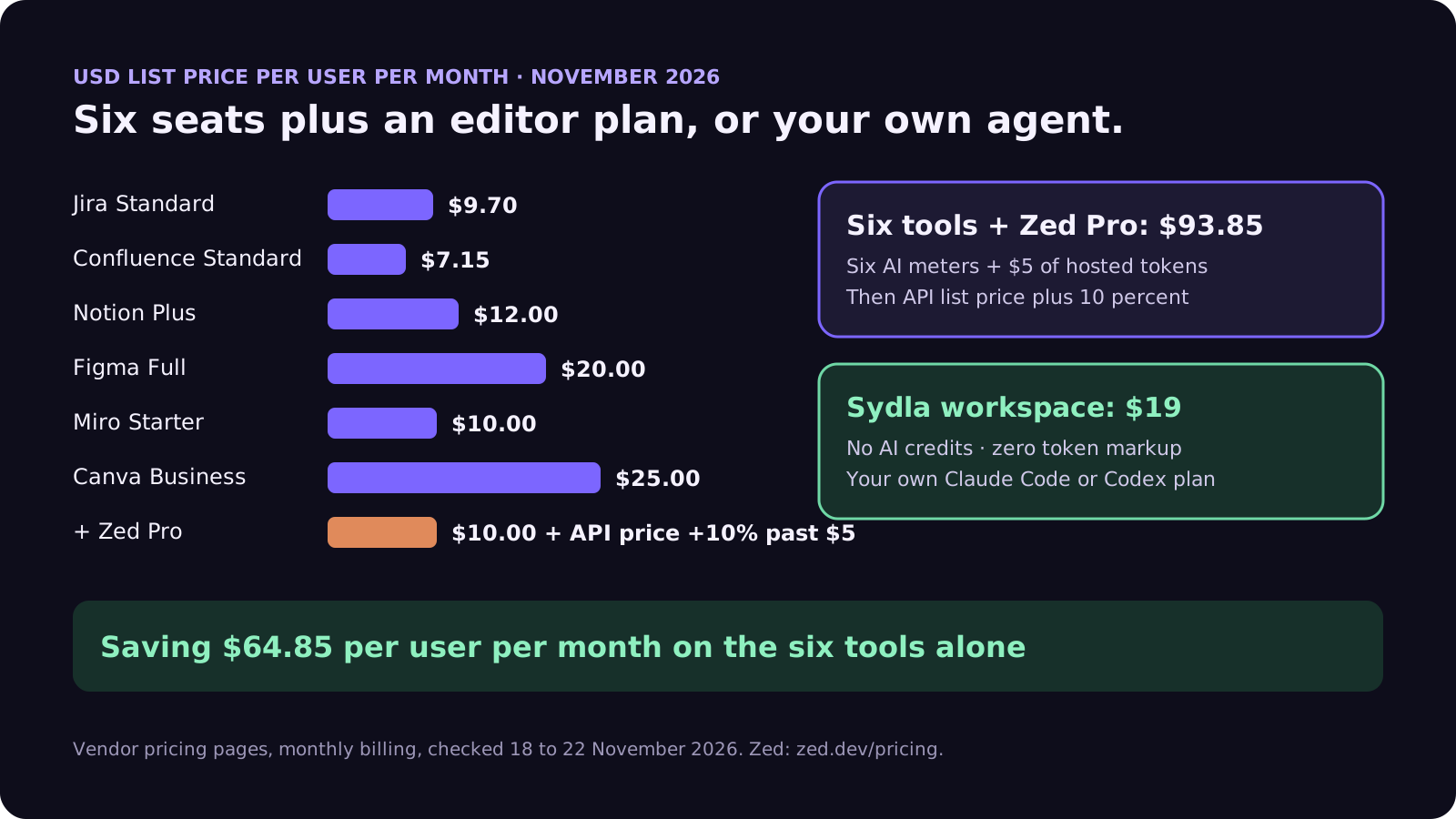
The six tools come to $83.85 per user per month before any overage, against $19 for Sydla, a saving of $64.85. Add Zed Pro and the stack is $93.85 per person with seven allowances to watch. The stack cost guide works through 5, 10 and 25 people, and the comparison overview covers each tool.
Technical walkthrough: Zed, your agent and a shared brief
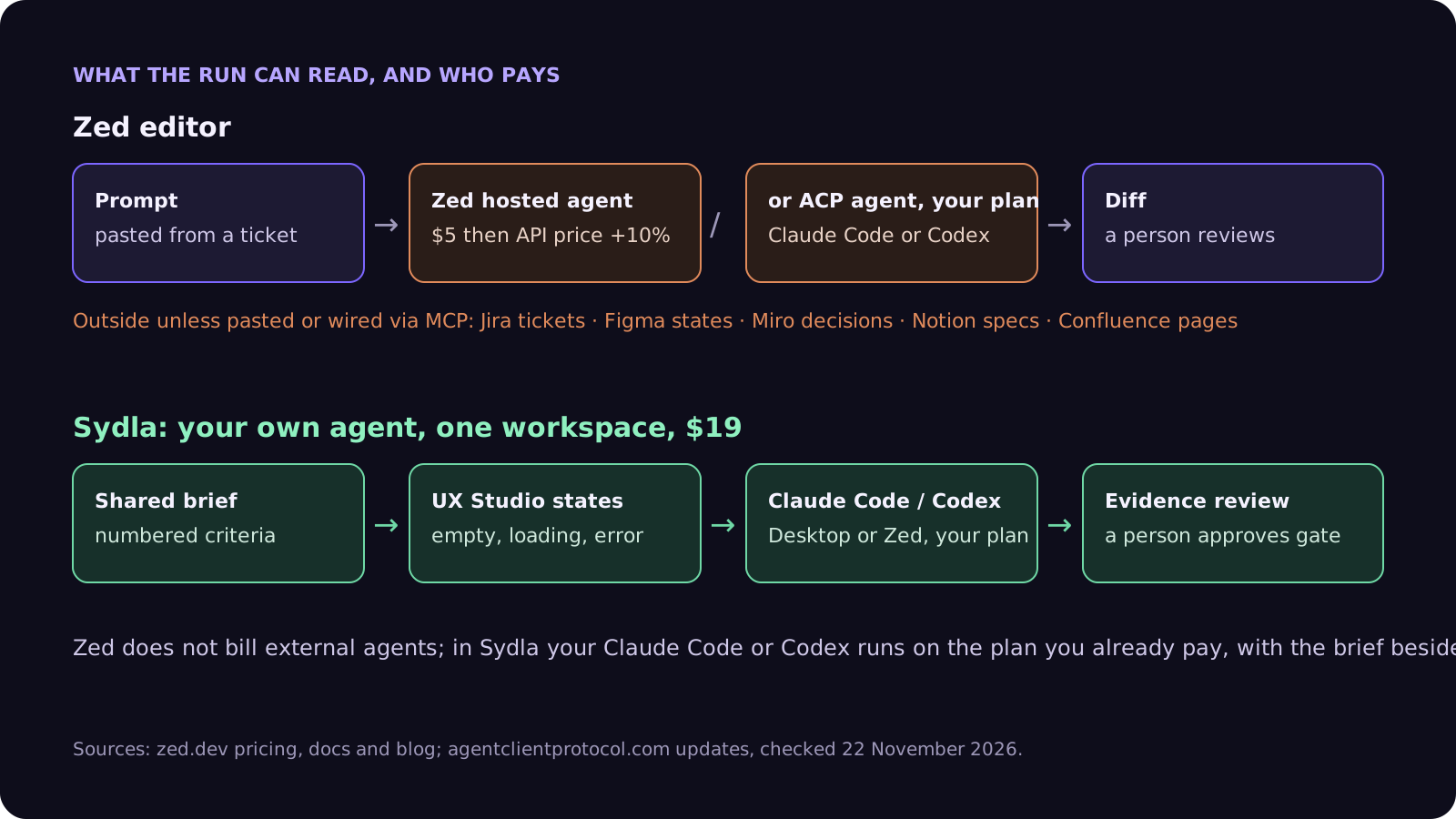
Sydla does not replace your editor and does not add a meter. The context lives in one workspace, and the agent you already pay for reads it, whether you start it in Zed, a terminal or Sydla Desktop.
- Brief. Each ticket sits in an initiative with a versioned brief, numbered acceptance criteria and a done-means line. Every save is signed by its author, a person or an agent.
- UX Studio. Screens and their states, empty, loading, error and success, are designed next to the ticket and published as a handoff with tokens and a URL per state.
- Run in Zed. Add Sydla as an MCP server in Zed's agent settings with the sydla.com/mcp URL and your key in the headers. Claude Agent and Codex started through ACP can use the same server, or you register it once in the CLI: claude mcp add with the HTTP transport for Claude Code, or an mcp_servers.sydla table in config.toml for Codex. Then the first prompt is short: read the work item, follow the criteria, record evidence.
- Run in Sydla Desktop. Open the ticket, start a thread and choose claude or codex. Desktop drives the CLI you are already signed in to, so the model, limits and bill stay on your plan. Each thread has an access level, Read only, Edit files or Full access, with a Preview panel and a Changes view. Keep Zed open on the same worktree to read the diff hunk by hunk.
- Review. The agent records evidence against each criterion: test output, screenshots of each state and the diff. A person reviews it and decides the merge and release gates. An agent can request a gate but never approve one, and the record stays with the ticket rather than in an editor thread.
The brief to pull request walkthrough shows one feature end to end, and the Sydla Desktop setup guide covers the install and sign-in for both CLIs.
Five checks before you move the team to Zed
Zed is a fast, well-built editor with the most open agent story of 2026. Before rolling it out, check five things.
- Which plan pays. If everyone has a Claude or ChatGPT plan, Personal plus external agents costs nothing. Pro buys edit predictions and $5 of hosted tokens; overage carries a 10 percent markup.
- Spend limits. Pro's default lets usage reach $15 a month per person. Set the limit to $0 if you want a flat $10, or raise it on purpose.
- Claude plan terms. Claude Agent through ACP runs on the Agent SDK; Claude Code in a Terminal Thread runs the real CLI. Anthropic's rules on third-party use have changed this year, so check them for Pro, Max and Ultra.
- Business scale. Business is $30 per seat with no included credit and no trial. For a five-person team that is $150 a month before any model usage.
- Where context lives. An editor does not fix a brief spread across five tools. Decide where the ticket, criteria and states live before you decide where the agent runs.
When Zed is the right choice
Be fair to Zed. It is the best choice if you want a fast native editor, real-time collaboration, an agent you can steer mid-turn, and the freedom to swap Claude Code, Codex, Gemini CLI or OpenCode without changing tools. Delta, its multiplayer review app now in public beta, is worth watching for teams that review a lot of agent work.
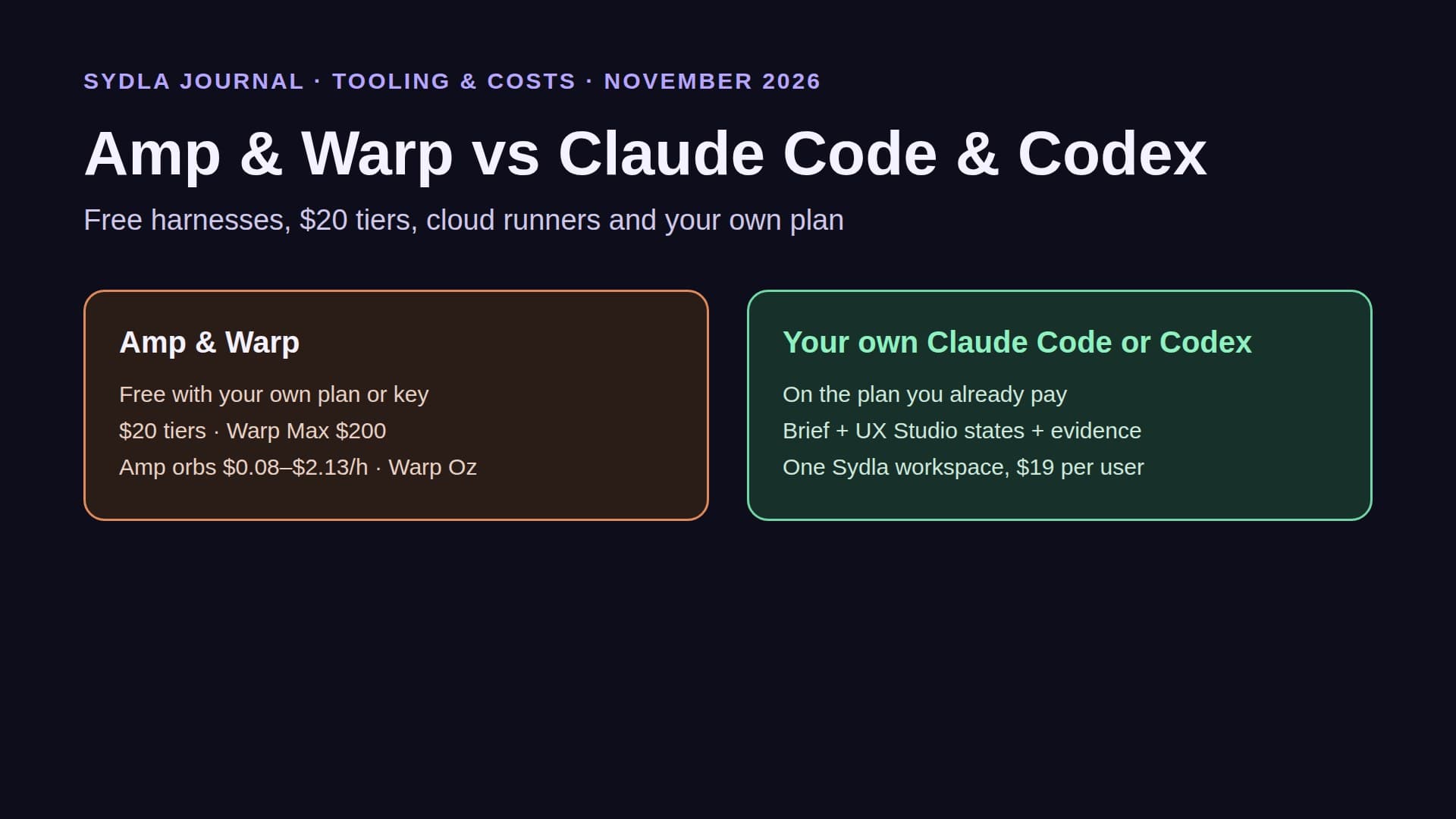
It is a weaker fit if your team lives in a terminal or JetBrains already, or if the real problem is not the editor but a brief that lives in five places. The Cursor and X Subscription pricing guide, the Amp and Warp comparison and the AI credit fatigue guide look at the same question from other sides.
Try it on your next ticket
Sydla is $19 per user per month with every feature included and no AI credits to buy. Your Claude Code or Codex plan does the coding, in Zed or Sydla Desktop, and the brief, the states and the evidence live with the ticket. See the pricing section, read how Sydla works, then start your workspace and keep your Claude Code and Codex accounts.
Frequently asked questions
How much does Zed cost in 2026?
Zed Personal is free with your own API keys or external agents. Pro is $10 a month with $5 of hosted tokens and unlimited edit predictions, then API list price plus 10 percent. Business is $30 per seat with no bundled credit, as of November 2026. Pro has a 14-day trial with no card; Business has none.
Can I use Claude Code or Codex in Zed?
Yes. Both install from the ACP Registry as external agents, Claude Agent through an adapter on the Claude Agent SDK and Codex through an ACP adapter. You can also run the claude CLI in a Terminal Thread. Zed does not charge for external agents; your Claude or ChatGPT plan pays.
What is the Agent Client Protocol (ACP)?
ACP is an open protocol, started by Zed, that lets any editor drive any coding agent, the way LSP did for language servers. v1 is stable and v2 moved to Preview on 20 November 2026. Clients include Zed, JetBrains IDEs, Neovim, Emacs, VS Code and Visual Studio.
Is Zed Pro worth it if I already pay for Claude or ChatGPT?
Only for Zed's edit predictions and a small hosted model allowance. External agents and a ChatGPT sign-in already work on the free Personal plan. Set the Pro spend limit to $0 if you want the bill capped at exactly $10 a month.
Do I still need Jira, Figma and Notion if my agent runs in Zed?
The agent still needs a ticket, a brief and designed states. In a six-tool stack that is $83.85 per user a month with six AI meters. Sydla holds the brief, criteria, UX Studio states and evidence for $19 per user and runs your own Claude Code or Codex with zero token markup.