Cursor's X Subscription: what Claude and GPT now cost inside Cursor, and the cheaper way to keep them (2026)
Since Cursor joined SpaceX, new plans run on The X Subscription: a weekly pool for Grok and Composer, and Claude, GPT and Gemini billed at API list price from prepaid credit. Here is what a month of Claude in Cursor costs now, and how to keep Claude Code or Codex on the plan you already pay for.
The plan renewed. The Claude allowance did not.
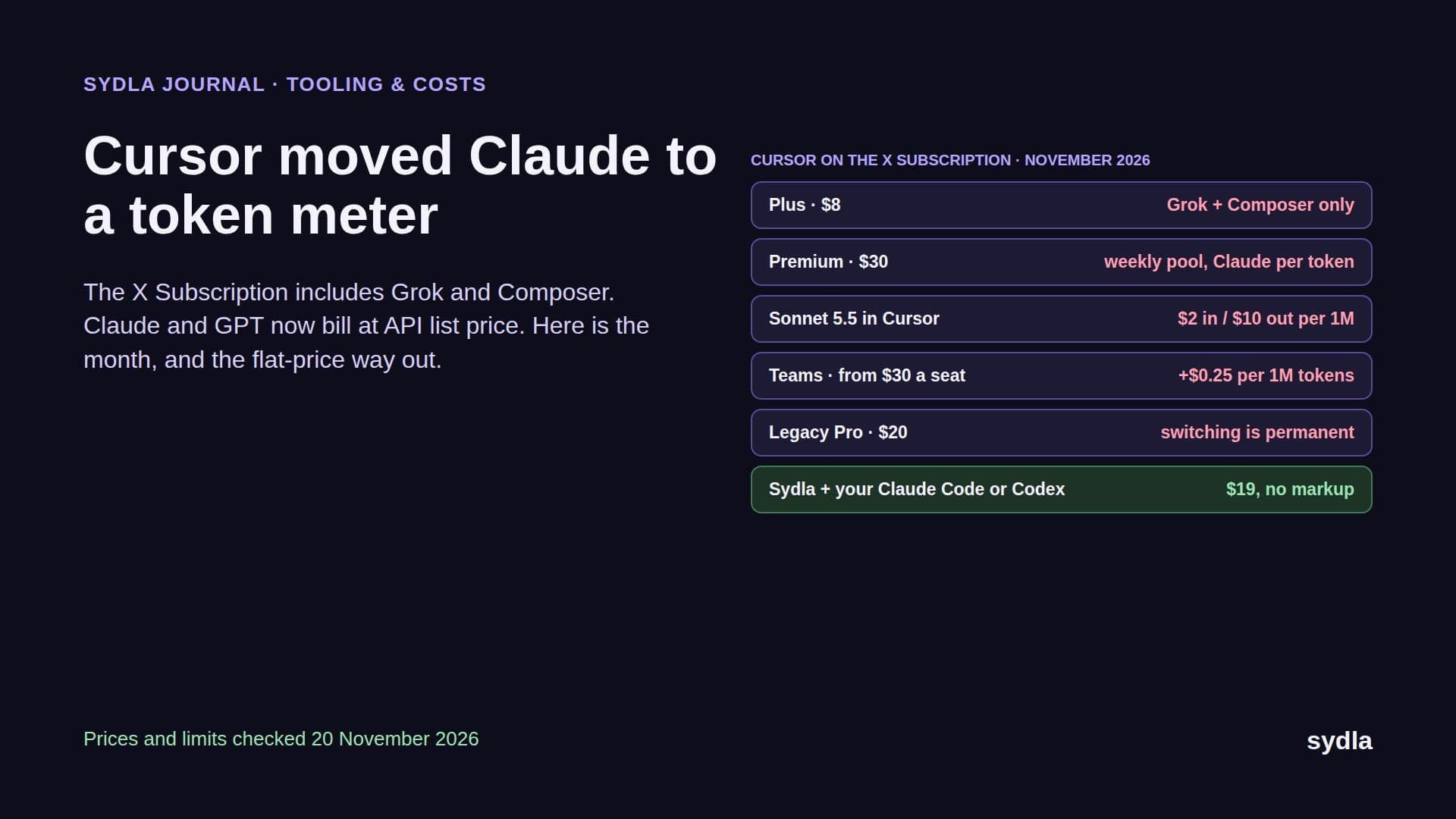
For two years the deal was simple. You paid Cursor $20 a month, picked Claude or GPT in the model menu, and an included allowance covered most of a normal month. In November 2026 a new Cursor account looks different. Checkout says The X Subscription, the bill comes from X Subscription Corp, and the plan page has a line that changes the maths for anyone who works with Claude: third-party models are billed separately by usage.
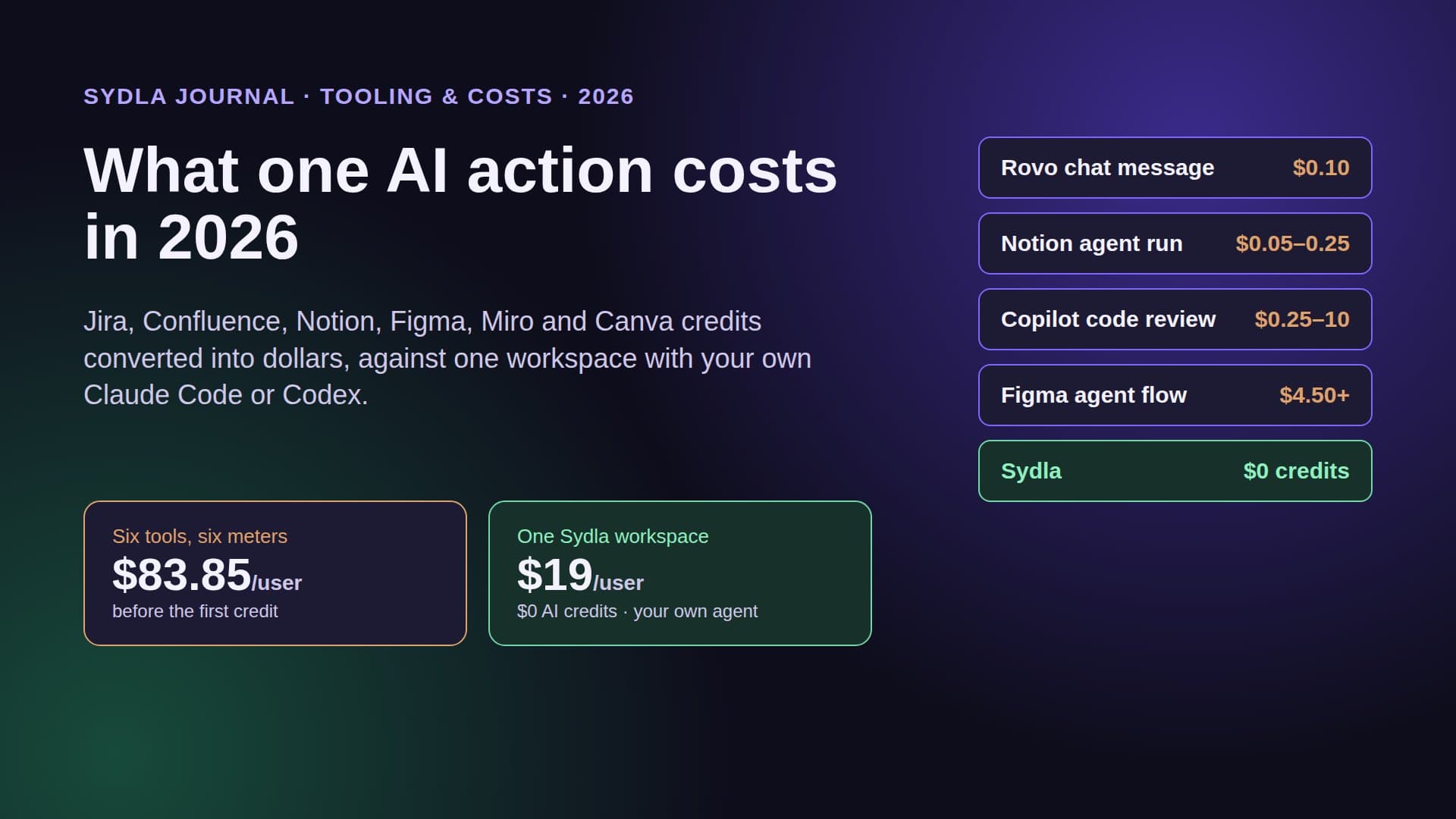
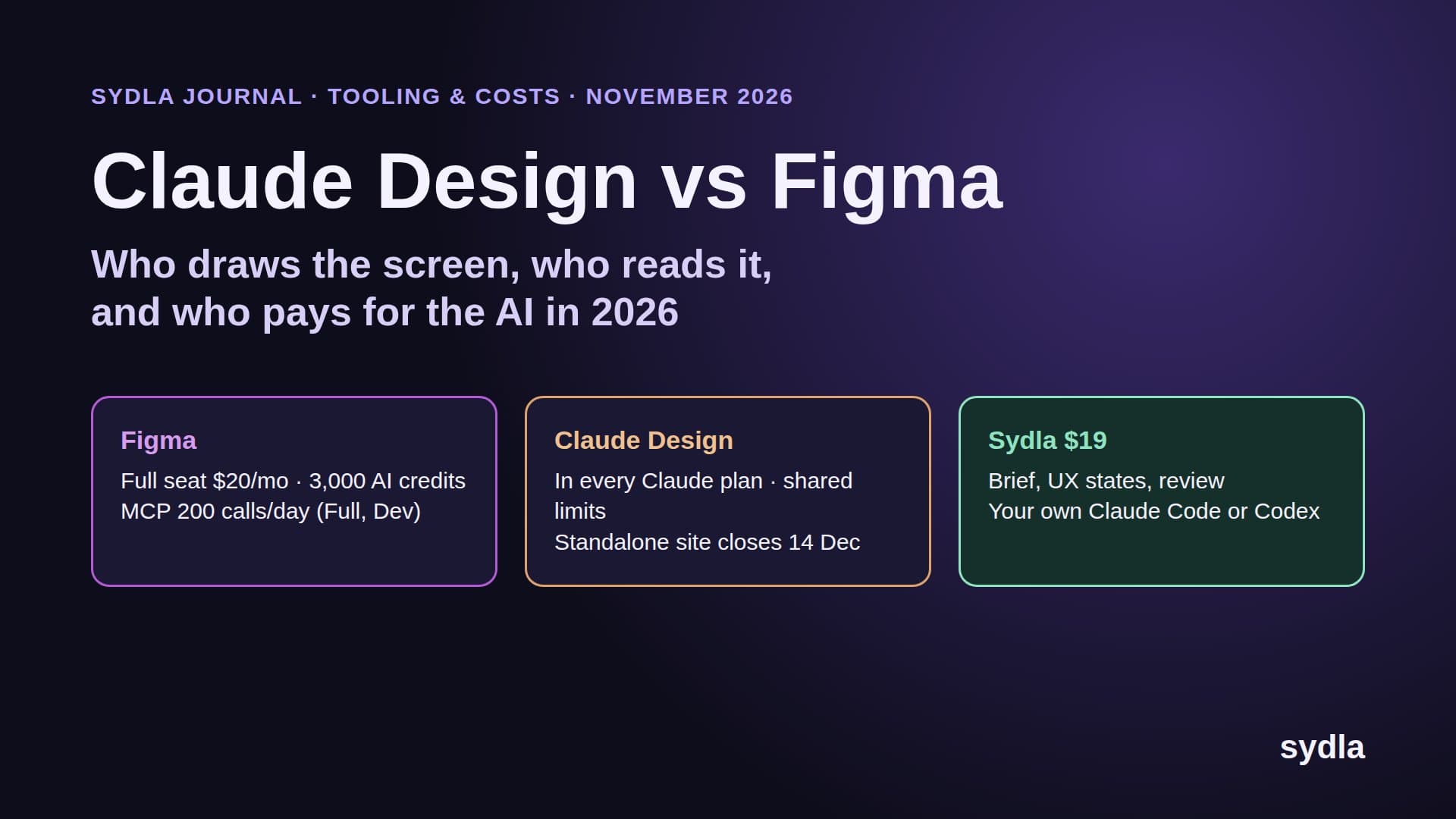
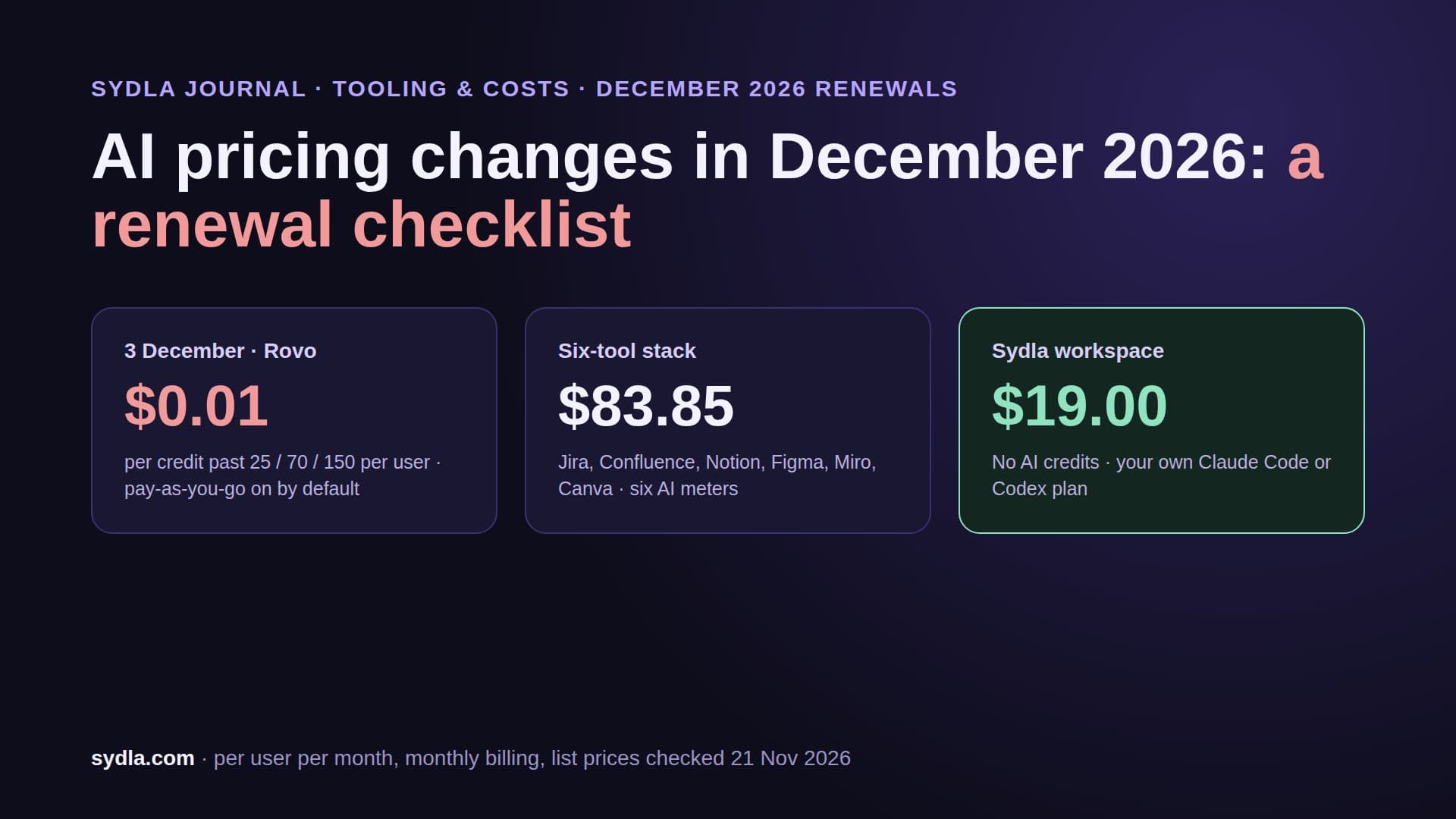
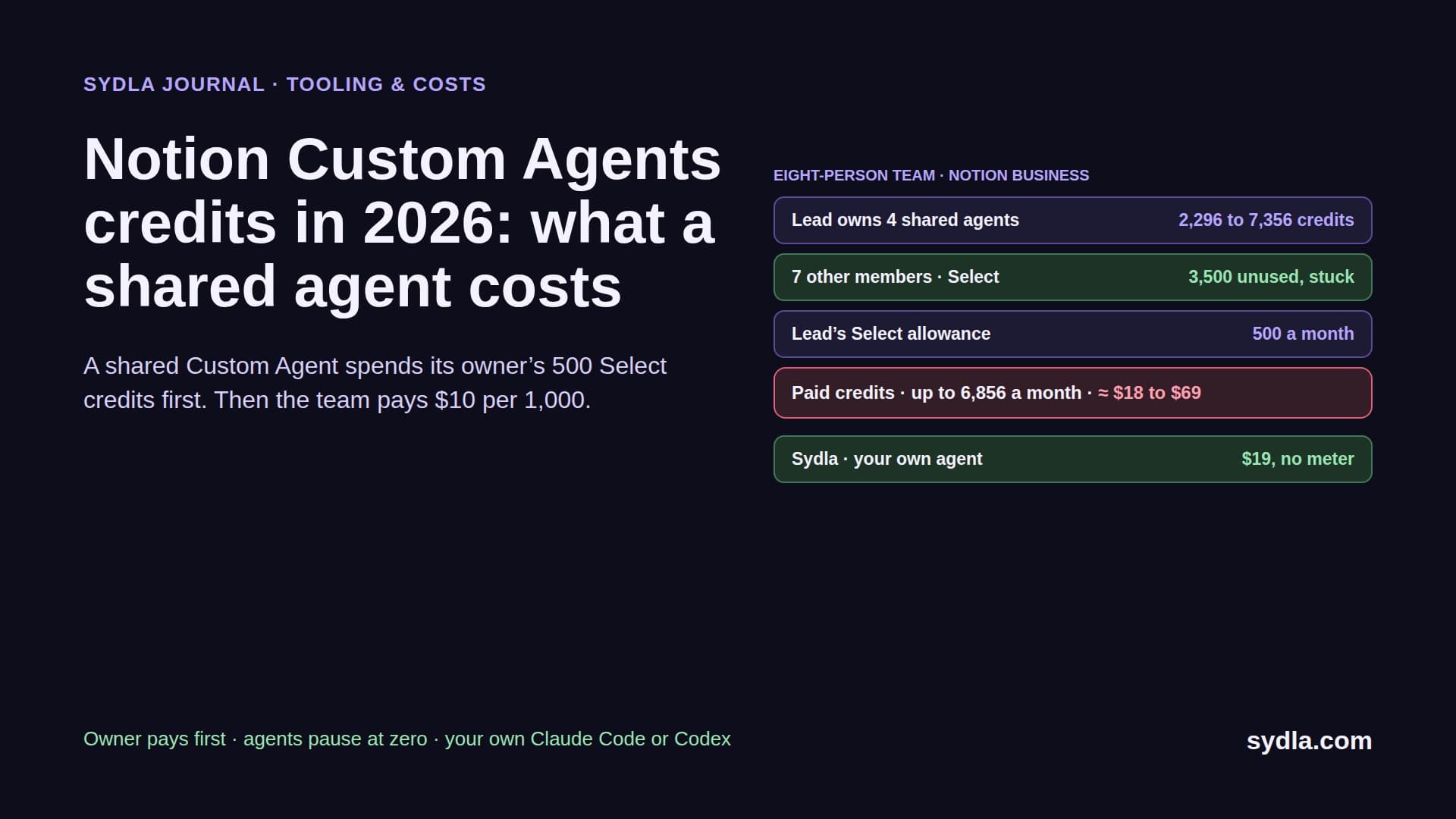
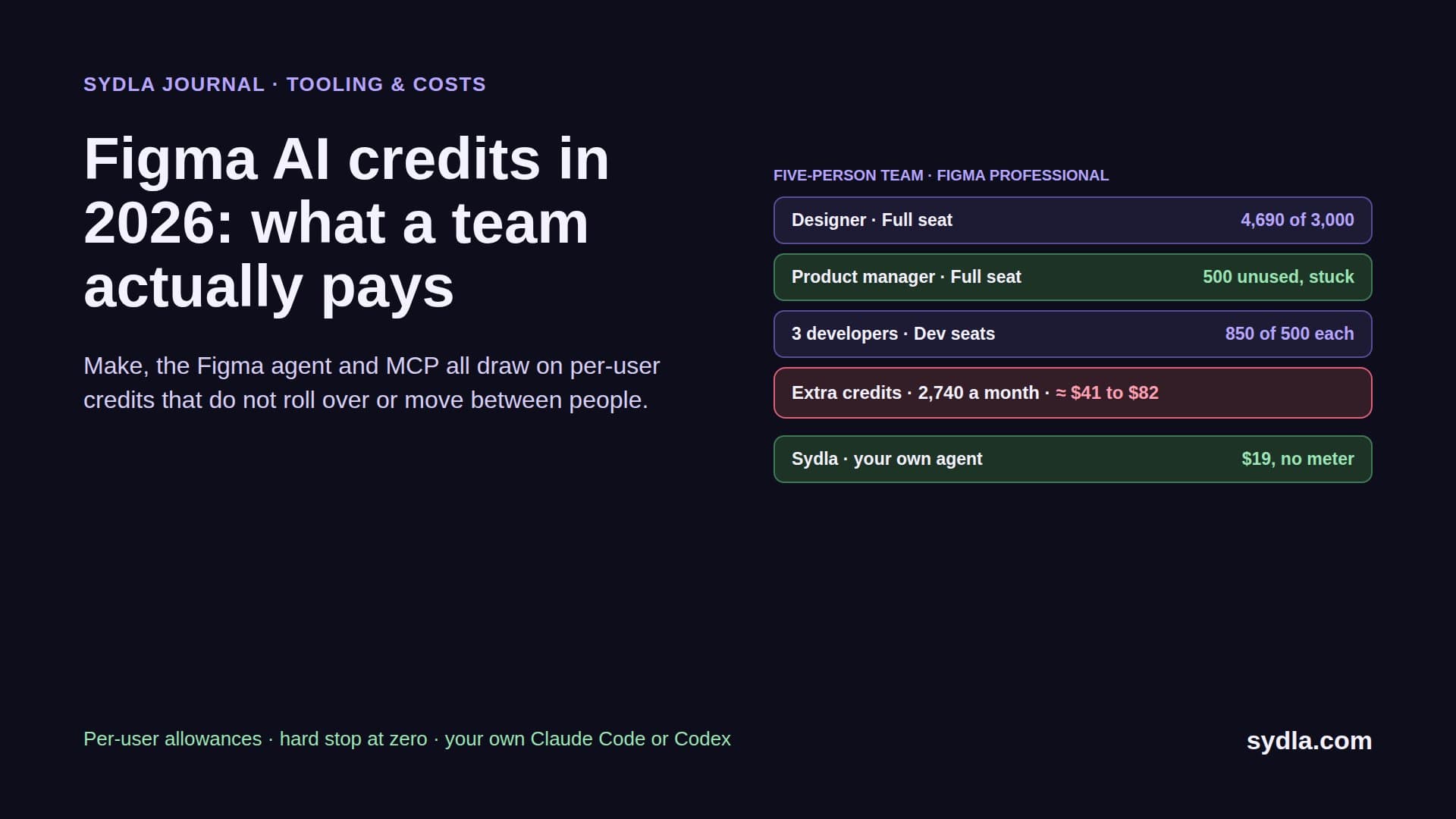
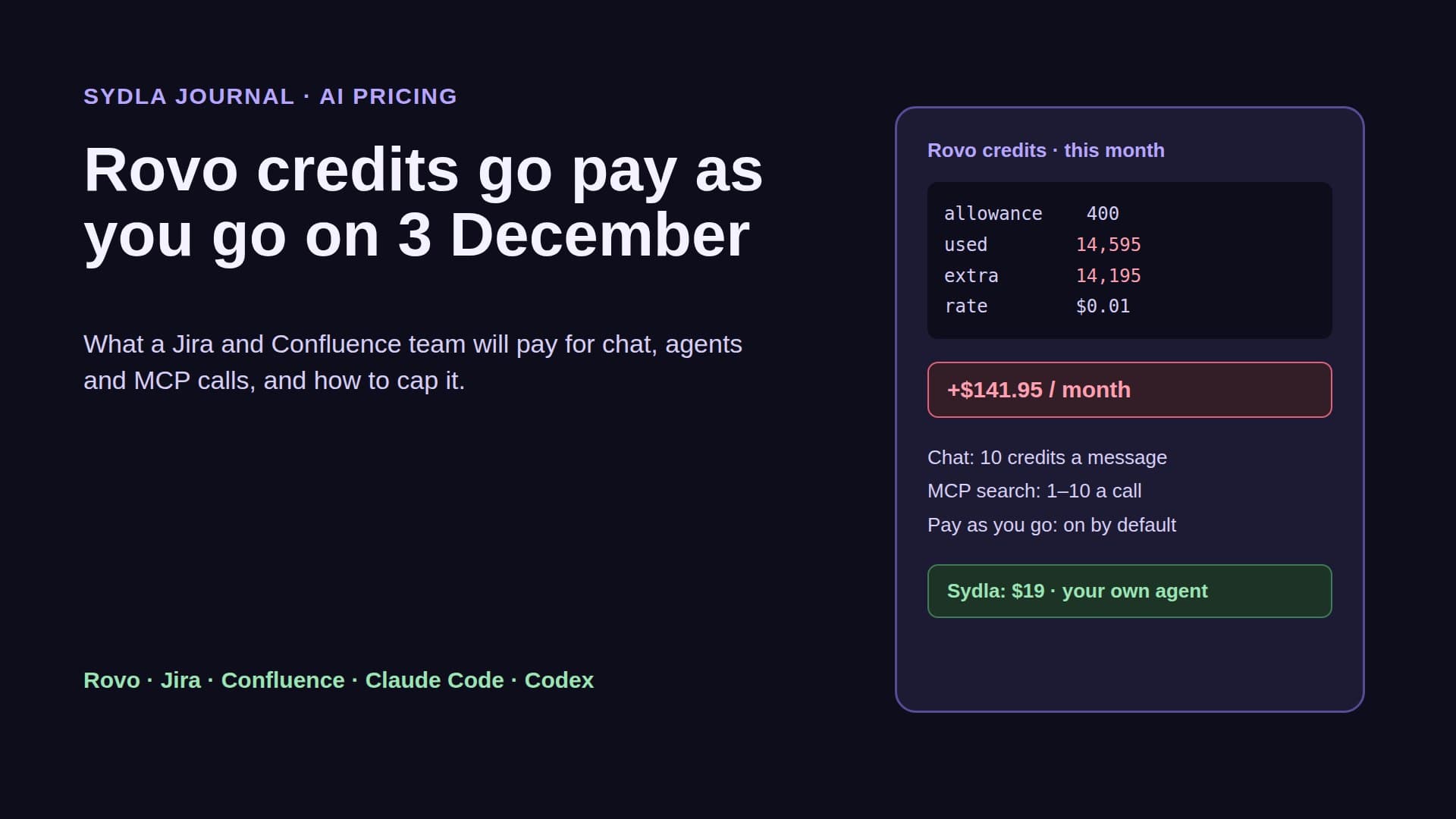
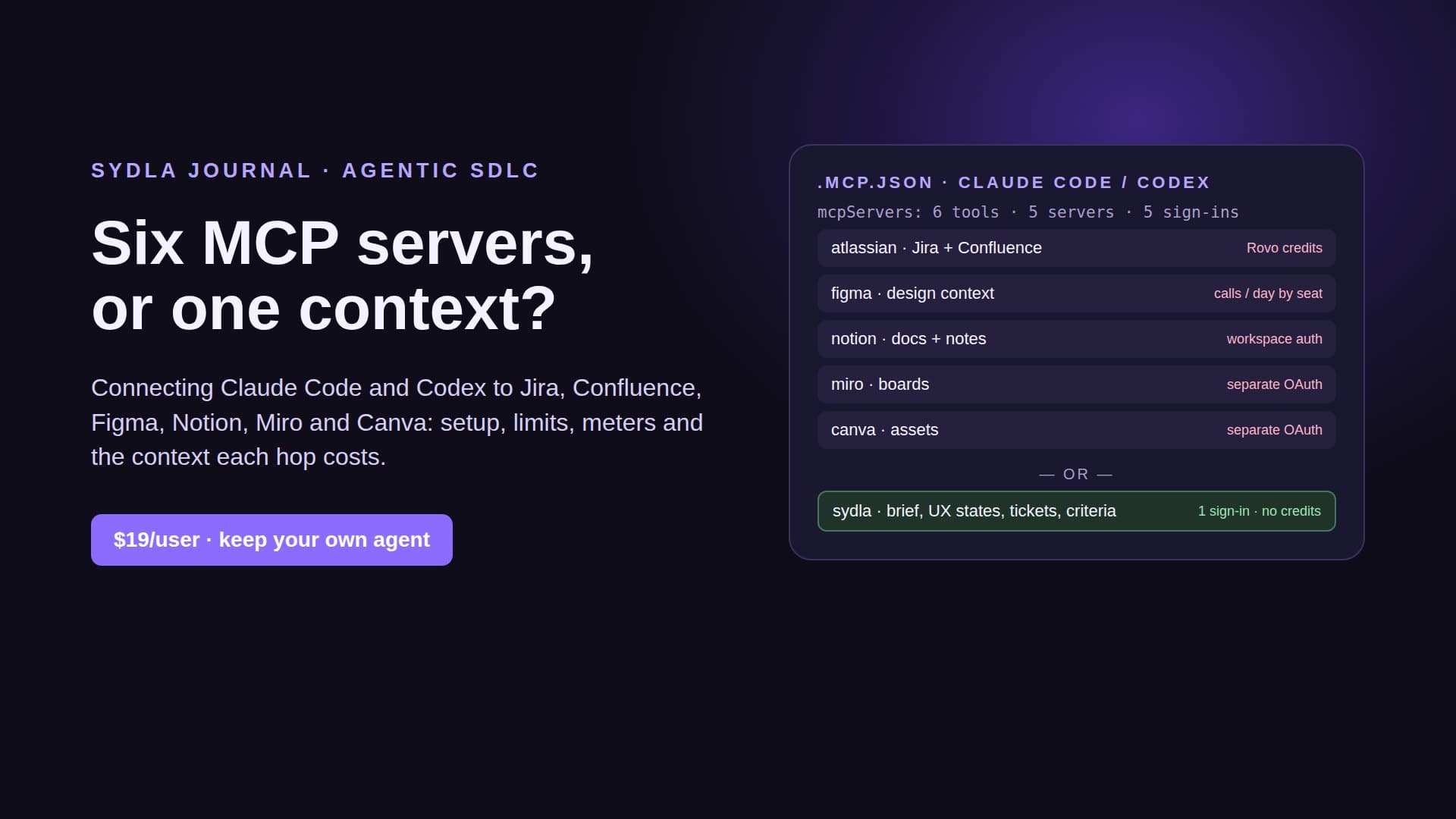
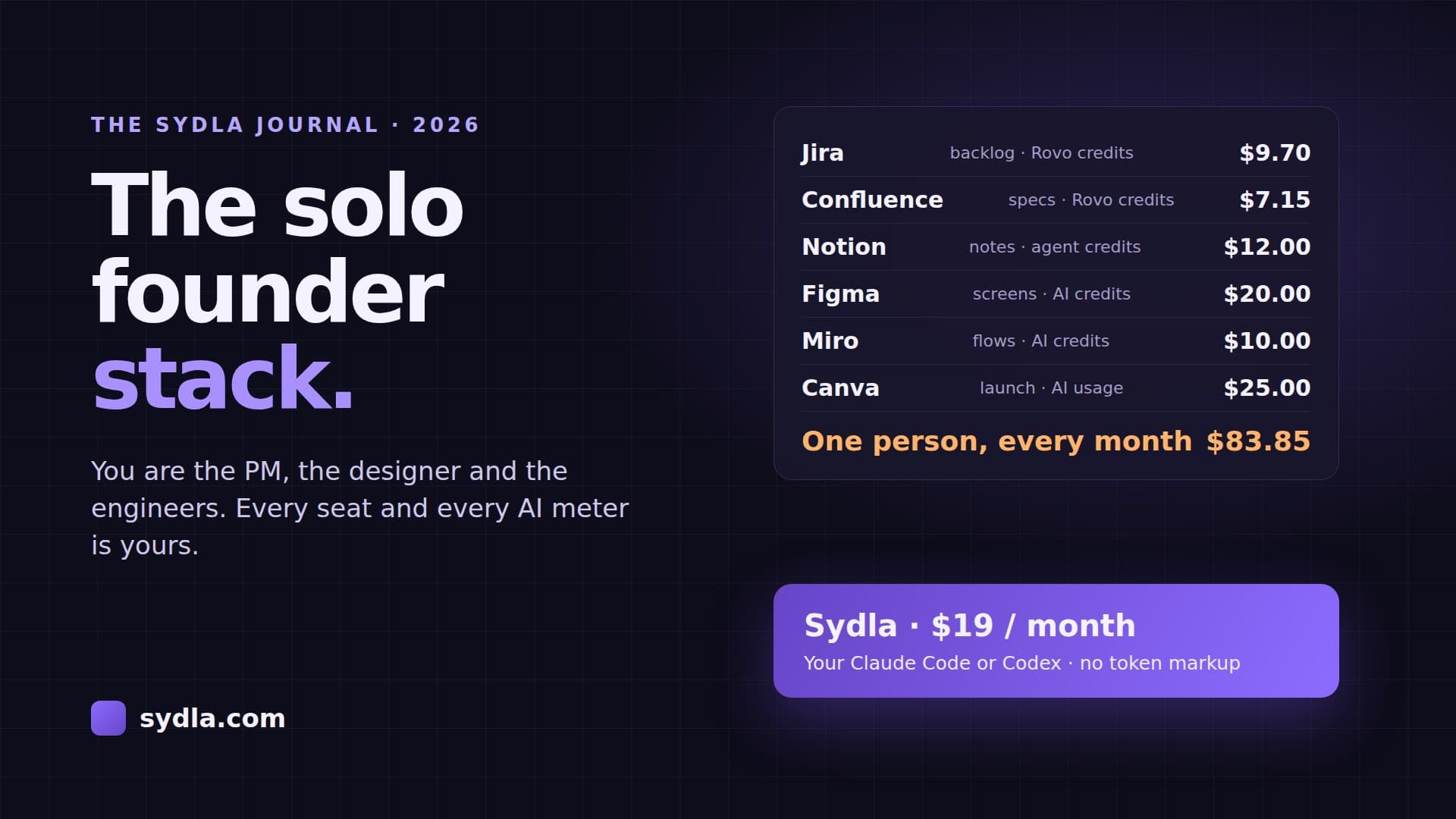
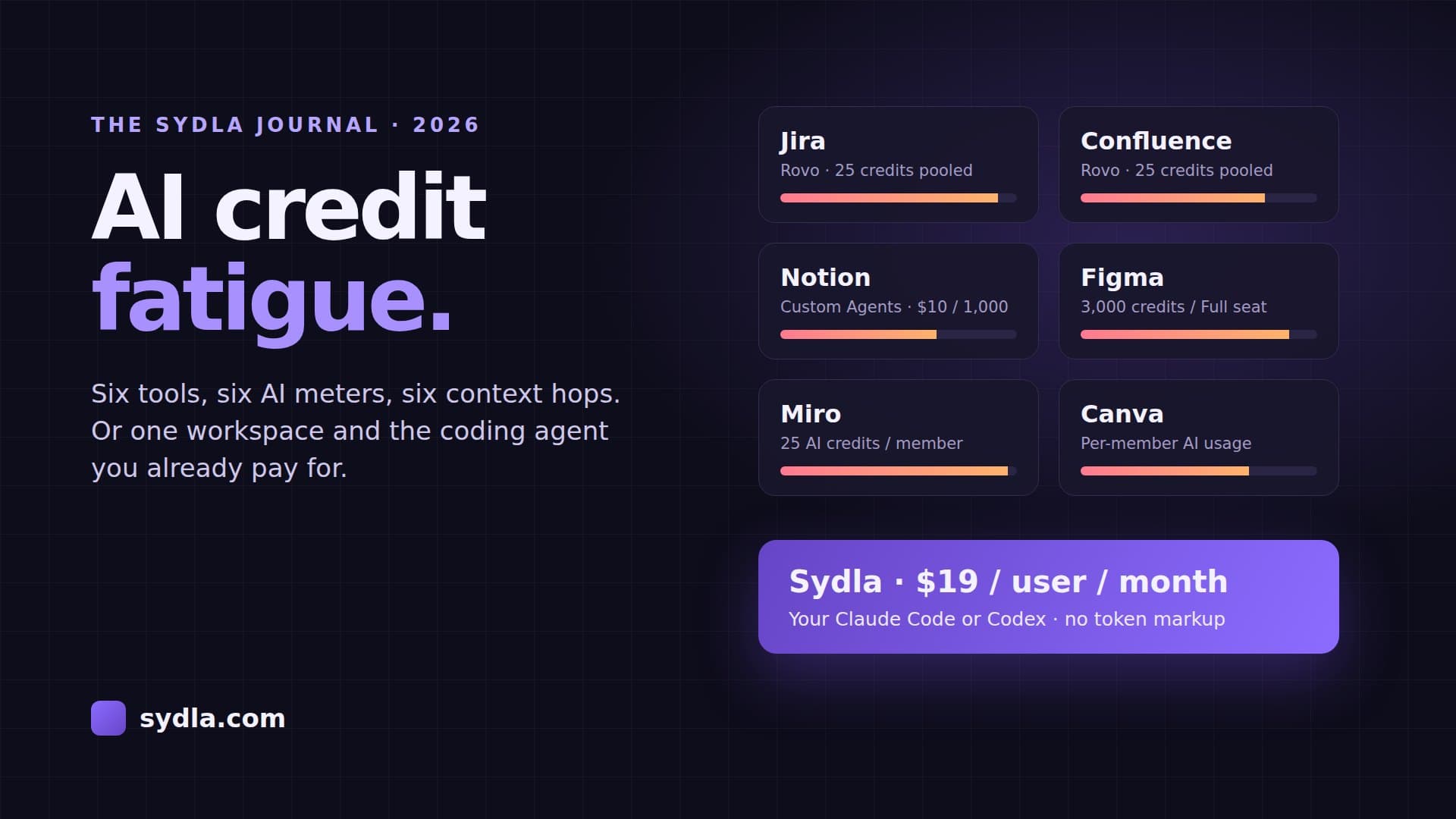
This is the newest form of AI credit fatigue. The product stack already meters AI in six places: Rovo credits in Jira and Confluence, Notion credits, Figma AI credits, Miro credits and Canva's AI allowance. Now the editor where the code gets written has moved the models most teams standardised on into a seventh meter, priced token by token.
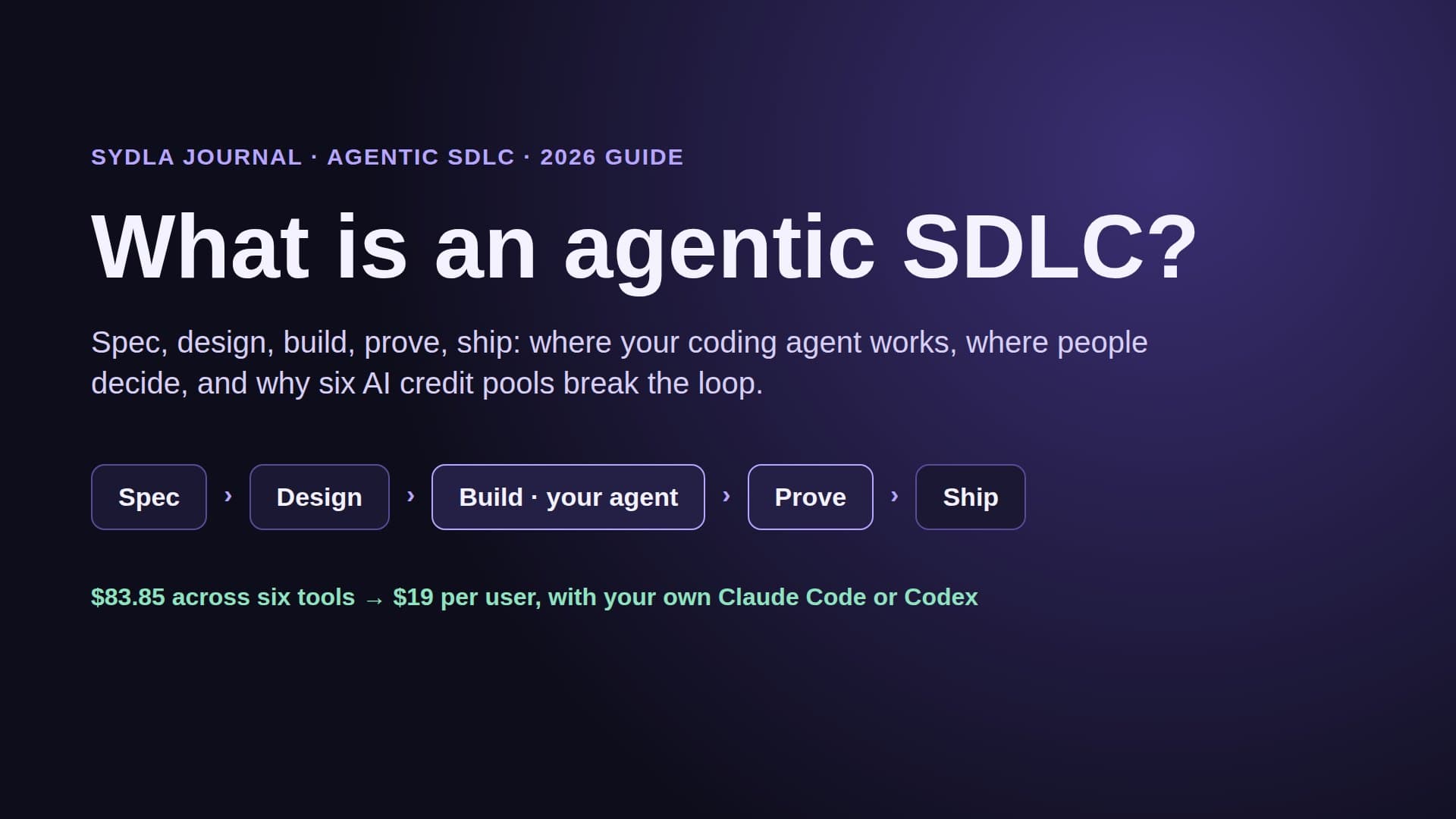
This guide reads Cursor's own pricing page and docs as of 20 November 2026. It explains what changed, works out what a month of Claude Sonnet in Cursor costs at list price, and shows the other path: keep Cursor as your editor if you like it, and run Claude Code or Codex on the subscription you already pay for, connected to a shared brief and UX states in Sydla.
What changed: Cursor plans on The X Subscription
Cursor announced on 14 August 2026 that SpaceX had completed its acquisition. Cursor is now sold as part of The X Subscription, one plan for Cursor, the Grok apps and X. New customers start there. Each paid tier includes a weekly pool of usage for Cursor's own models, Grok 4.7, Grok 4.6, Grok 4.5 and Composer 2.5, shared with Grok Chat, Voice, Imagine and Grok Bot.
| Plan | Price / month | Included usage | Claude, GPT and Gemini | Notes |
|---|---|---|---|---|
| Plus | $8 | Base weekly pool, Cursor models only | Not available, and no own API keys | Fixed settings: Fast off, medium effort. No Cloud Agents, Bugbot or Auto |
| Premium | $30 | 4x Plus, weekly | API list price from the first request, paid from prepaid credit | Adds Cloud Agents, Automations, Bugbot code review and Origin code hosting |
| Super | $100 | 15x Plus, weekly | API list price from prepaid credit | Priority model access at peak times |
| Ultra | $200 | 50x Plus, weekly | API list price from prepaid credit | Earliest access to new models |
| Teams | $30, $100 or $200 a seat | Matches the seat's tier | API list price plus a Cursor Token Rate of $0.25 per million tokens | SSO, admin, usage analytics; Plus seats not offered |
Annual billing is $80, $300, $1,000 and $2,000 a year for Plus, Premium, Super and Ultra. Extra usage is prepaid: you buy credit, optionally turn on Auto Top-up, and set a monthly additional usage limit at grok.com/dashboard/billing. Opting in to regional data residency adds 10% to model prices.
If you are on a legacy Pro, Pro+ or Teams plan
Nothing changes unless you switch. Cursor's docs call Hobby, Pro at $20, Pro+ at $60, Ultra at $200, Teams Standard at $40 and Teams Premium at $120 legacy Cursor plans. They keep their two monthly pools, Cursor Models and Other Models, so Claude and GPT stay covered by an included allowance, with on-demand usage billed in arrears after that.
Cursor maps each legacy plan to a comparable tier: Pro to Premium at $30, Pro+ to Super at $100, Teams Standard to a $30 Premium seat. Each new tier includes at least twice the Cursor-model usage, and none includes the third-party allowance. Two warnings from the help center are worth reading twice. Switching is permanent and Support cannot undo it. And existing customers can still move between legacy tiers without switching.
So the practical question for a team on legacy Pro is not whether the new plan is bigger. It is which models your team actually uses. If most of your agent work runs on Claude or GPT, the switch moves that work from an included pool to a token meter.
What a month of Claude in Cursor costs now
Cursor publishes the per-token price of every third-party model. Claude Sonnet 5.5 is $2 per million input tokens, $2.50 per million cache writes, $0.10 per million cache reads and $10 per million output tokens. Claude Opus 5.5 is $4, $5, $0.20 and $20. GPT-5.6 Terra is $2 in and $12 out. These match the providers' own API list prices, so Cursor adds no margin for individuals.
Teams is different. On Teams and Enterprise, eligible third-party requests carry a Cursor Token Rate of $0.25 per million tokens, applied to input, output and cached tokens, including when you bring your own API key. Only models whose cache-read price is strictly below $0.10 per million are exempt. Sonnet 5.5 reads cache at exactly $0.10, so it pays the rate. Agents re-read a lot of cached context, which makes this line bigger than it looks.
Here is a worked example with an assumed workload: one developer, 20 active days a month, each day 1.5 million fresh input tokens, 1 million cache writes, 15 million cache reads and 0.4 million output tokens. That is a realistic agent day on a medium repository. On Sonnet 5.5 the day costs $3.00 + $2.50 + $1.50 + $4.00 = $11.00, so $220 a month. The same day on Opus 5.5 costs $22.00, so $440 a month. On a Teams seat, the 17.9 million tokens a day add $4.48 of Cursor Token Rate, another $89.50 a month on Sonnet.
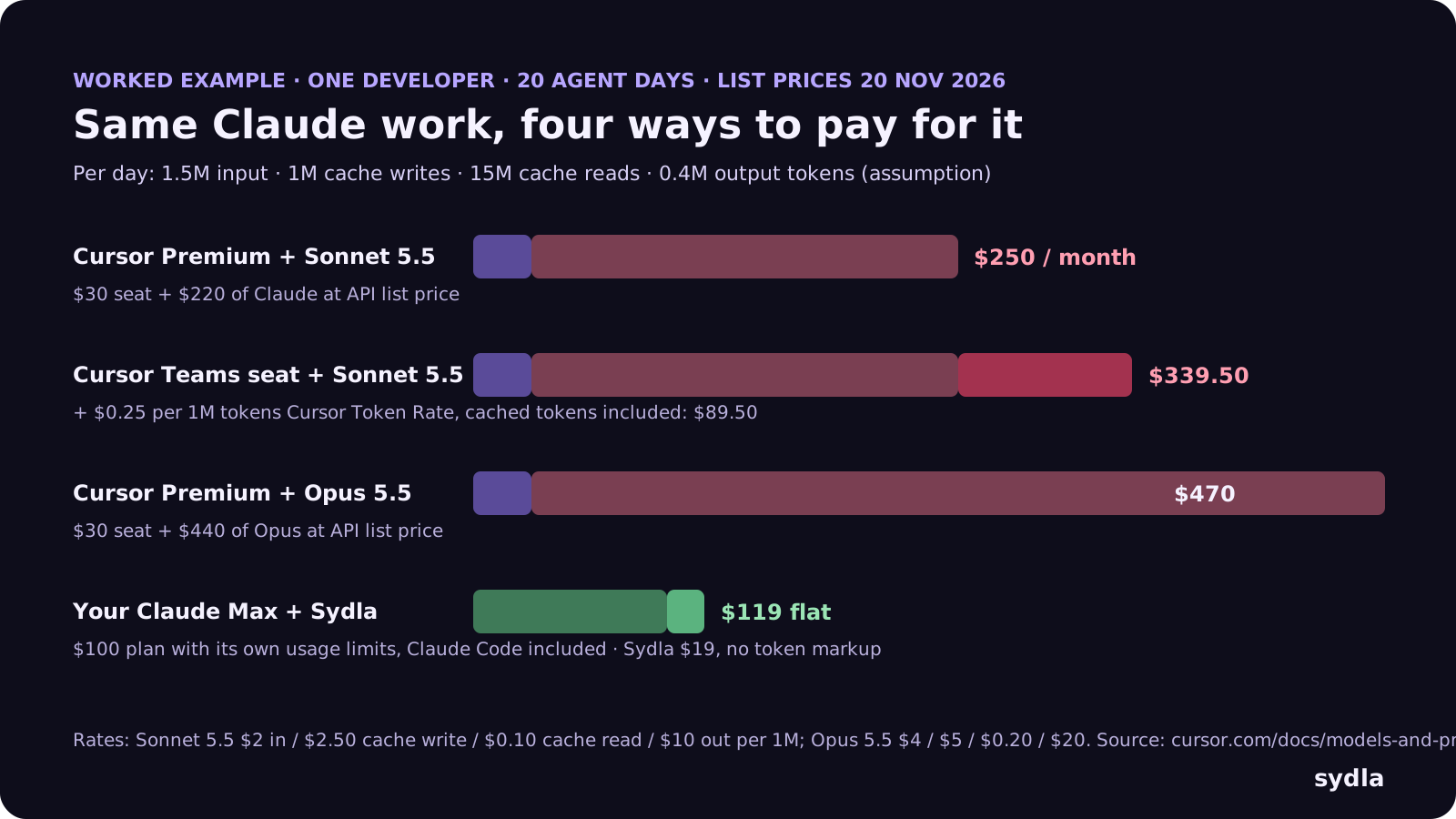
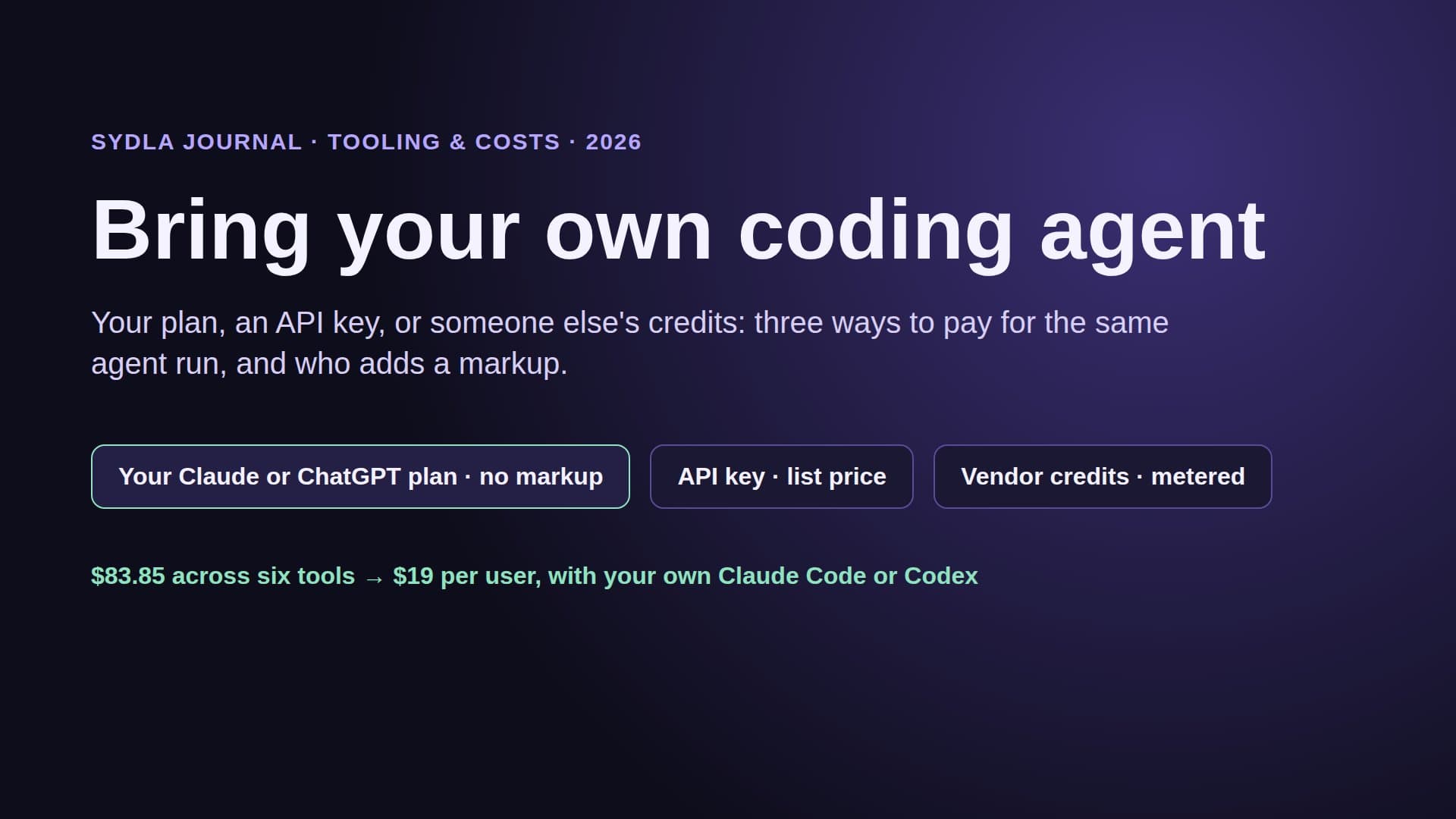
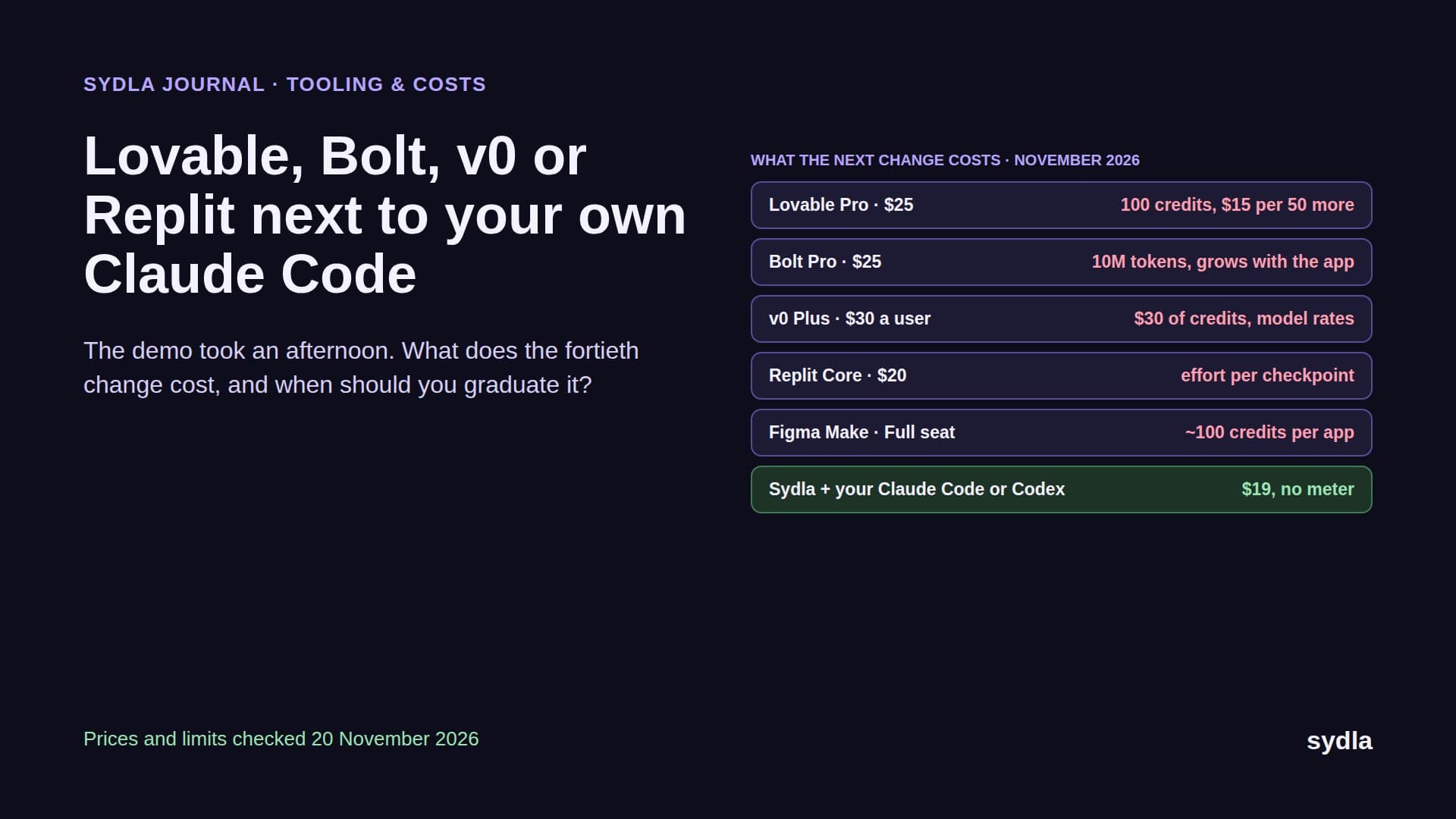
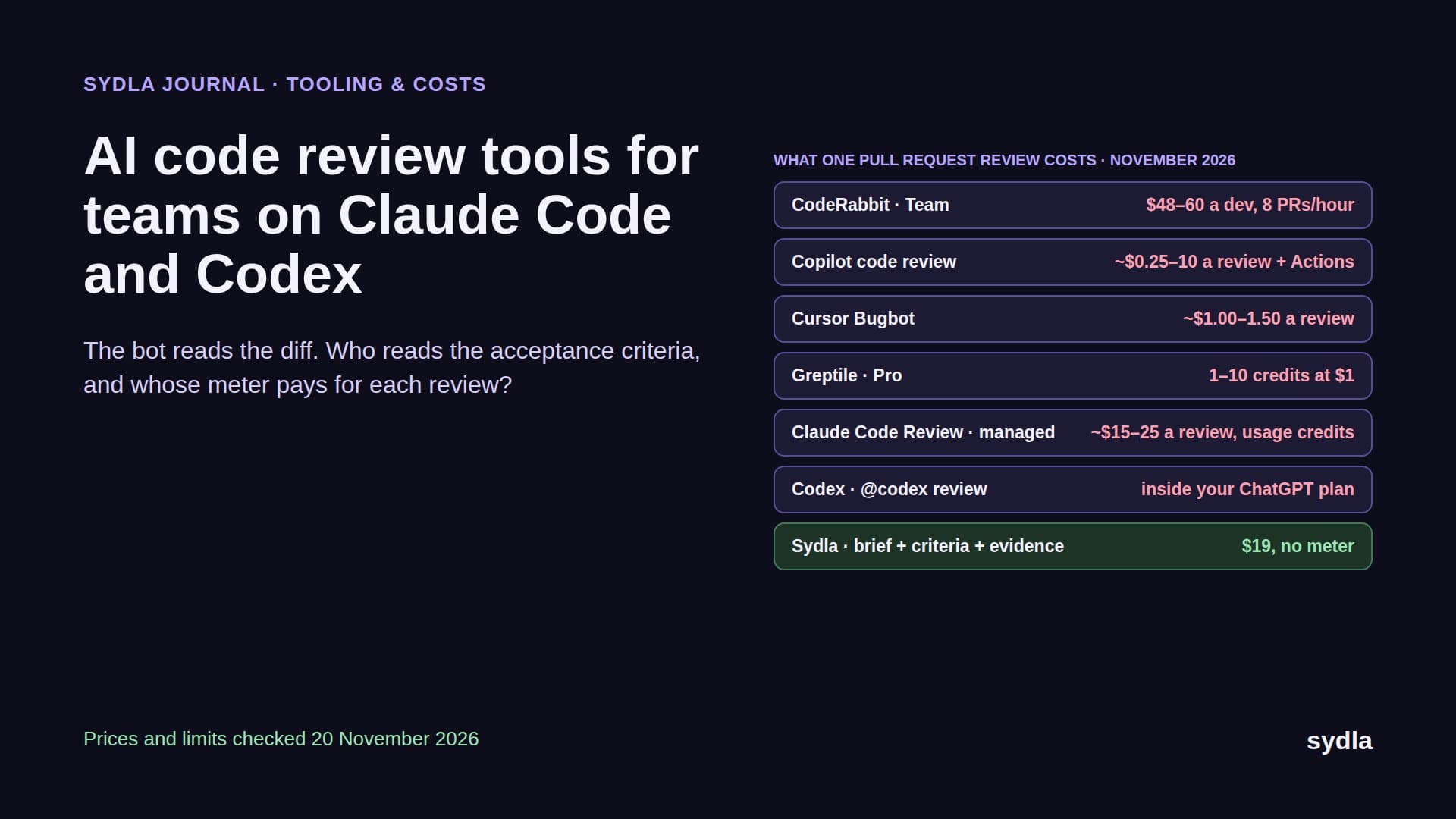
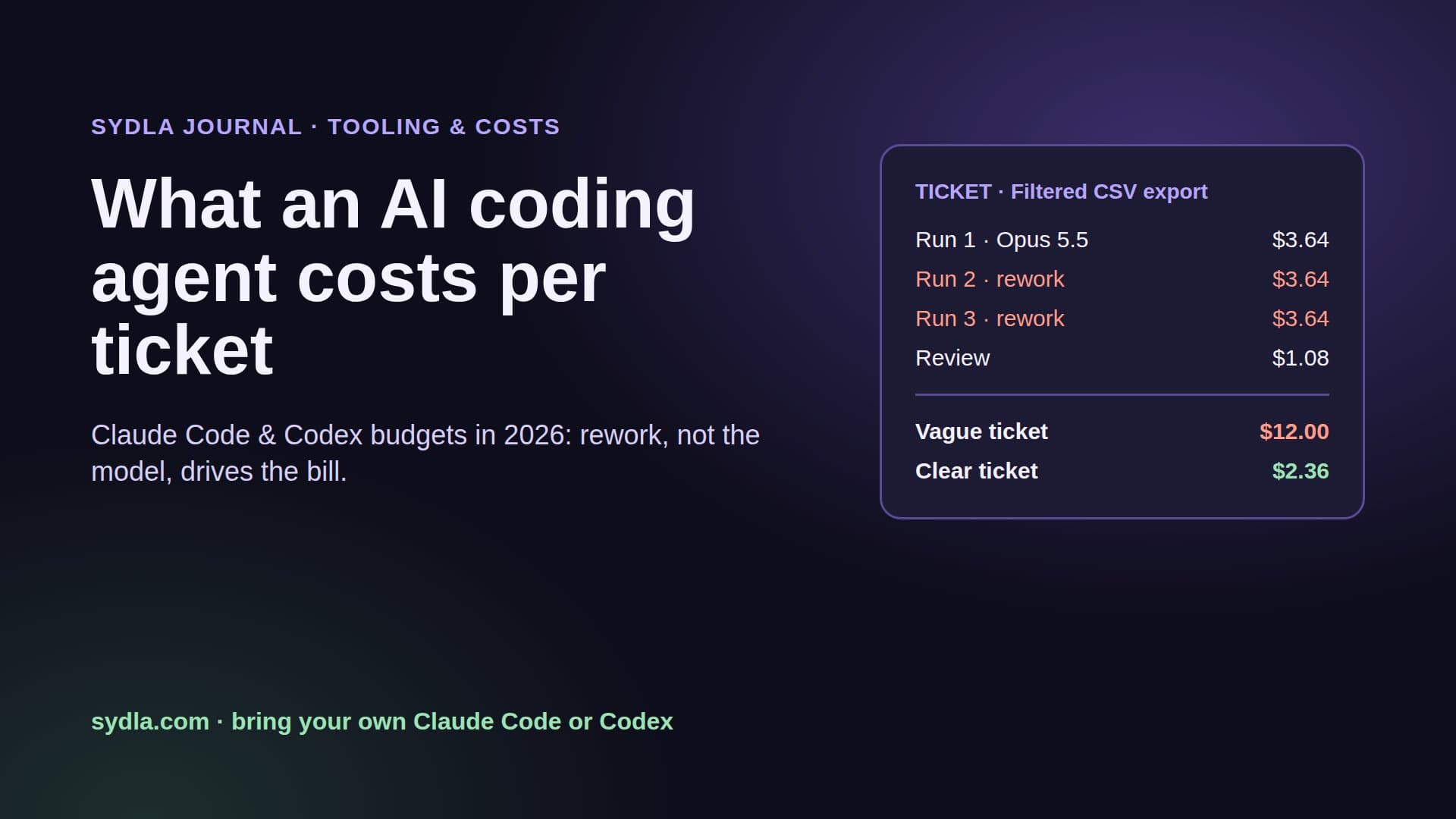
Set that next to a flat plan. Claude Code is included in Claude Pro at $20 a month, or $17 billed yearly, with Max at $100 and Ultra at $200 for heavier use. Codex is included in ChatGPT Plus at $20. Those plans have usage limits of their own, and a team that runs agents all day will hit them. But the limit is a ceiling on a flat price, not a meter on every token. For the full per-ticket view, our cost per ticket guide works through the same rates on real tickets.
To be fair to Cursor: the weekly pool for Grok 4.7 and Composer 2.5 is generous, and Composer 2.5 beyond the pool is $0.50 in and $2.50 out per million tokens. If your team is happy on Cursor's own models, Premium at $30 may cover a full month. The bill grows when your standard is Claude or GPT.
The editor is one meter. The stack has six more.
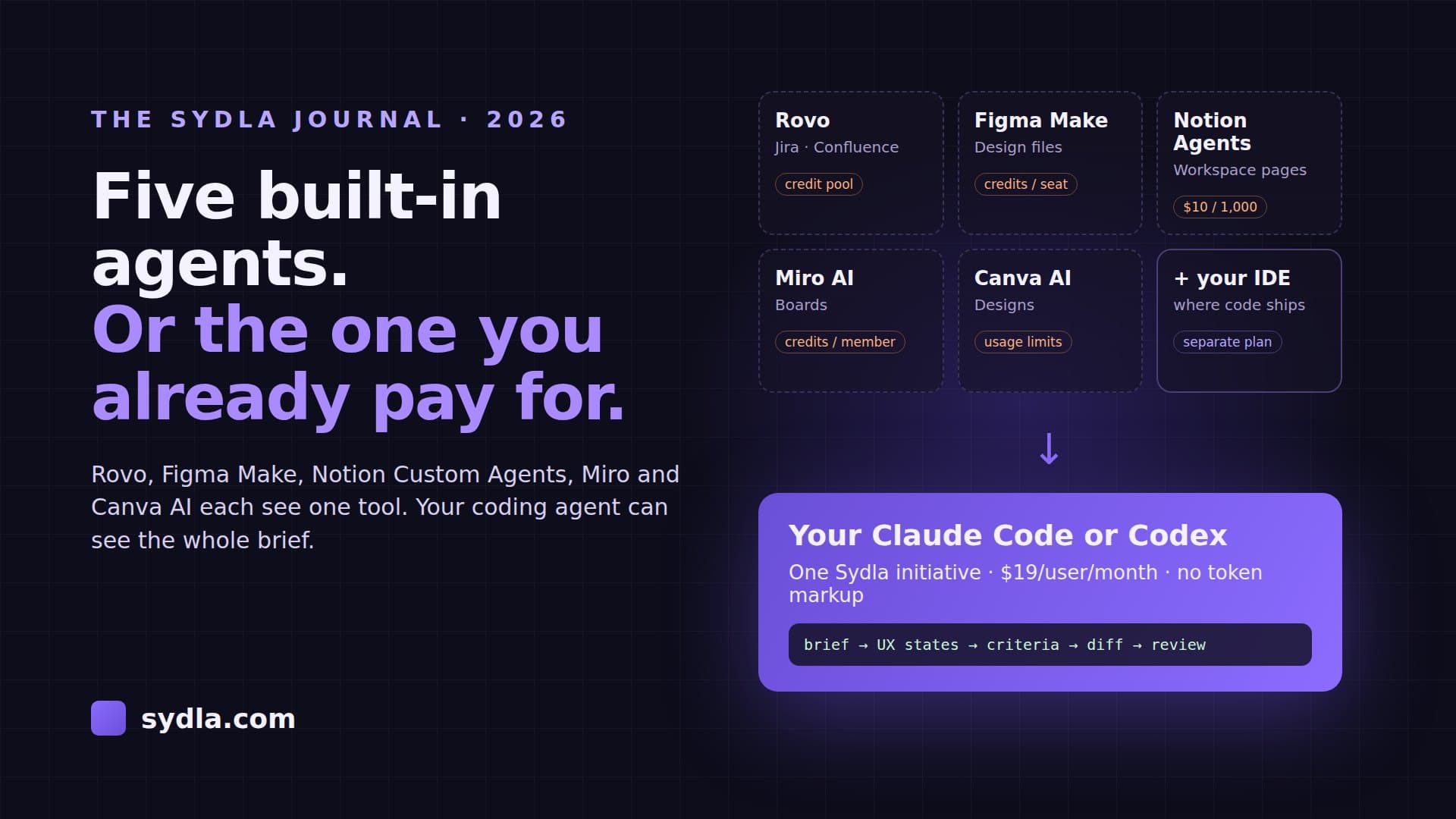
Whatever runs the code, the agent still needs the ticket, the spec, the screens and the decisions. In most teams those live in six tools, each with its own seat and its own AI allowance. Each tool has its own page on our comparison hub.
| Tool and plan | Seat / month | Built-in AI billing | What the agent needs from it |
|---|---|---|---|
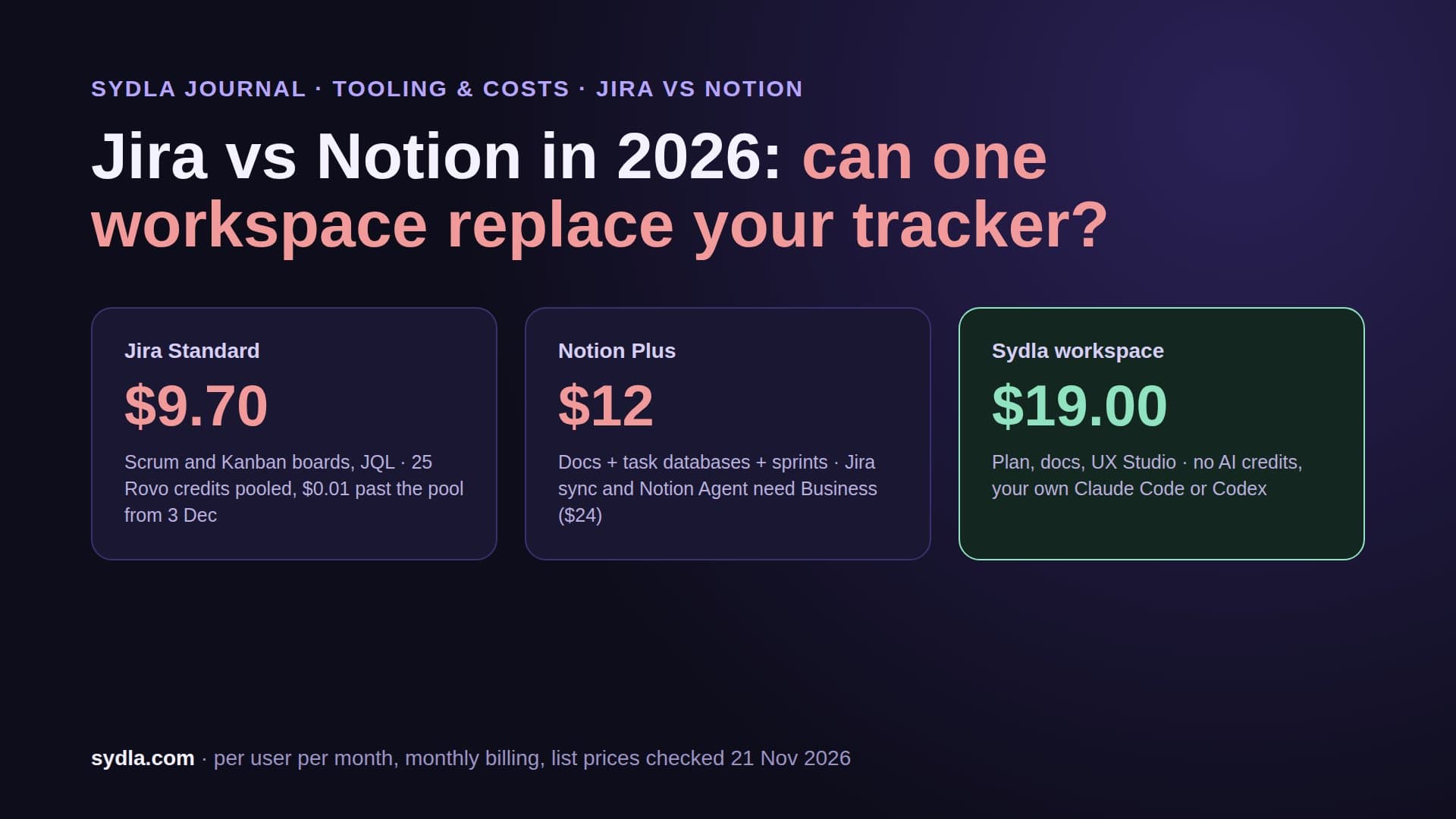
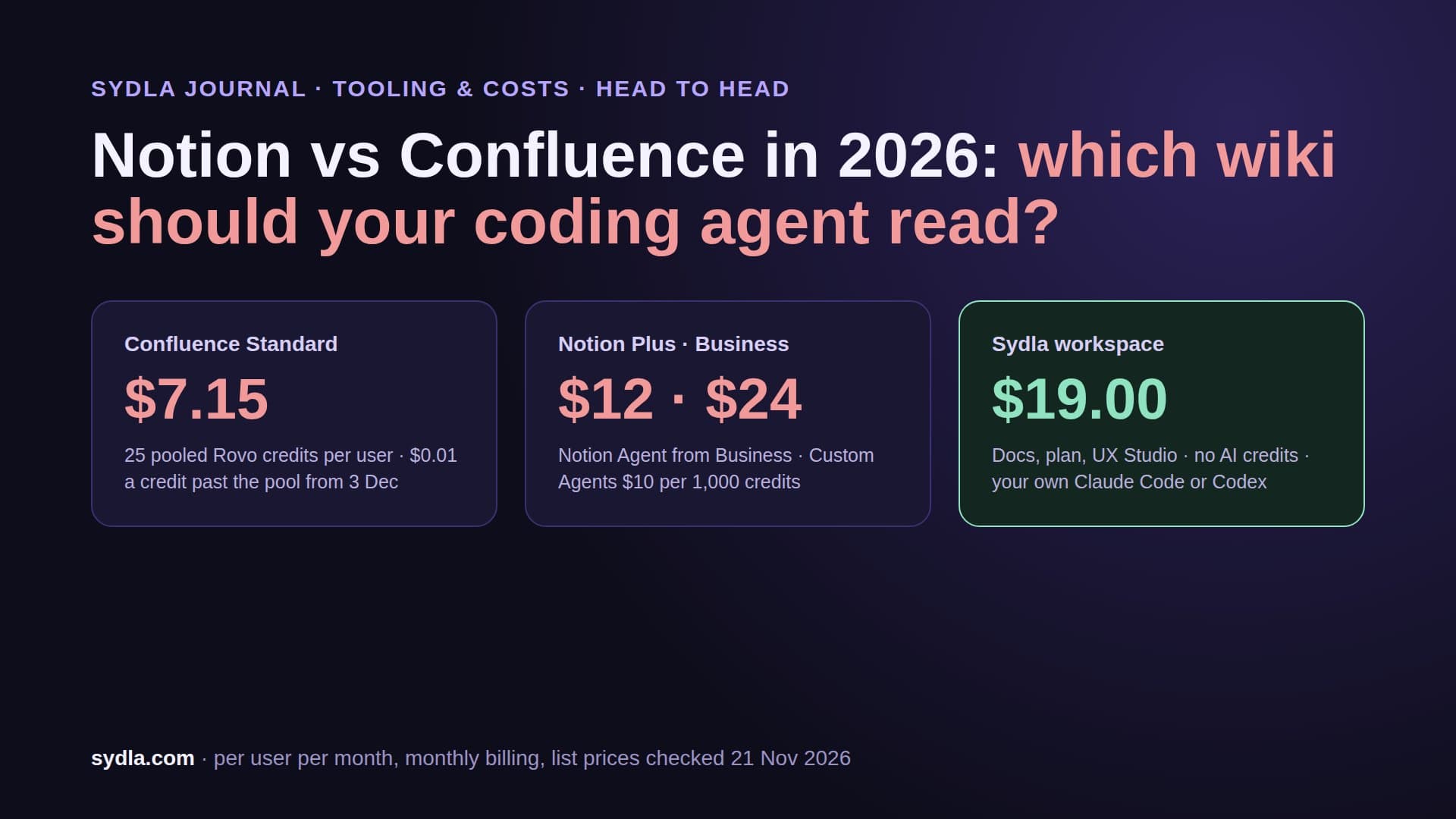
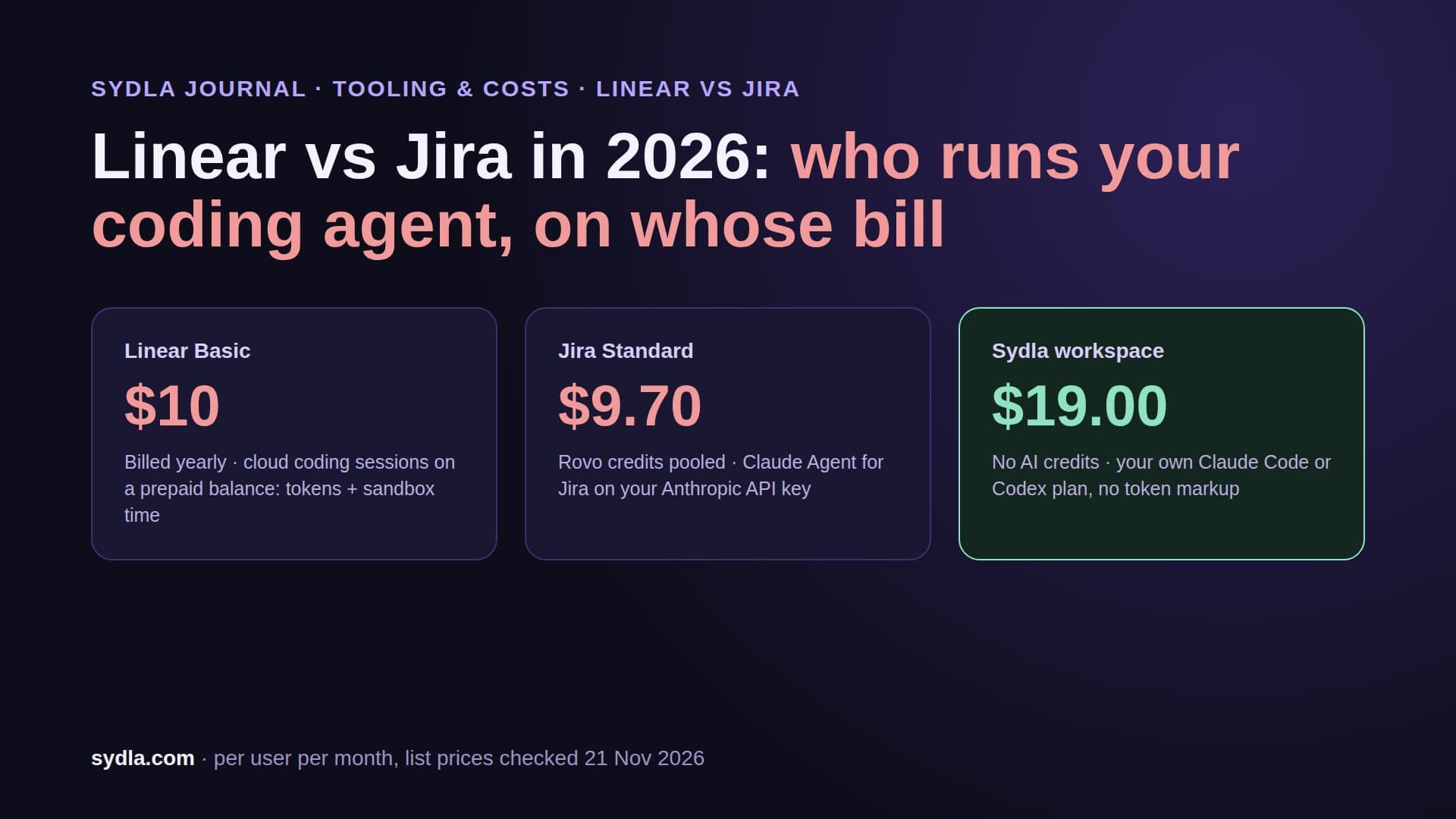
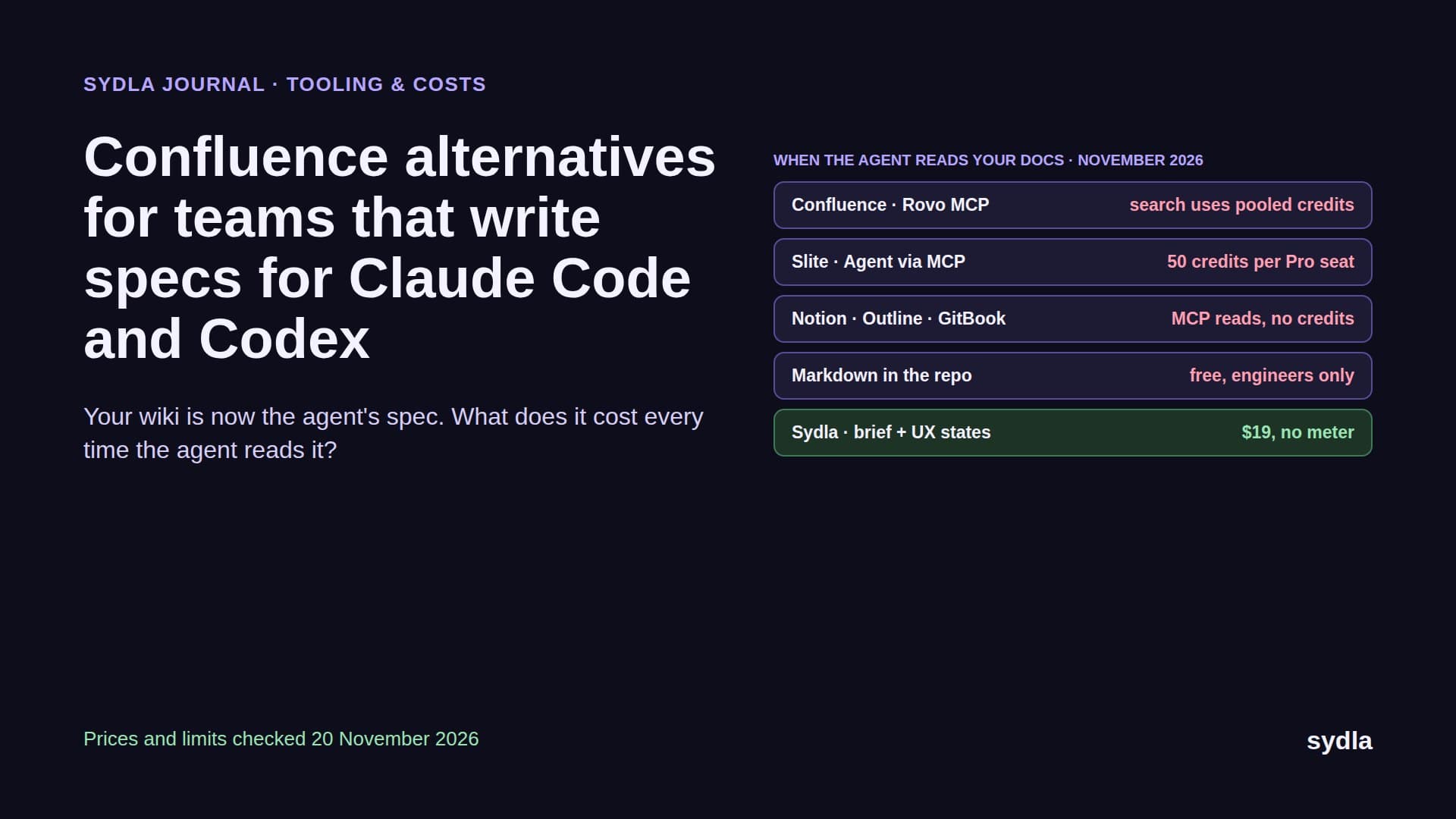
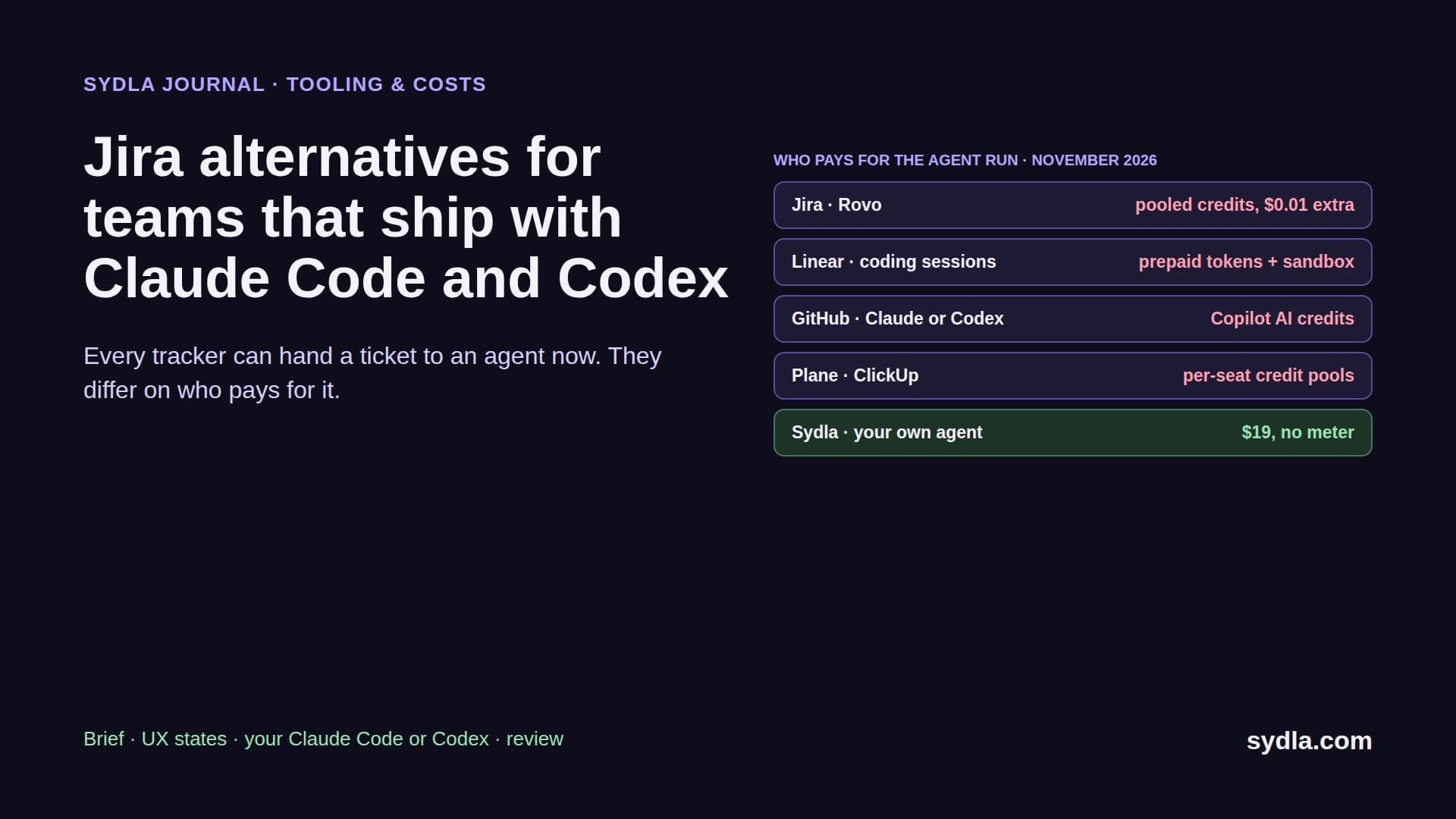
| Jira Standard | $9.70 | 25 Rovo credits per user per month, pooled; $0.01 per extra credit from 3 December 2026 | The ticket and acceptance criteria |
| Confluence Standard | $7.15 | 25 Rovo credits per user per month, same pool | The spec and decisions |
| Notion Plus | $12.00 | Custom Agents need Business or Enterprise, then $10 per 1,000 credits | Notes and research |
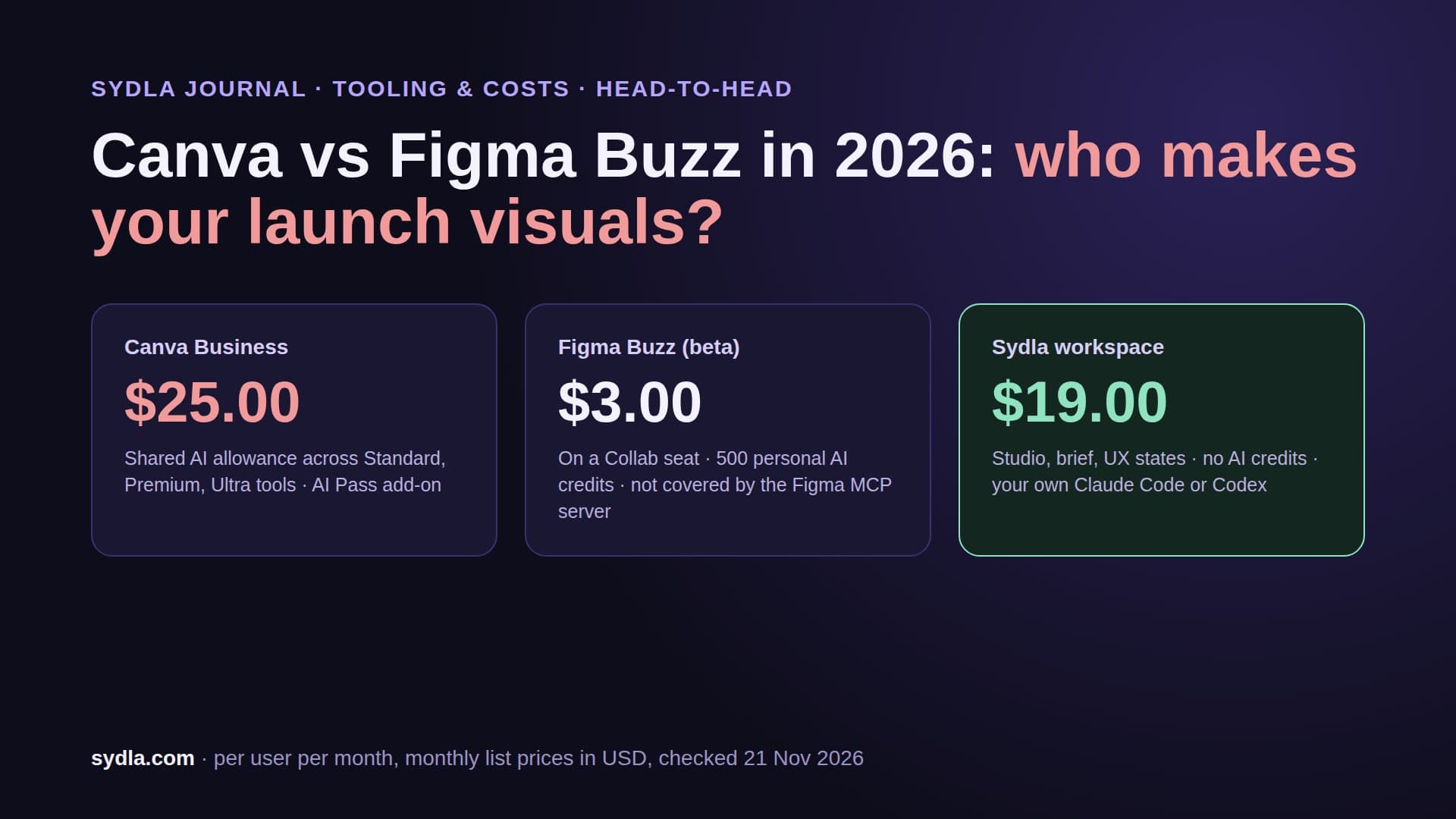
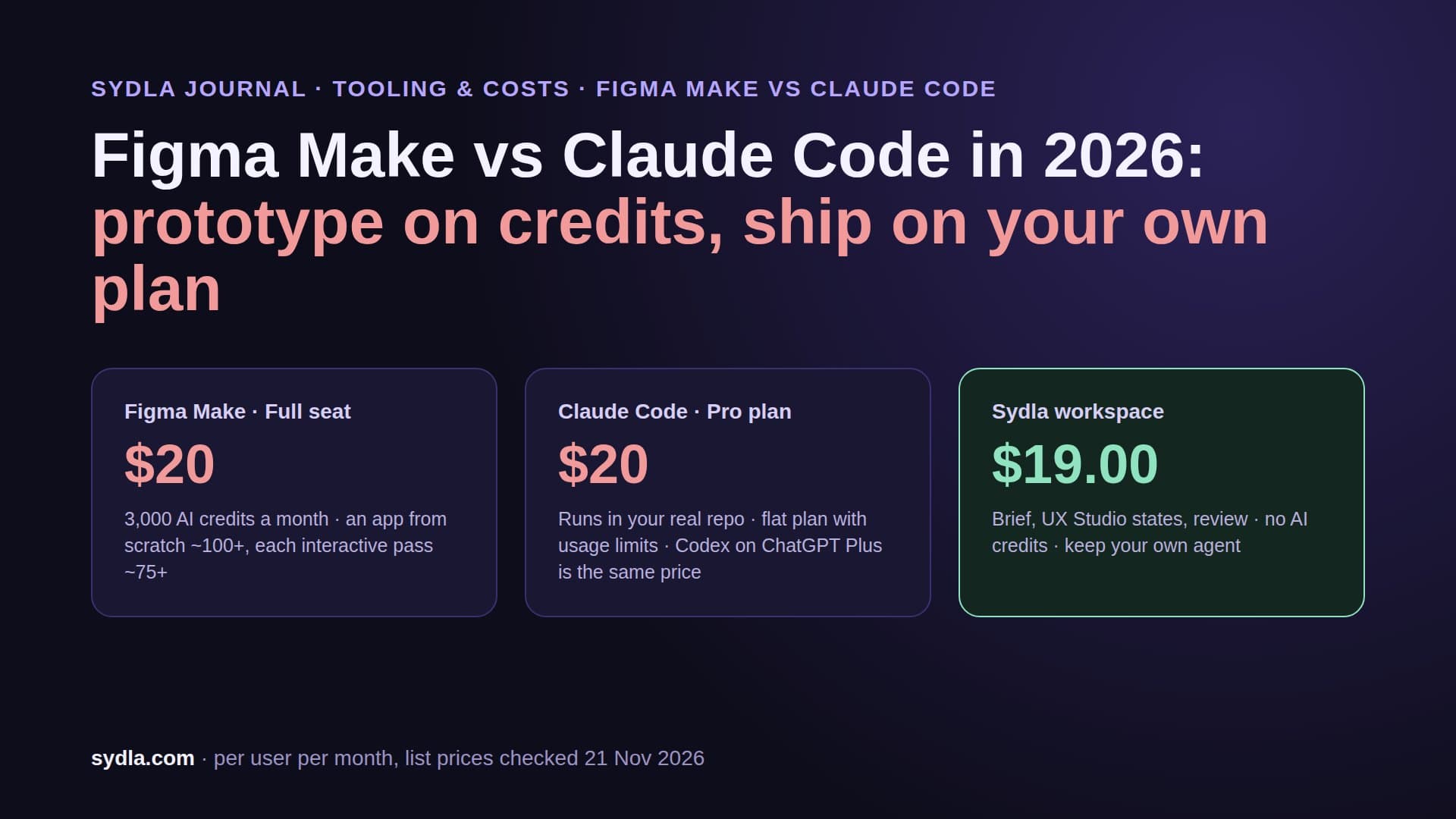
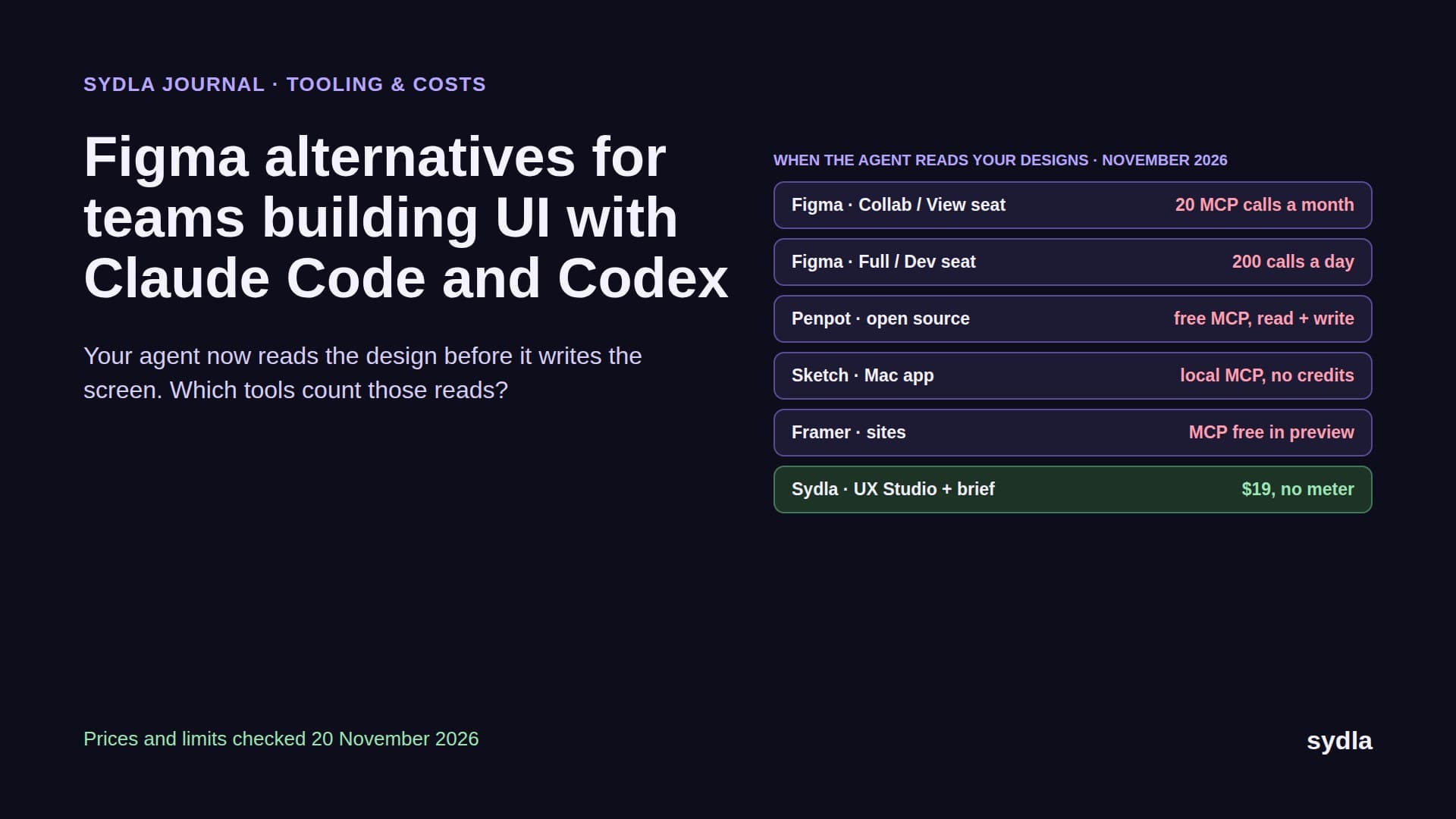
| Figma Professional, Full seat | $20.00 | 3,000 AI credits a month, no rollover; MCP reads capped per day | Screens and states |
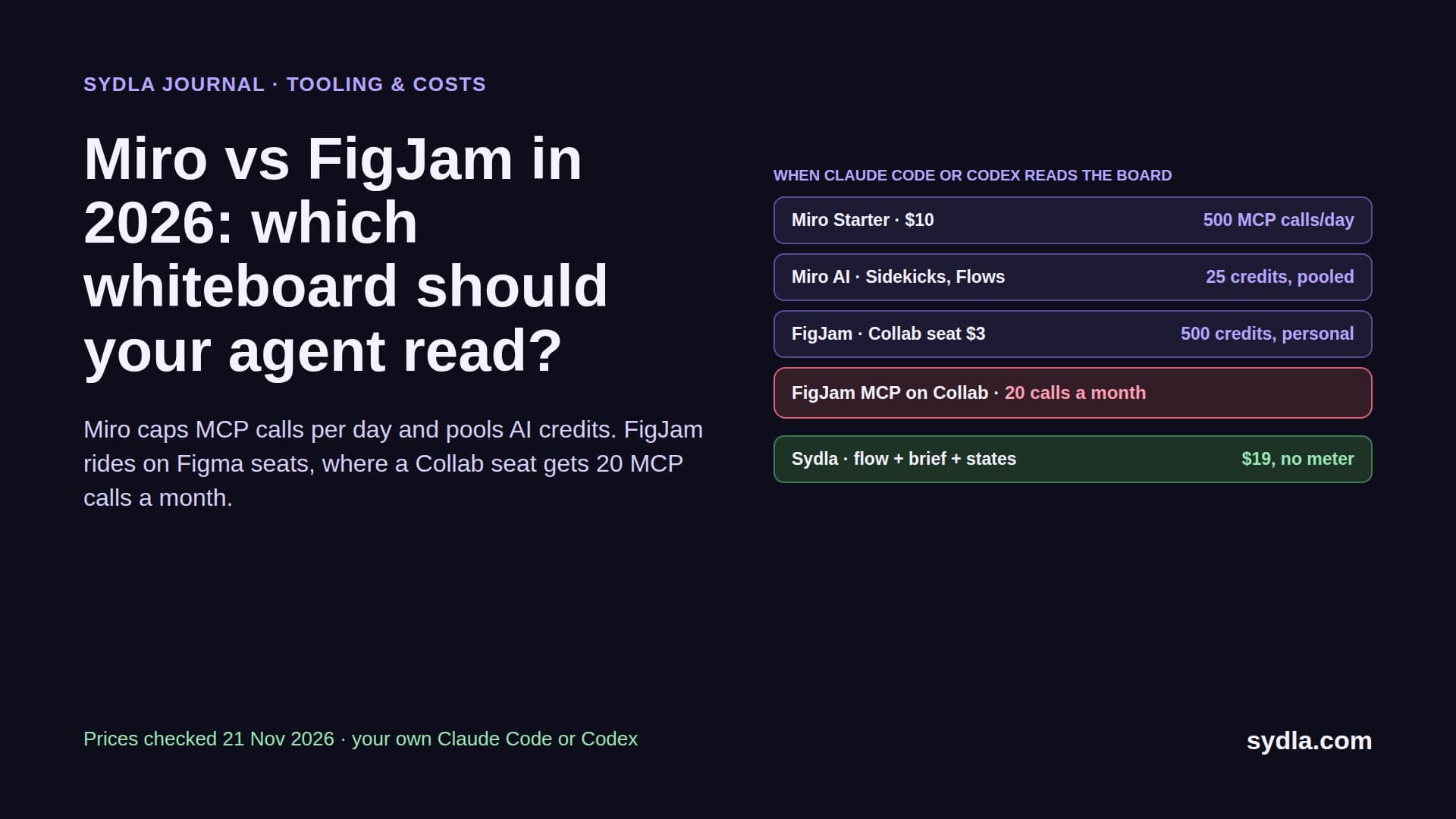
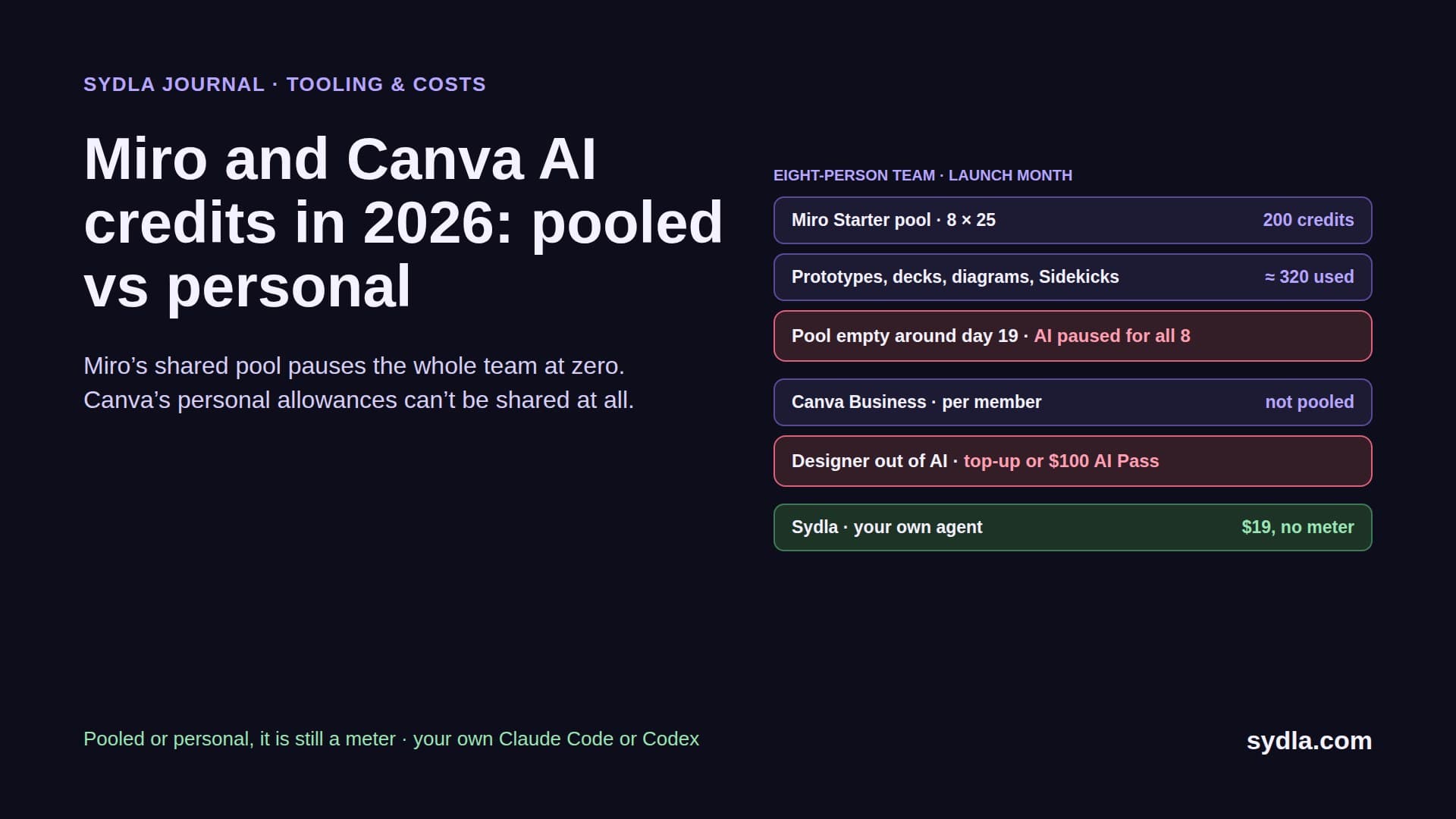
| Miro Starter | $10.00 | 25 credits per member, pooled; AI pauses at zero | Flows and diagrams |
| Canva Business | $25.00 | Per-member AI allowance, top-ups on Business | Launch visuals |
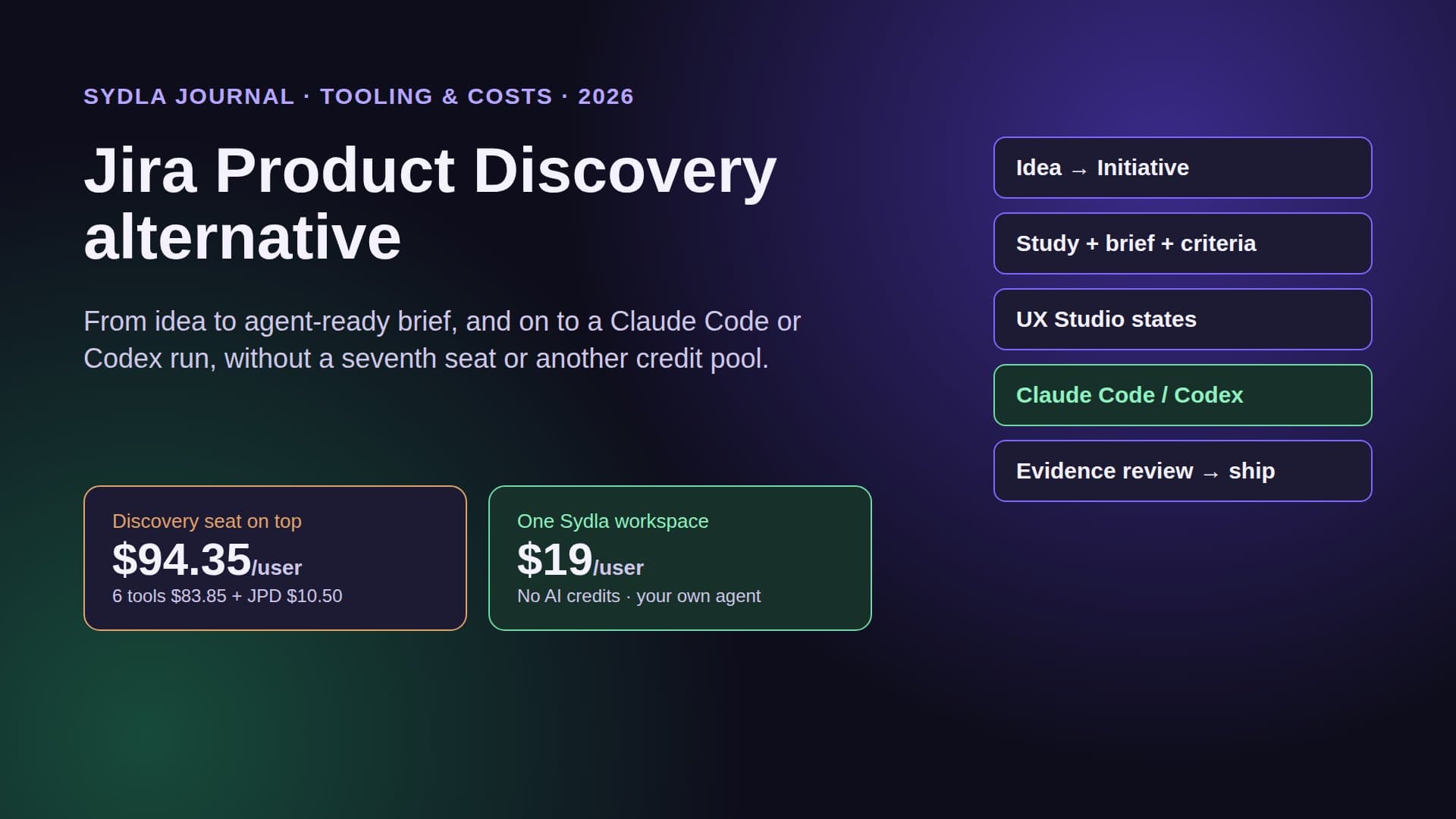
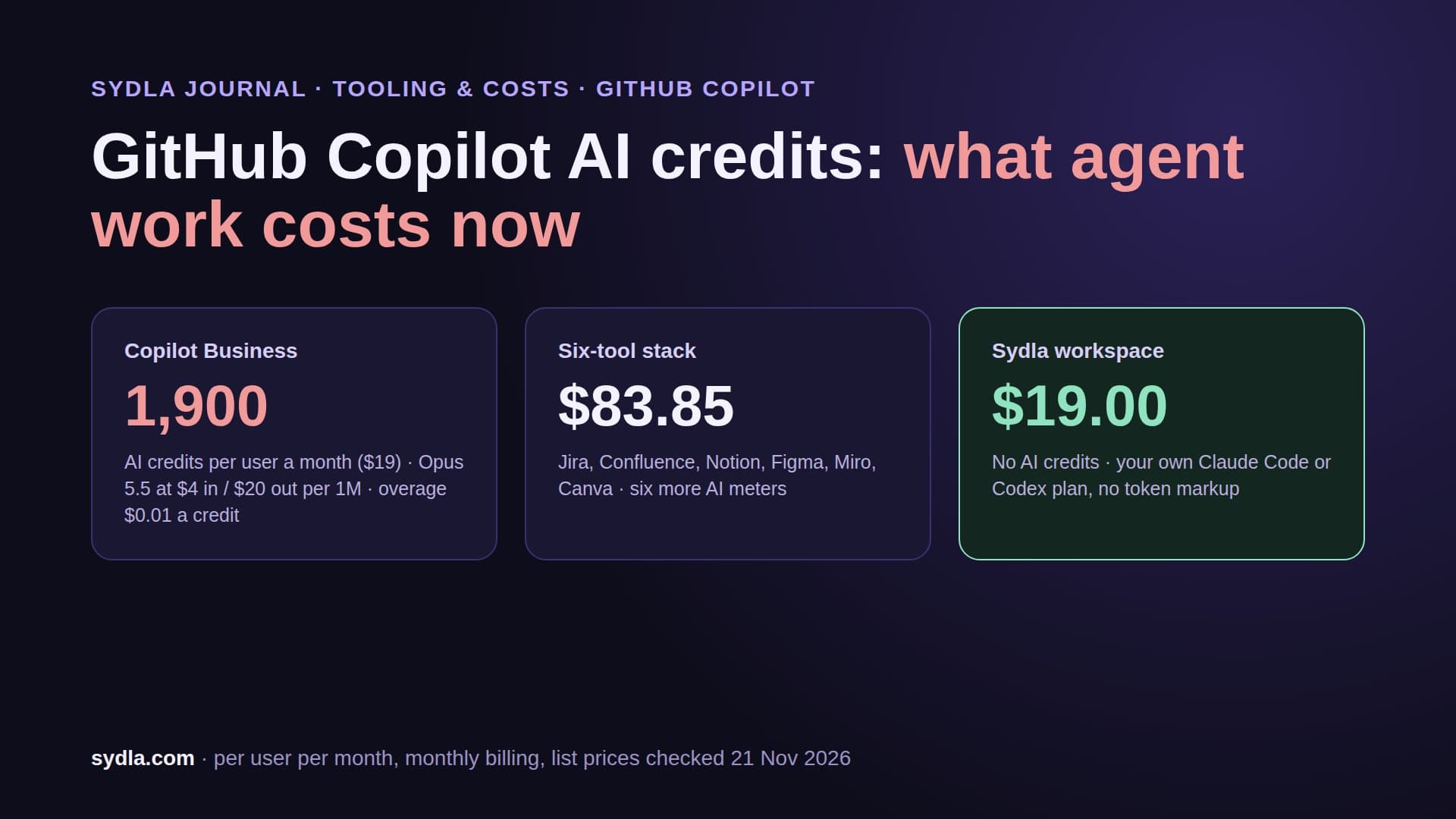
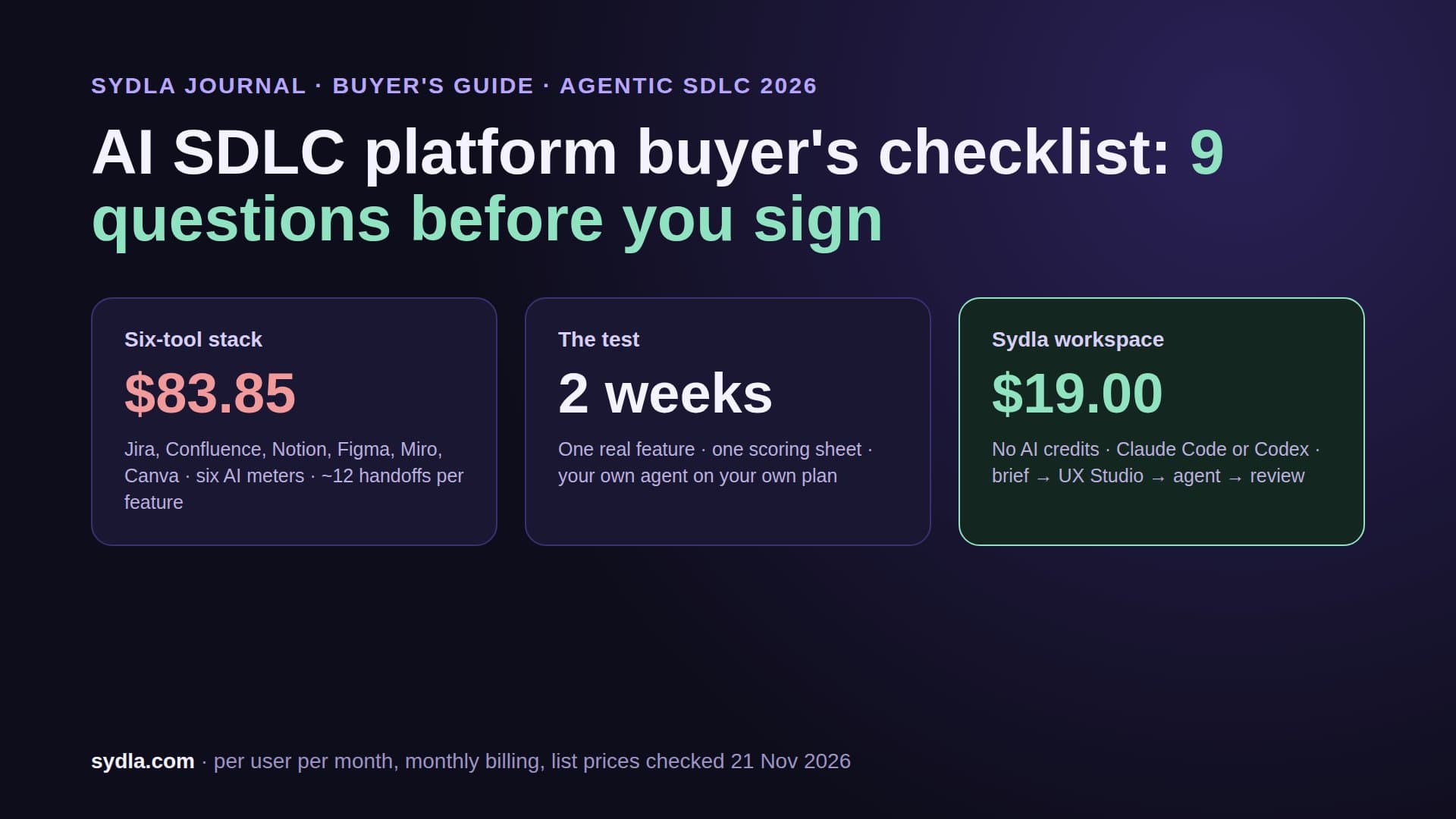
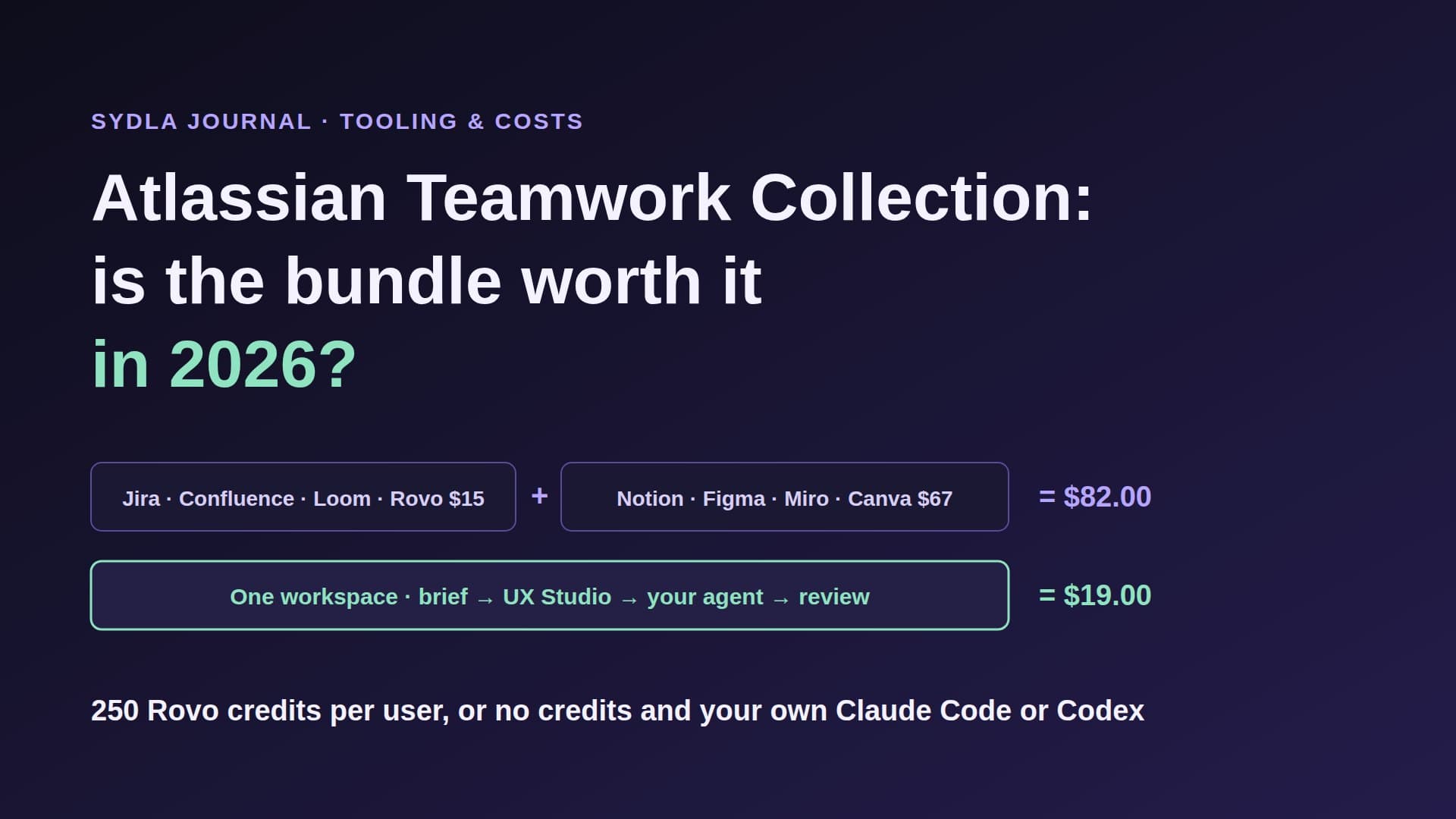
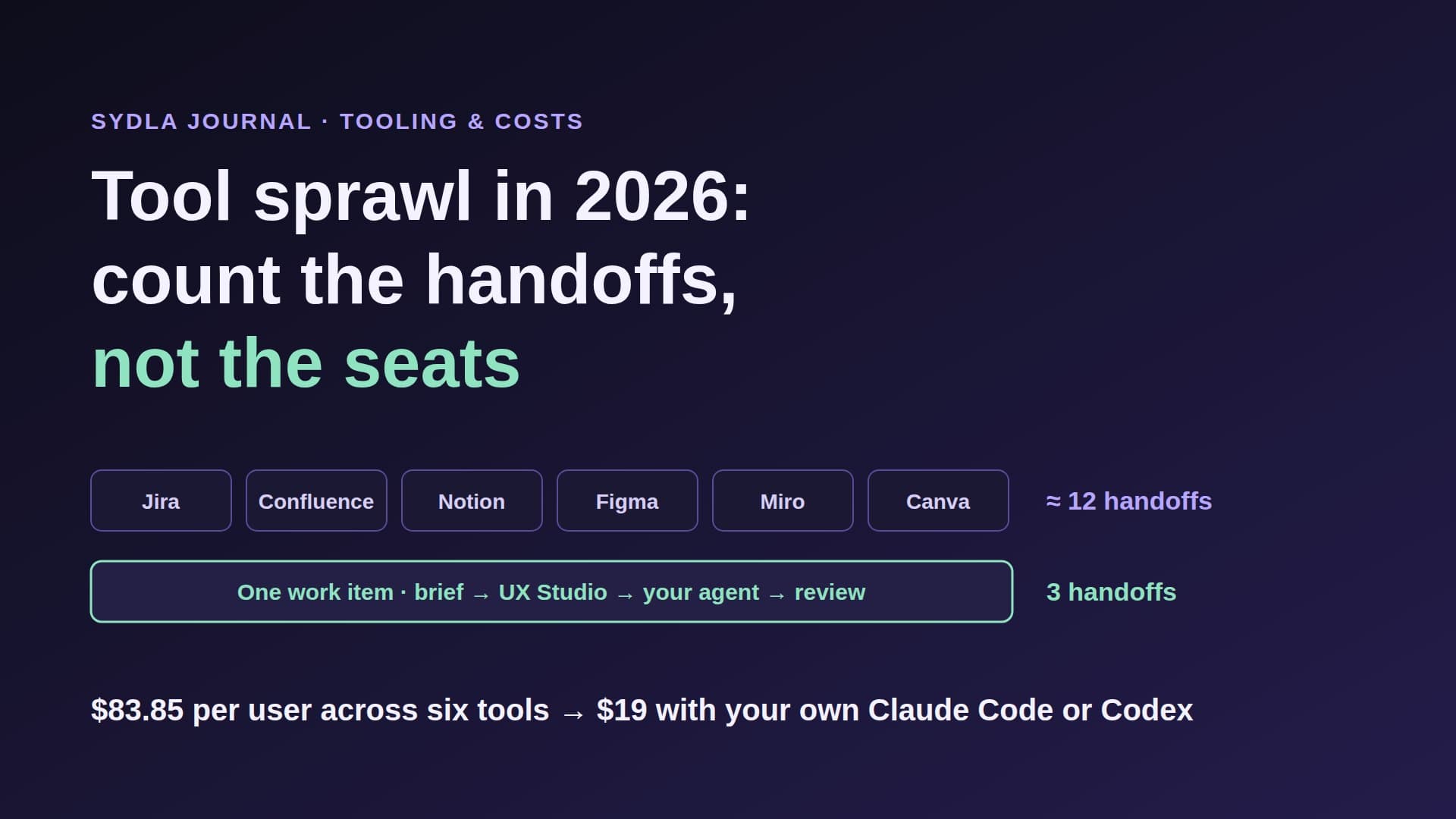
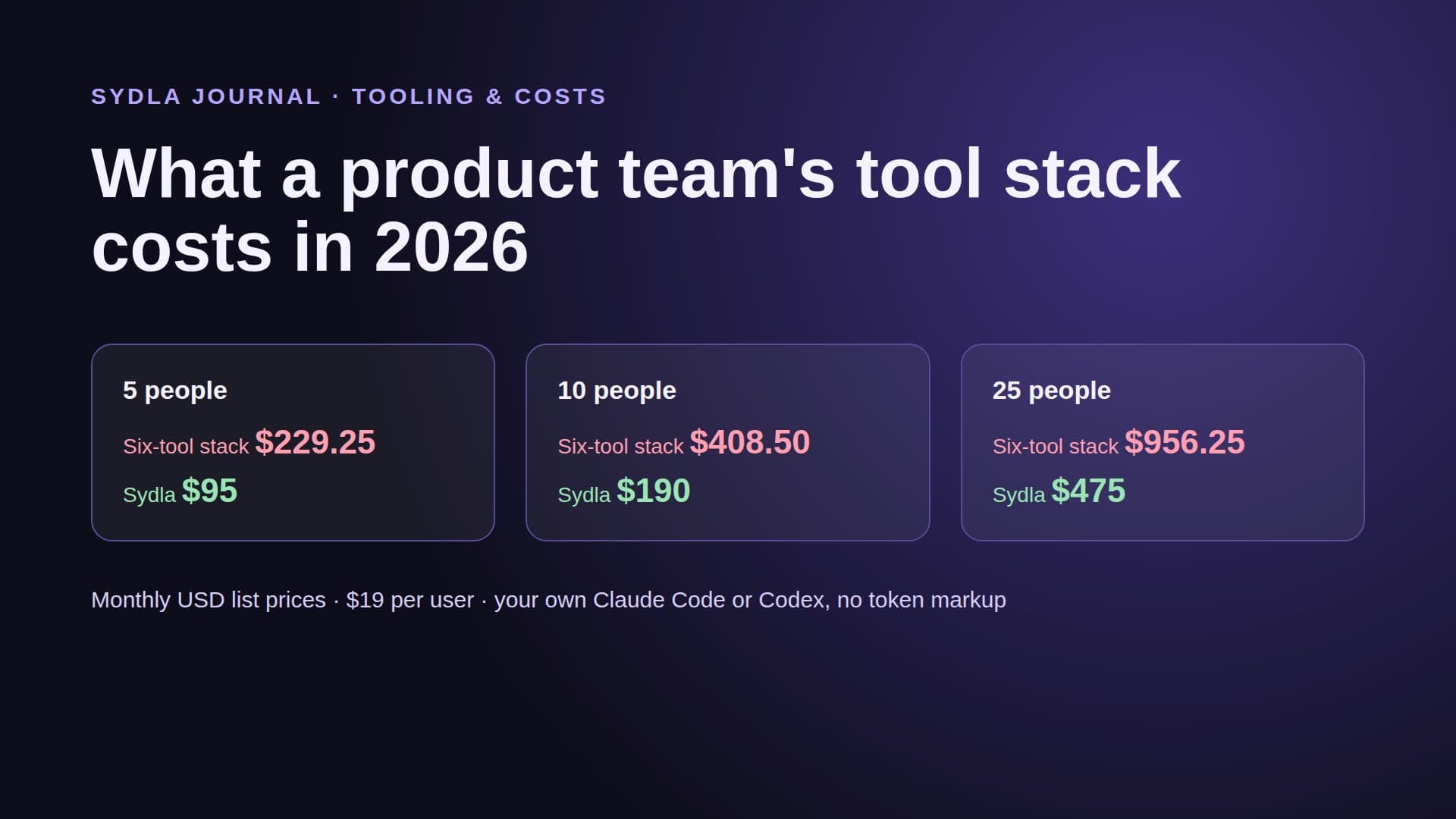
| Six-tool total | $83.85 | Six meters, plus Cursor's token meter for Claude or GPT | Six context hops per ticket |
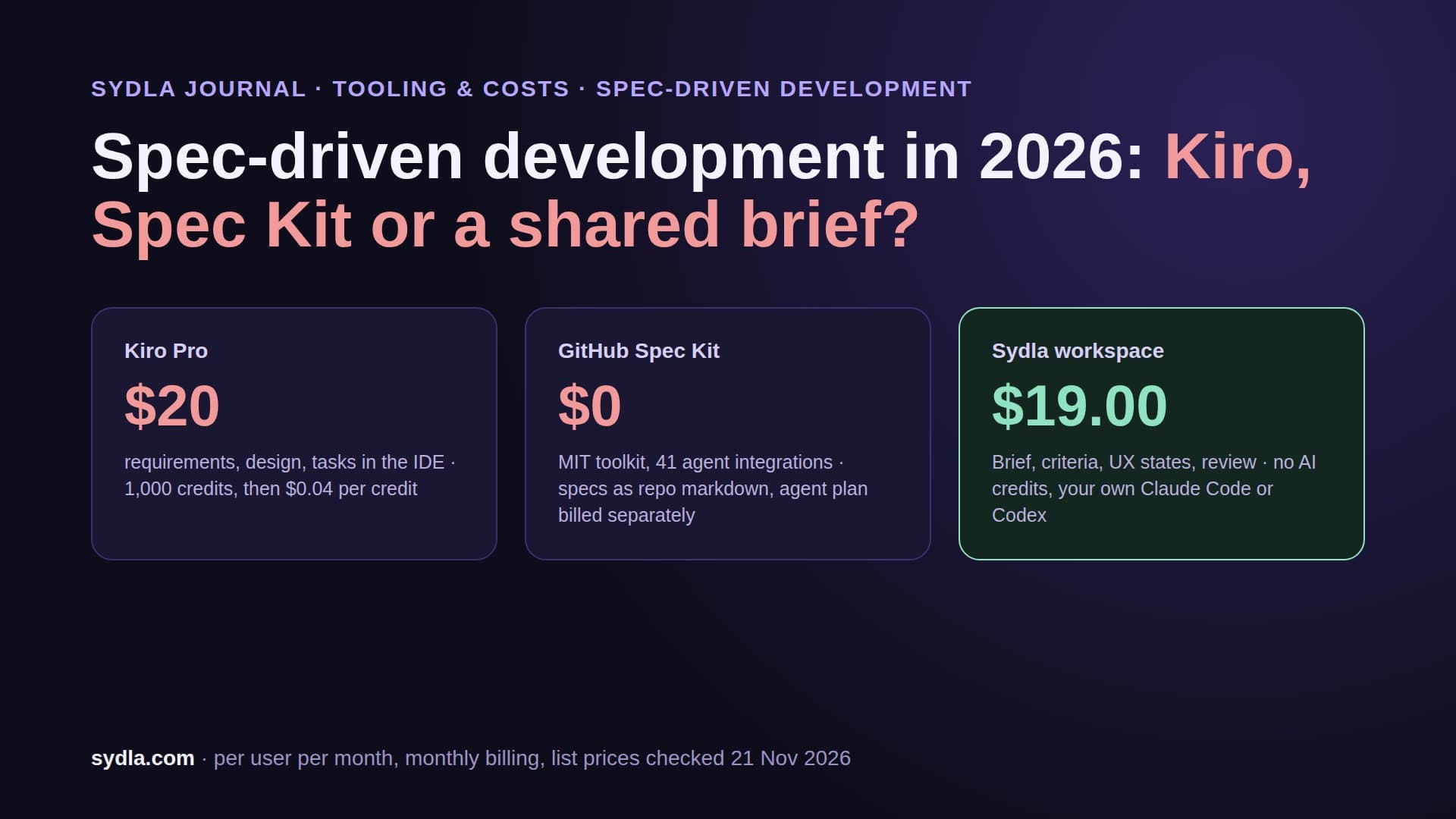
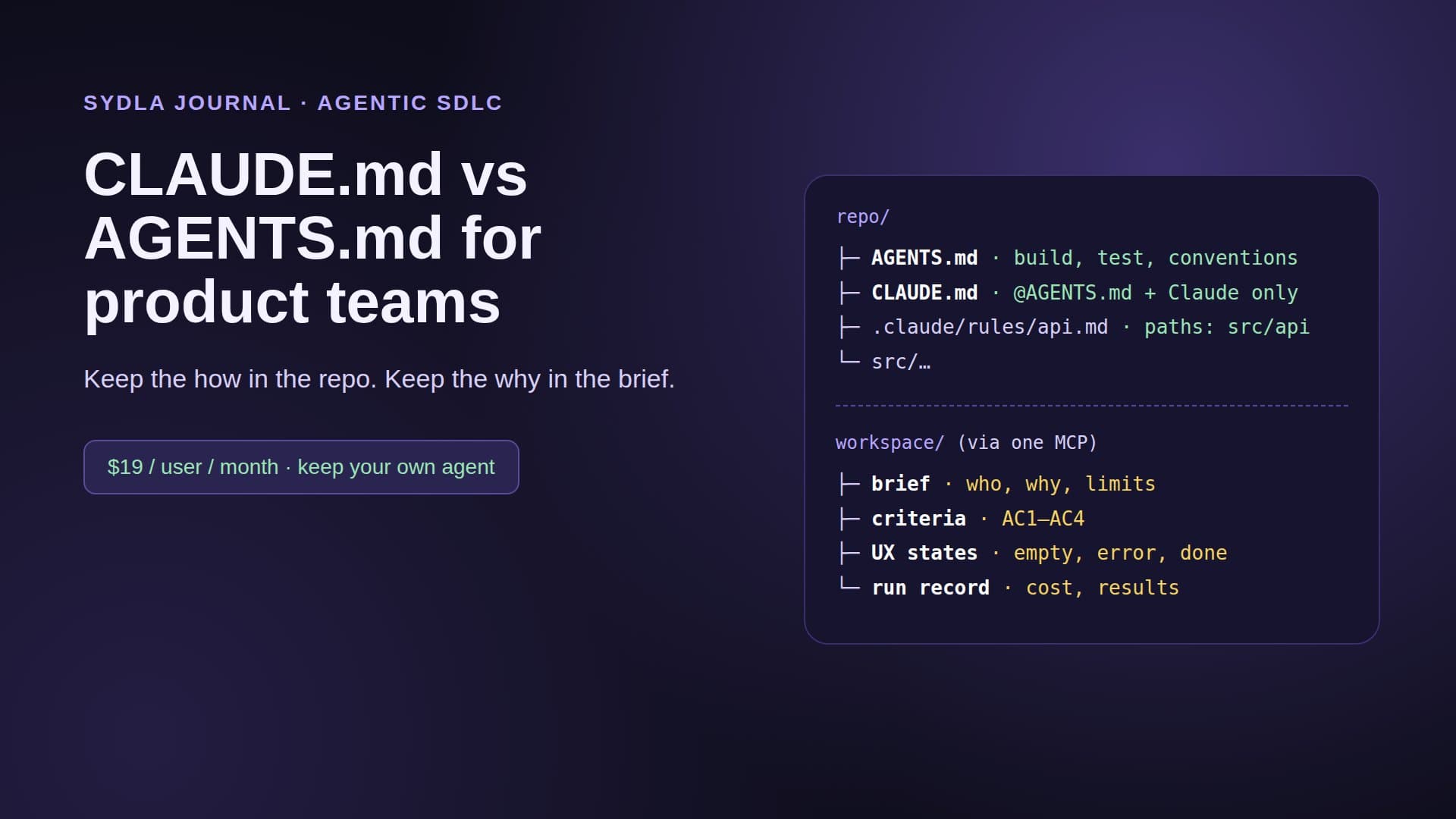
| [Sydla](/) | $19.00 | None: your own Claude Code or Codex plan pays for the model, with no token markup | One work item: brief, criteria, UX states, runs and evidence |
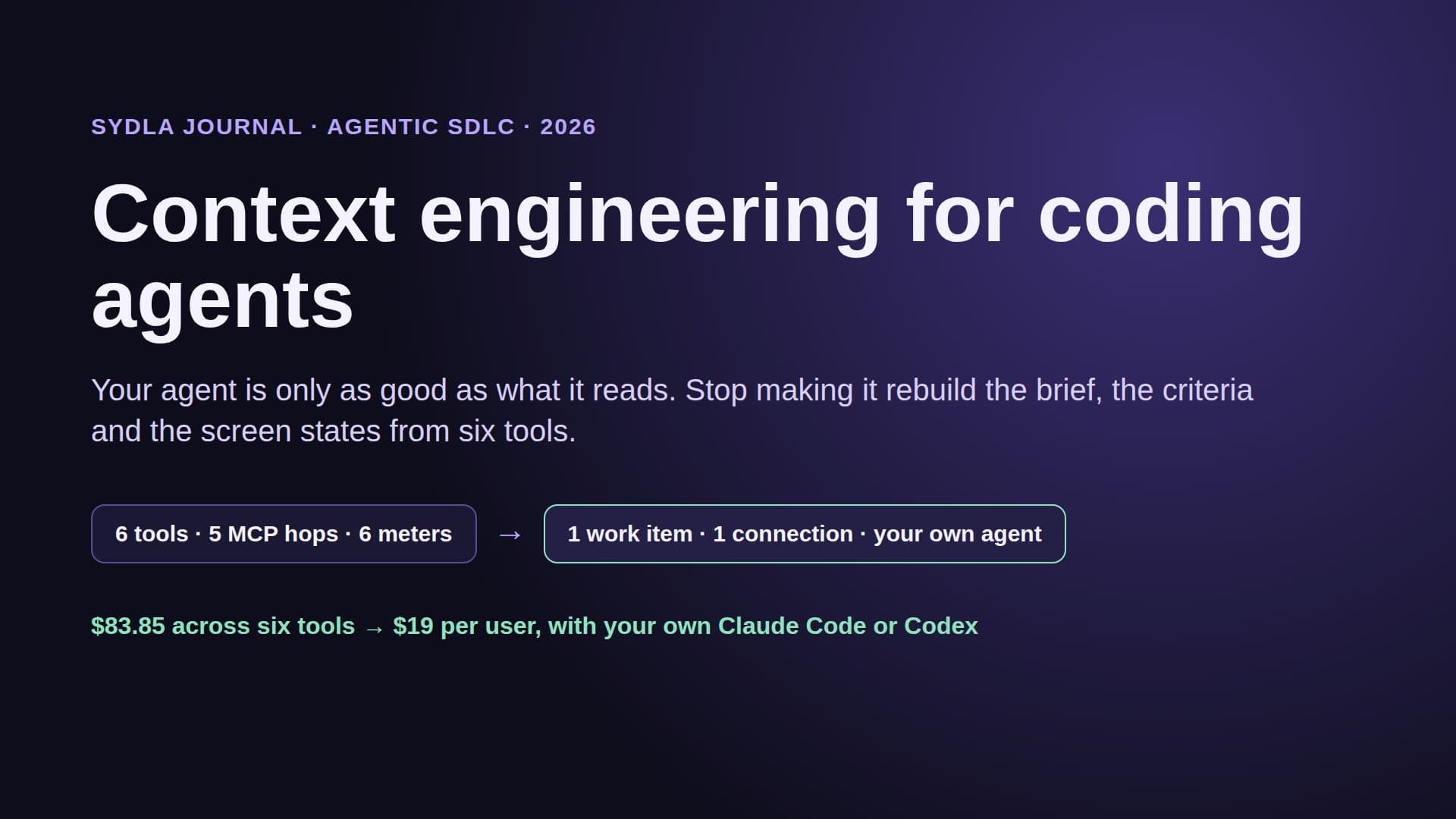
Sydla costs $64.85 per user per month less than the six-tool stack, before any editor or model spend. The pricing section lists every plan, and the full comparison is honest about where each specialist tool still wins. The meter is only half the cost. The other half is the context hop: each MCP server is another login, another rate limit and another place where the agent reads a stale copy. Our MCP servers guide counts those hops tool by tool.
Walkthrough: keep Claude Code or Codex on your own plan with Sydla Desktop
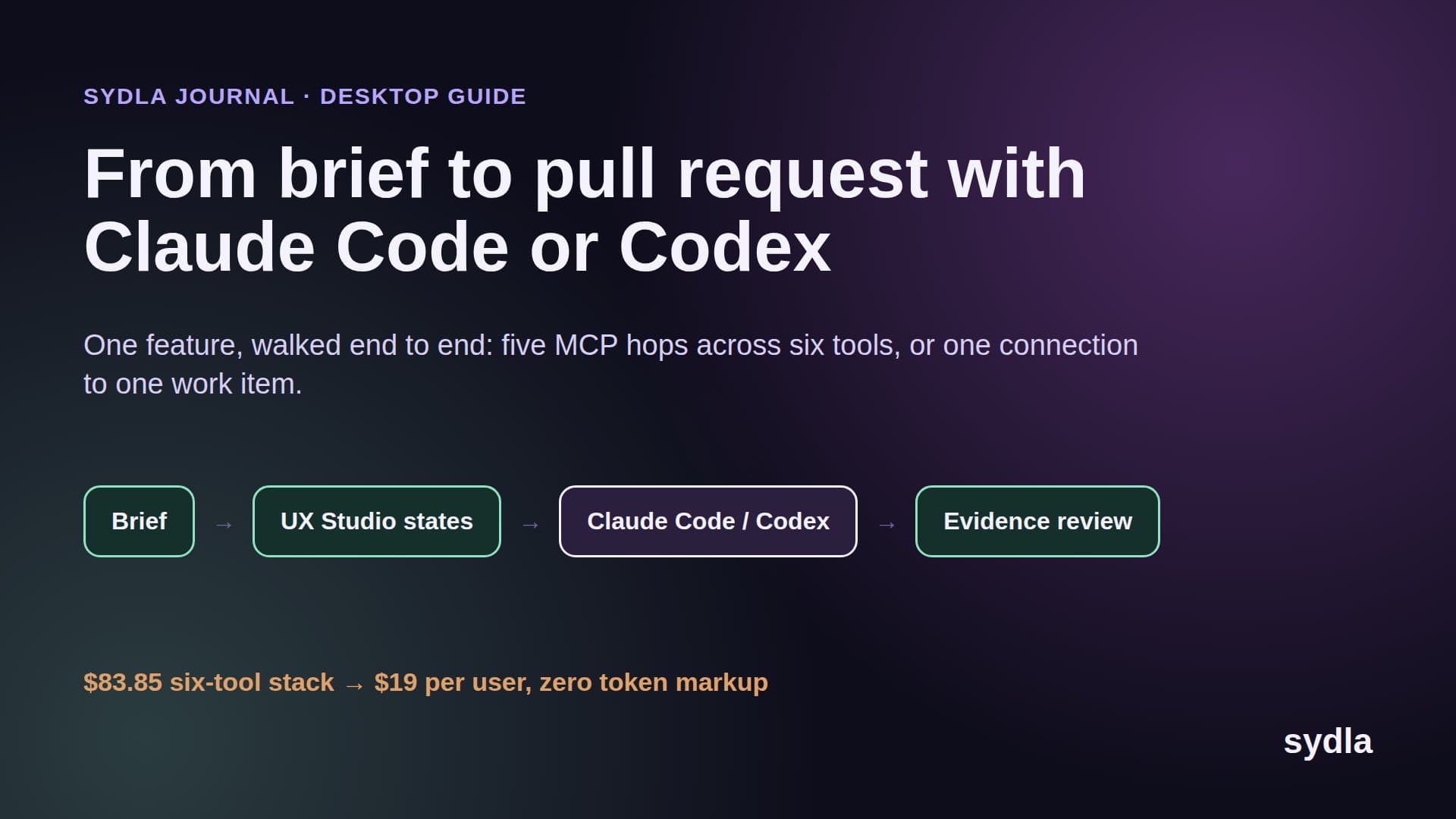
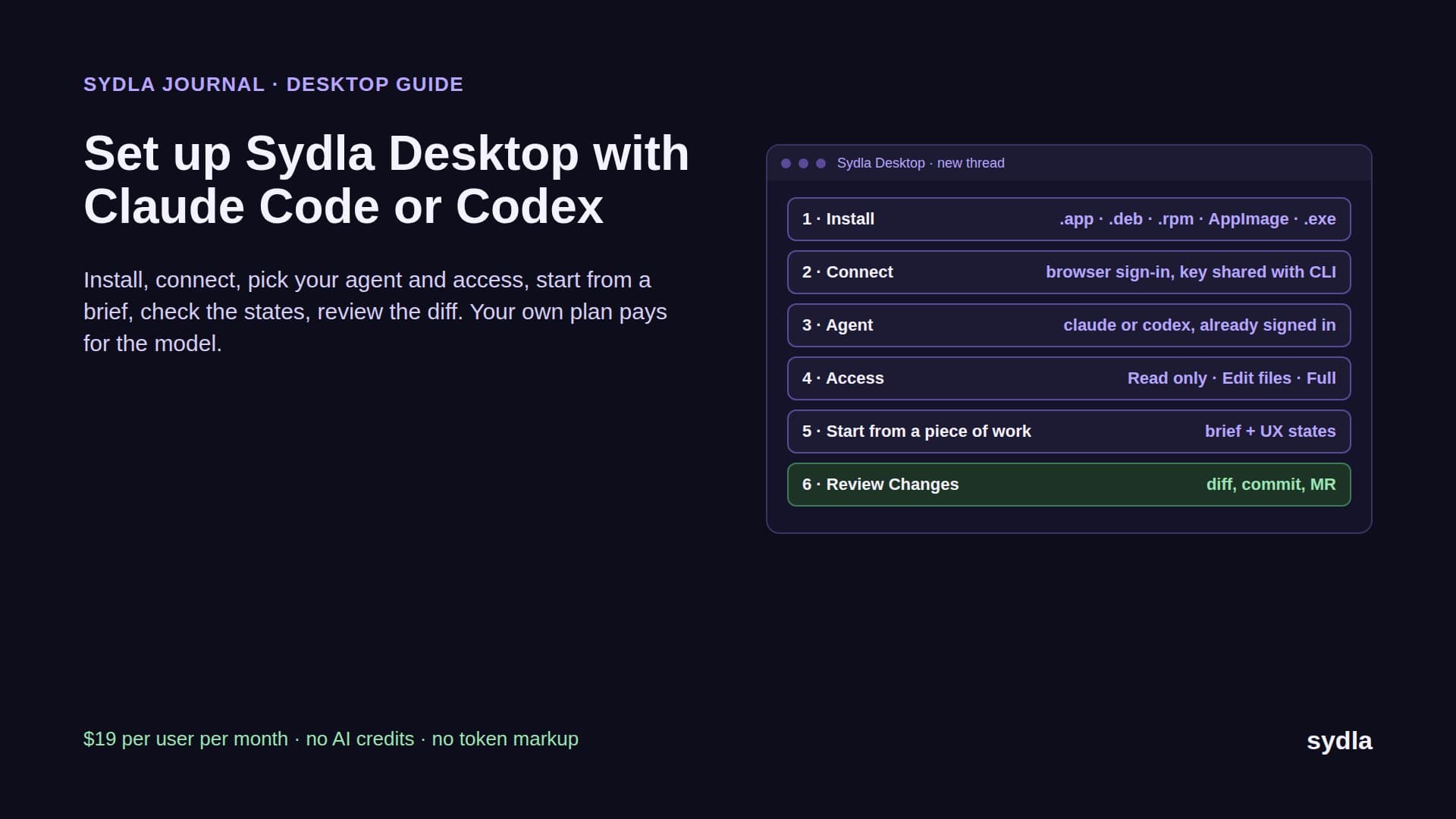
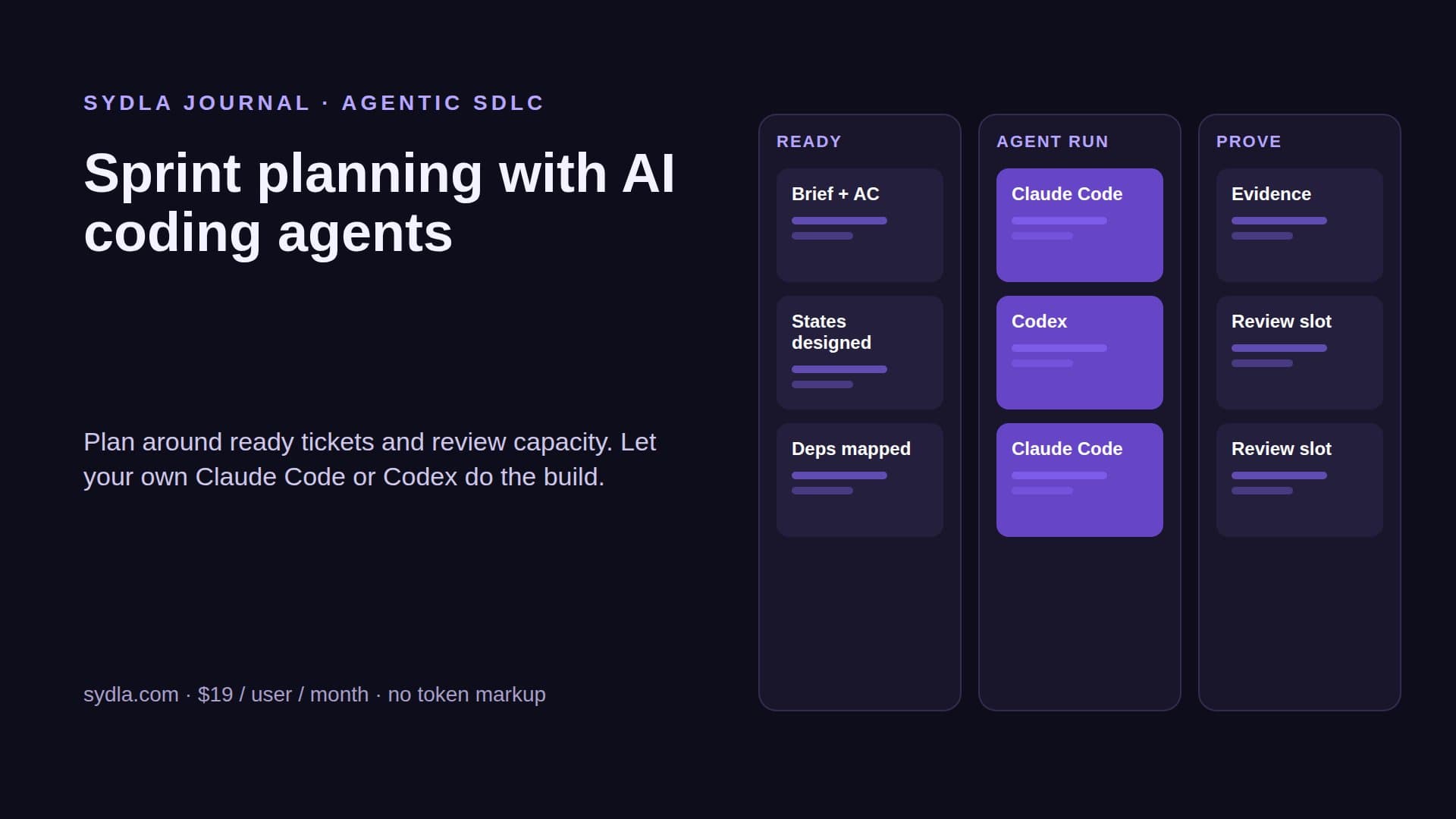
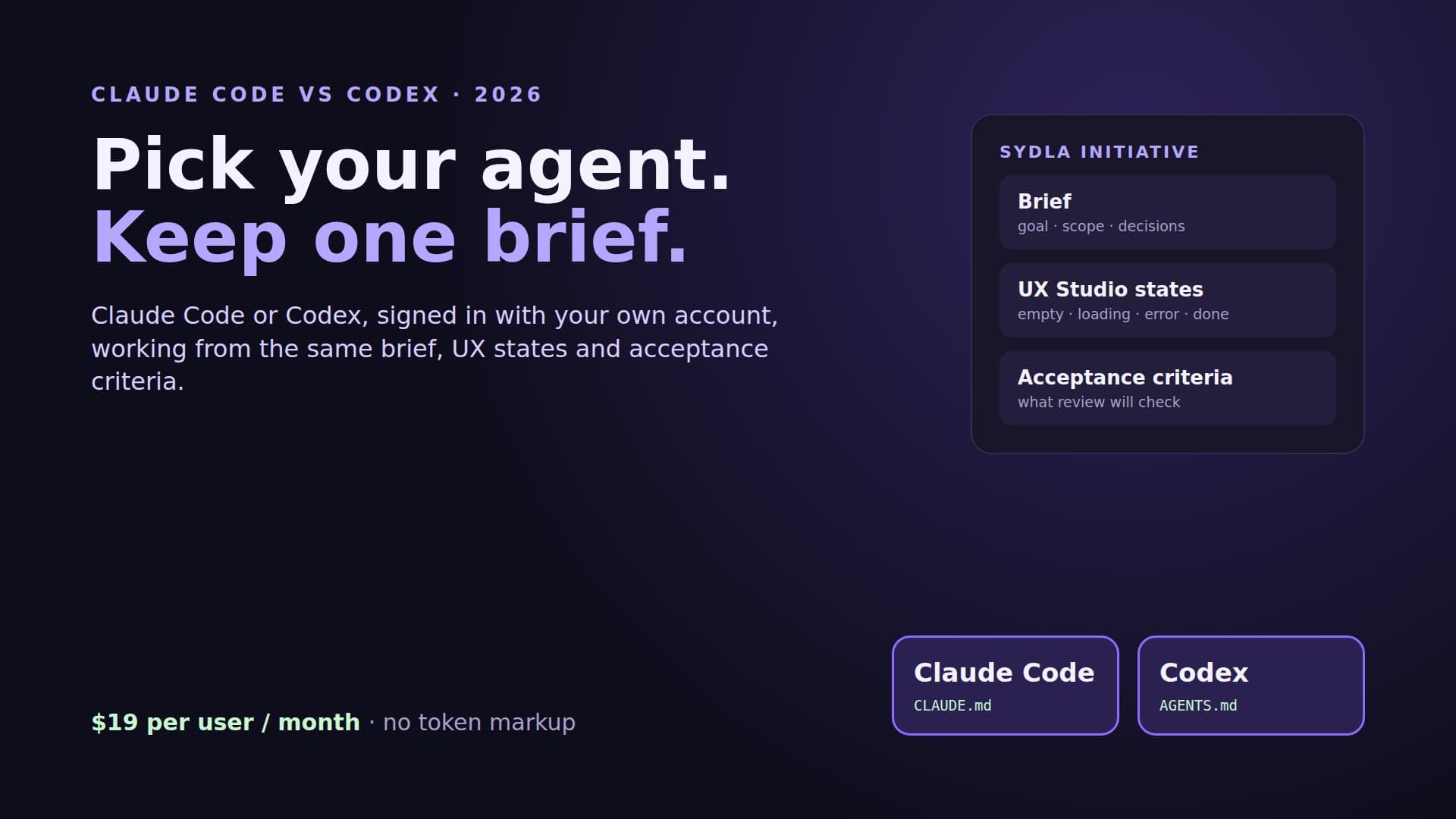
You do not have to choose between an editor you like and a model you trust. Keep Cursor, VS Code or any editor for reading and small edits. Let Claude Code or Codex do the agent work on the subscription you already pay for, started from a shared brief instead of a chat box. Here is the loop in Sydla:
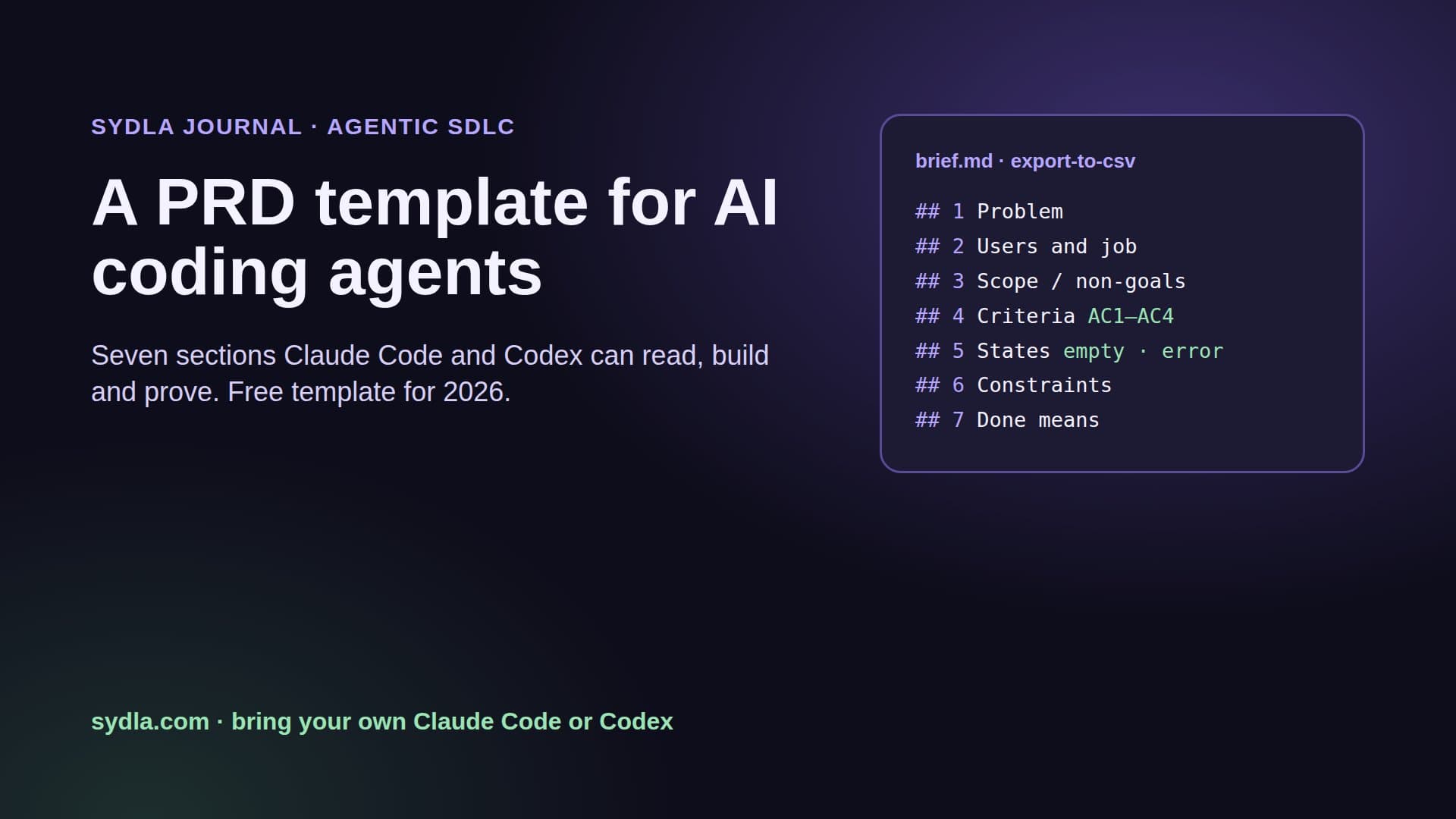
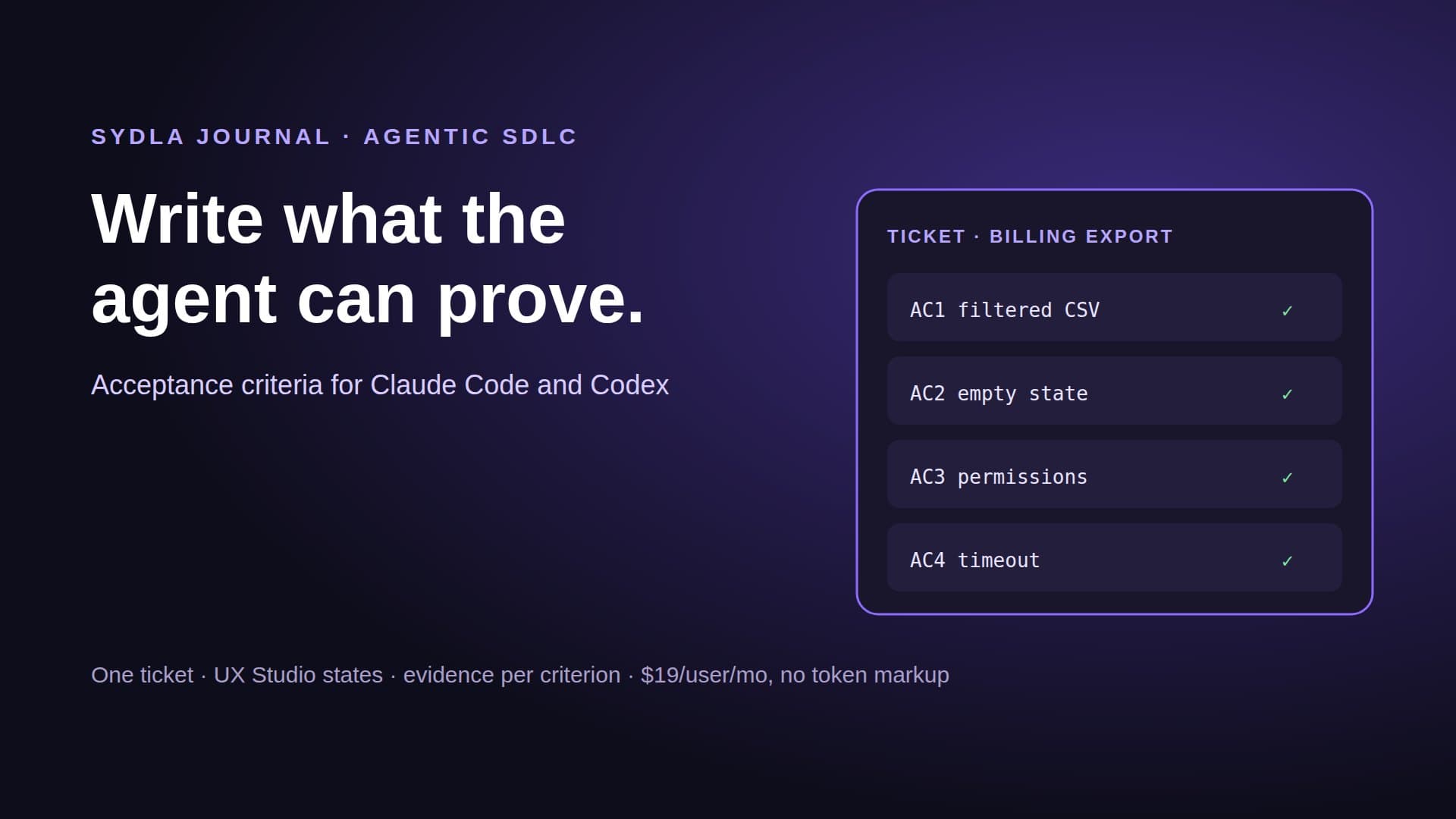
- Write the brief once. In Sydla Docs, record the goal, the users, what is out of scope and numbered acceptance criteria, such as: AC3, an admin who exports invoices with no rows gets the empty state with a date-range hint, not a blank CSV. The brief, the plan and its tickets sit in one initiative. Our PRD template for coding agents gives the seven sections that matter.
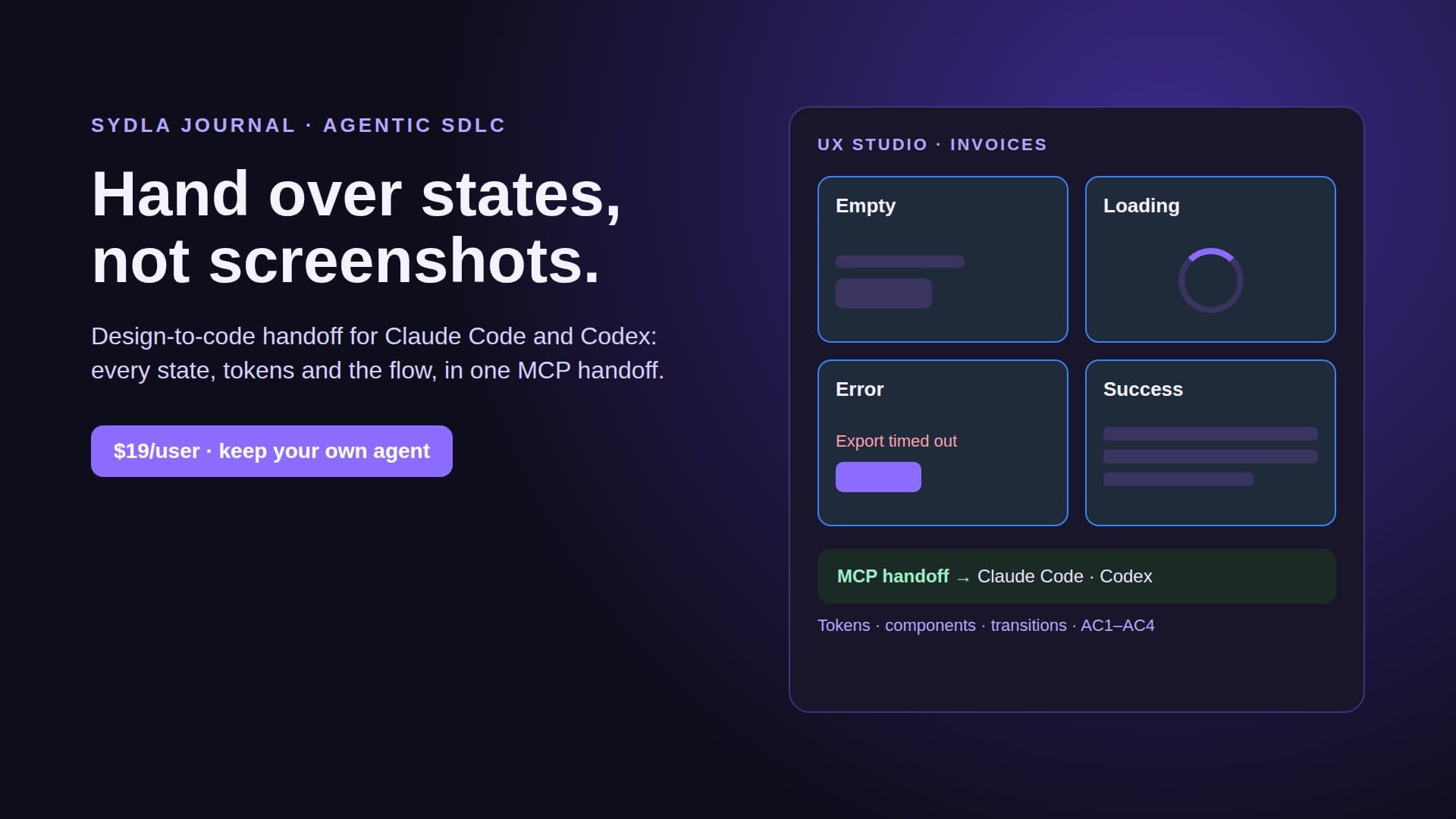
- Draw the states in UX Studio. Add the empty, loading, error, success and permission-denied screens next to the happy path, then publish the handoff on the same initiative. The agent reads states, not a screenshot.
- Open a thread in Sydla Desktop. Add your repository folder. Desktop matches its Git remote to your Sydla project, so a thread started from a piece of work opens in that folder on its own branch. It starts the Claude Code or Codex CLI already signed in on your machine, with your own plan and limits. Choose Read only to frame the change, Edit files to implement it, or Full access.
- Let the agent read the initiative, not your clipboard. Through one Sydla MCP connection, the agent opens the brief, the criteria and the UX handoff. It edits, runs the tests and opens the local dev server in its own headless browser to check each state against the design.
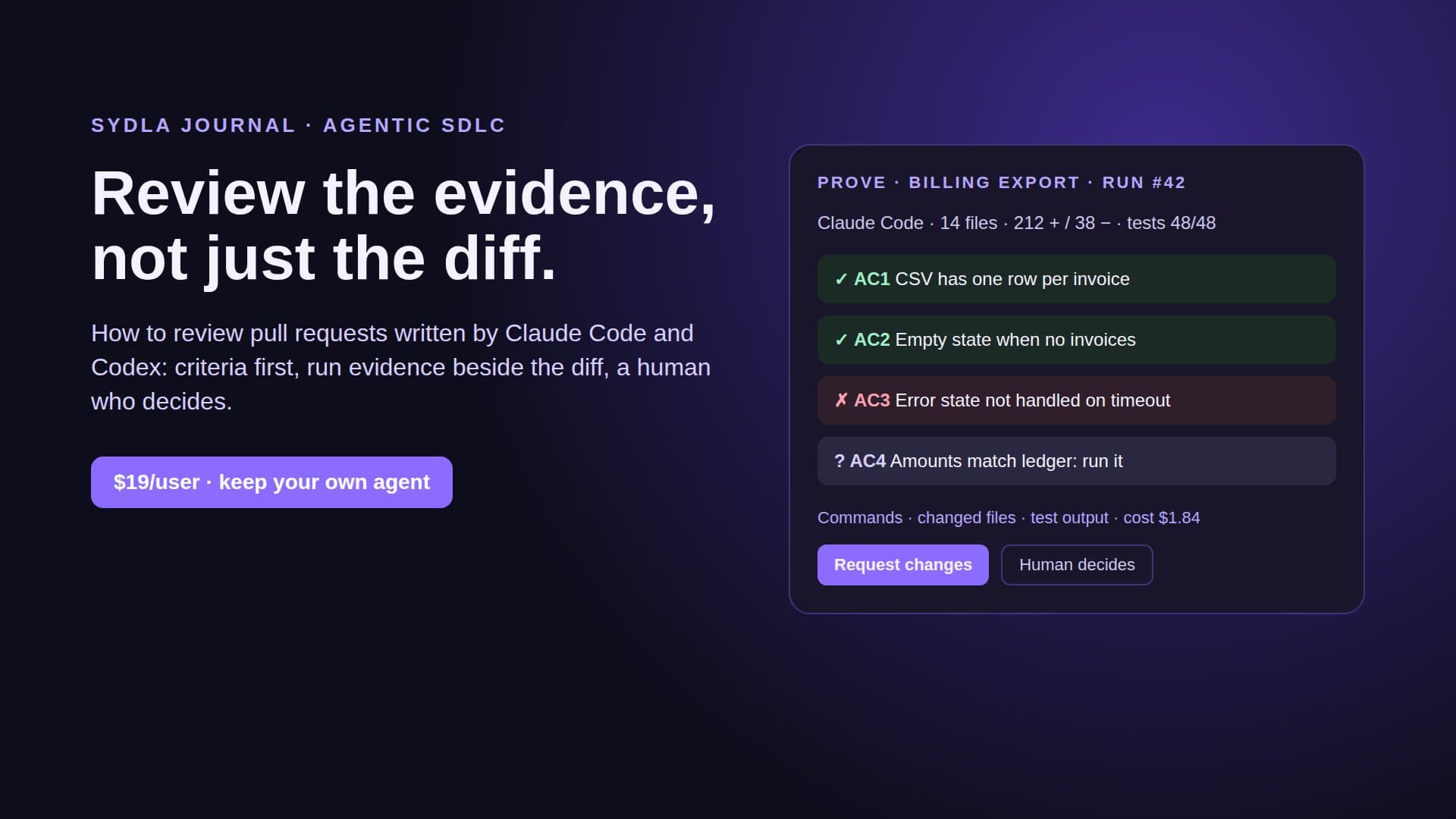
- Review the evidence, then decide. The thread shows every command and tool call, and Changes shows the diff against the last commit. Check it against the criteria and the states, commit on the thread's branch and ship through your normal review. A person makes the gate decision, never the agent. The AI pull request review guide has the four-pass checklist.
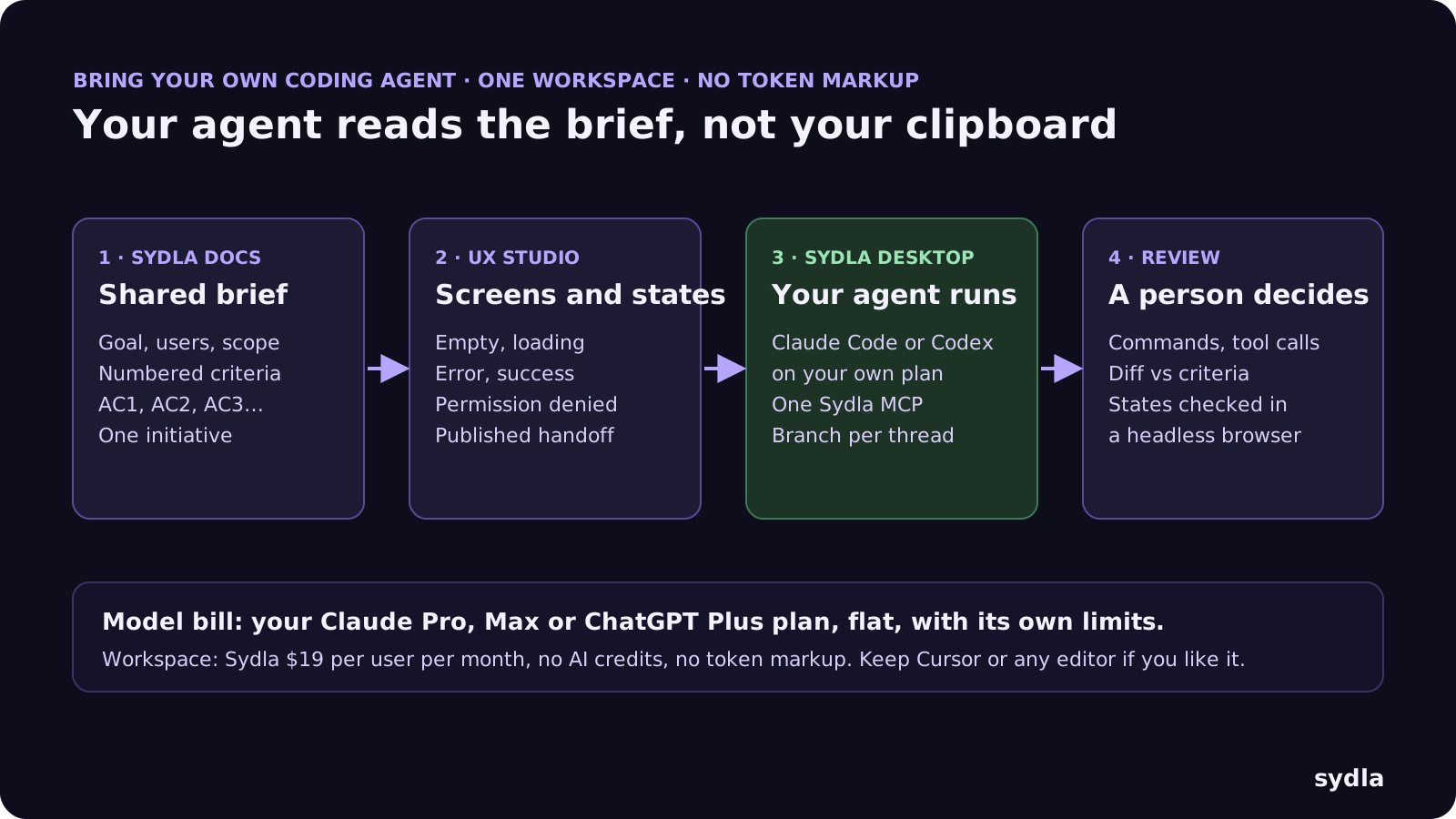
The money changes at step three. The model bill is your Claude or ChatGPT plan, flat, with its own usage limits. Sydla sells no AI credits and adds no markup. If Claude Code is new to your team, the Desktop guide covers installation, and Claude Code vs Codex for product teams helps you pick one, or both.
Which setup fits which team
There is no single right answer. It depends on which models you use and how much you run them:
- You mostly use Grok or Composer: Cursor Premium at $30 is good value. The weekly pool covers a lot of work, and Bugbot and Cloud Agents come with it.
- You are on legacy Pro and use Claude daily: stay on legacy Pro for now. Switching is permanent and moves your Claude work to a token meter.
- Your team standardised on Claude or GPT: run Claude Code or Codex on your own plan. Keep Cursor as an editor if people like it, but stop paying per token, and the $0.25 Teams rate, for the same model.
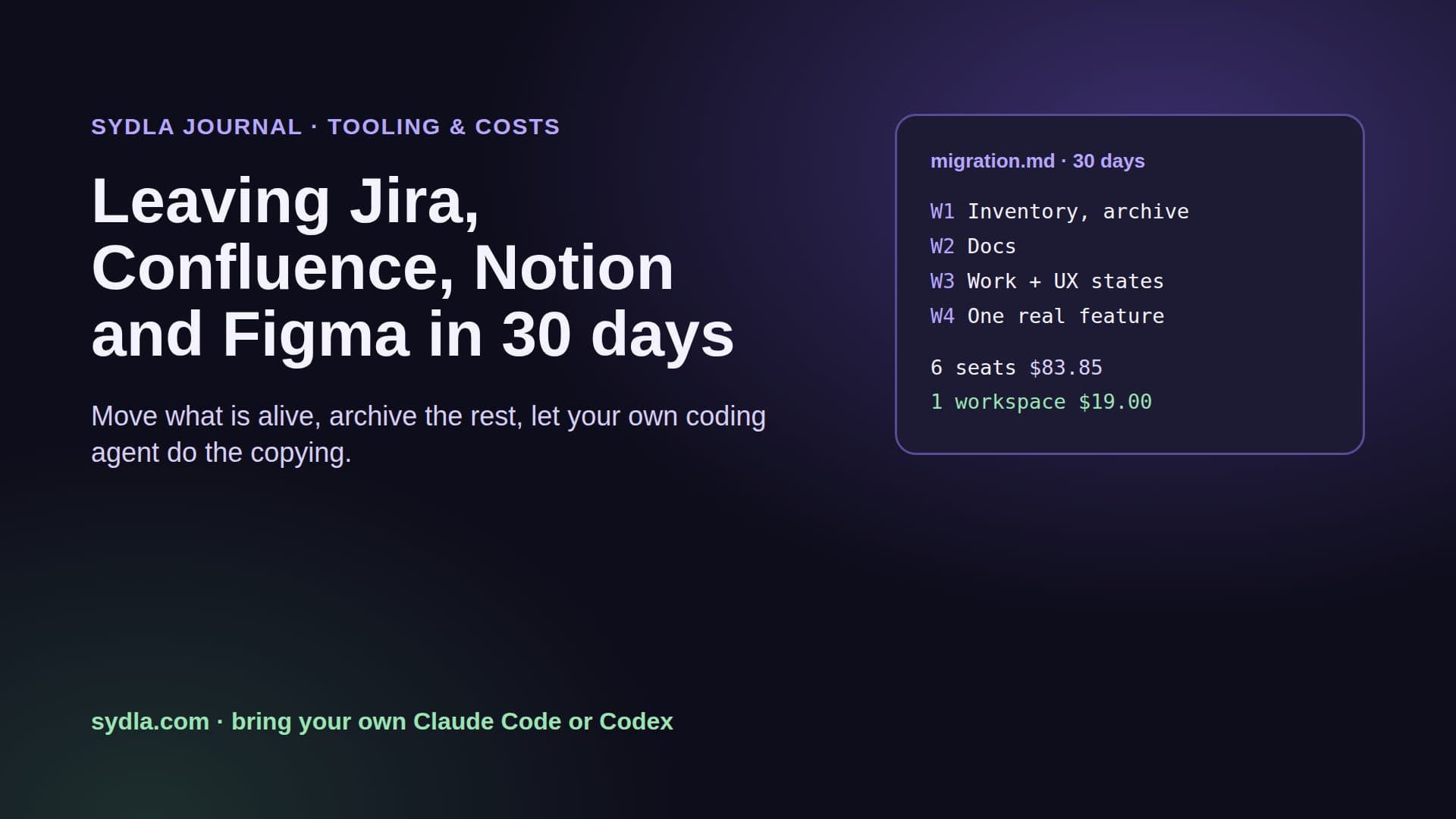
- You are paying for six tools plus an editor: move the brief, the plan, the states and the agent runs into one workspace. The 30-day migration plan shows what to move first, and the solo founder stack guide does the yearly maths for a team of one.
Keep the model. Drop the meter.
Cursor's move is a reasonable business decision: its own models are included, everyone else's are sold at cost. But for a team whose agent work runs on Claude or GPT, it turns a flat line into a token meter that grows with every cached file the agent re-reads.
Pick the next feature your team was going to build in Cursor. Write its brief and states in Sydla this week, open a Desktop thread, and let your own Claude Code or Codex build it. Start your $19/mo AI SDLC workspace and keep your Claude Code and Codex accounts exactly as they are.
Frequently asked questions
How much does Cursor cost in 2026?
New Cursor plans are sold as The X Subscription: Free, Plus at $8 a month, Premium at $30, Super at $100 and Ultra at $200, with annual prices of $80, $300, $1,000 and $2,000. Teams costs $30, $100 or $200 per seat. Each paid plan includes a weekly usage pool for Cursor's own models, Grok and Composer. Claude, GPT and Gemini are billed separately at API list price on Premium and above.
Is Claude included in Cursor's X Subscription?
No. On The X Subscription, third-party models such as Claude, GPT and Gemini are not part of the included pool. On Premium and above you can use them from the first request at the model's API list price, paid from prepaid credit, for example $2 per million input tokens and $10 per million output tokens for Claude Sonnet 5.5. Plus and Free cannot use third-party models at all.
What is the Cursor Token Rate?
On Cursor Teams and Enterprise plans, eligible third-party model requests carry a Cursor Token Rate of $0.25 per million tokens on top of the API price. It applies to input, output and cached tokens, including requests with your own API key. Cursor's own models and models whose cache-read price is strictly below $0.10 per million tokens are exempt. Individual plans do not pay it.
Should I switch from Cursor legacy Pro to Premium?
Only if you mainly use Cursor's own models. Premium at $30 includes at least twice the Cursor-model usage of legacy Pro at $20, but drops the included allowance for Claude and GPT, which are then billed per token. Cursor says switching is permanent and cannot be undone, and legacy plans keep working unless you change or cancel them.
How can I use Claude Code without paying per token?
Claude Code is included in Claude Pro at $20 a month, or $17 billed yearly, and in Max at $100 and Ultra at $200, each with usage limits instead of a per-token bill. Codex is included in ChatGPT Plus at $20. Sydla Desktop runs those CLIs on your own plan, connected to a shared brief and UX states, for $19 per user per month with no AI credits and no token markup.