How to review AI-generated pull requests: check the evidence, not just the diff
When Claude Code or Codex writes the pull request, the reviewer becomes the bottleneck and the last line of defence. Here is a four-pass review method for agent-built changes, what the 2026 AI review bots cost per pull request, and how to review against the brief, the states and the run evidence in one place.

The agent wrote it in twenty minutes. Who reads it?
A coding agent can turn a clear ticket into a pull request of a few hundred lines before the reviewer has finished their coffee. That is the good news. The bad news is that review time did not shrink with it. A person still has to decide whether the change does what was asked, nothing more, and nothing dangerous, and agents produce more changes than any team used to review.
The usual response in 2026 is to add another AI. Claude Code, Codex, GitHub Copilot and Atlassian all sell an automated reviewer that comments on pull requests. They catch real bugs, and they are worth running. But each one is a new meter on top of the six tools most teams already pay for, and none of them knows what the change was supposed to do unless that intent is written down somewhere the reviewer can read.
This guide is about the human side of the review: what to check, in what order, and what the agent should hand you so you can check it quickly. It builds on our guides to acceptance criteria for AI coding agents and sprint planning with AI coding agents, where review capacity is the number the sprint is planned around.
Why agent pull requests need a different review
Reviewing a colleague's pull request relies on trust built over time. You know how they work, what they tend to miss and that they ran the thing before asking. An agent's pull request breaks those assumptions in four ways.
- It is confidently complete. The description says every requirement is handled, the tests pass and the code is tidy. Fluency is not evidence. The agent may have tested the happy path it wrote, not the behaviour you asked for.
- It fills gaps with guesses. Where the brief was silent, the agent chose. Most guesses are reasonable; the expensive ones are in error handling, permissions and the states nobody designed.
- It changes more than it needs to. Agents rename, refactor and "tidy" nearby code, and occasionally weaken or delete a test that got in the way. Scope creep hides real changes in noise.
- It is plausible line by line. Each hunk reads well in isolation. Problems sit between files: a check added in the UI but not the API, a migration without a rollback, a new dependency nobody approved.
So the reviewer's job moves up a level. Instead of reading every line from the top, start from the intent, check the evidence the run produced, read the risky parts closely and run the change yourself. That order catches the costly problems first and keeps the review to about thirty minutes for a typical change.
A four-pass review for AI-generated pull requests
This is the review method we use at Sydla for changes built by Claude Code or Codex. The times are for a medium change of a few hundred lines; scale them up for migrations, billing or security work.
- Pass 1, intent (2 minutes). Before opening the diff, read the brief and the acceptance criteria. Write down what a correct change must do and must not touch. If the ticket has no checkable criteria, stop: the review cannot pass or fail anything, and the fix is upstream.
- Pass 2, evidence (5 minutes). Read what the run did, not what it says it did: the commands it ran, the tests it executed and their output, the files it changed and, for each criterion, the proof it offers. A criterion with no evidence counts as unproven, however confident the summary sounds.
- Pass 3, risk (15 minutes). Now read code, but not top to bottom. Go straight to authentication and permissions, money and data handling, database migrations, deleted or weakened tests, new dependencies and anything outside the ticket's scope. Let an AI review bot cover style and the obvious bugs.
- Pass 4, run it (10 minutes). Check out the branch and walk through every designed state: empty, loading, error and success, plus the edge case someone raised in planning. Agents most often skip the error state, and only running the change shows it.
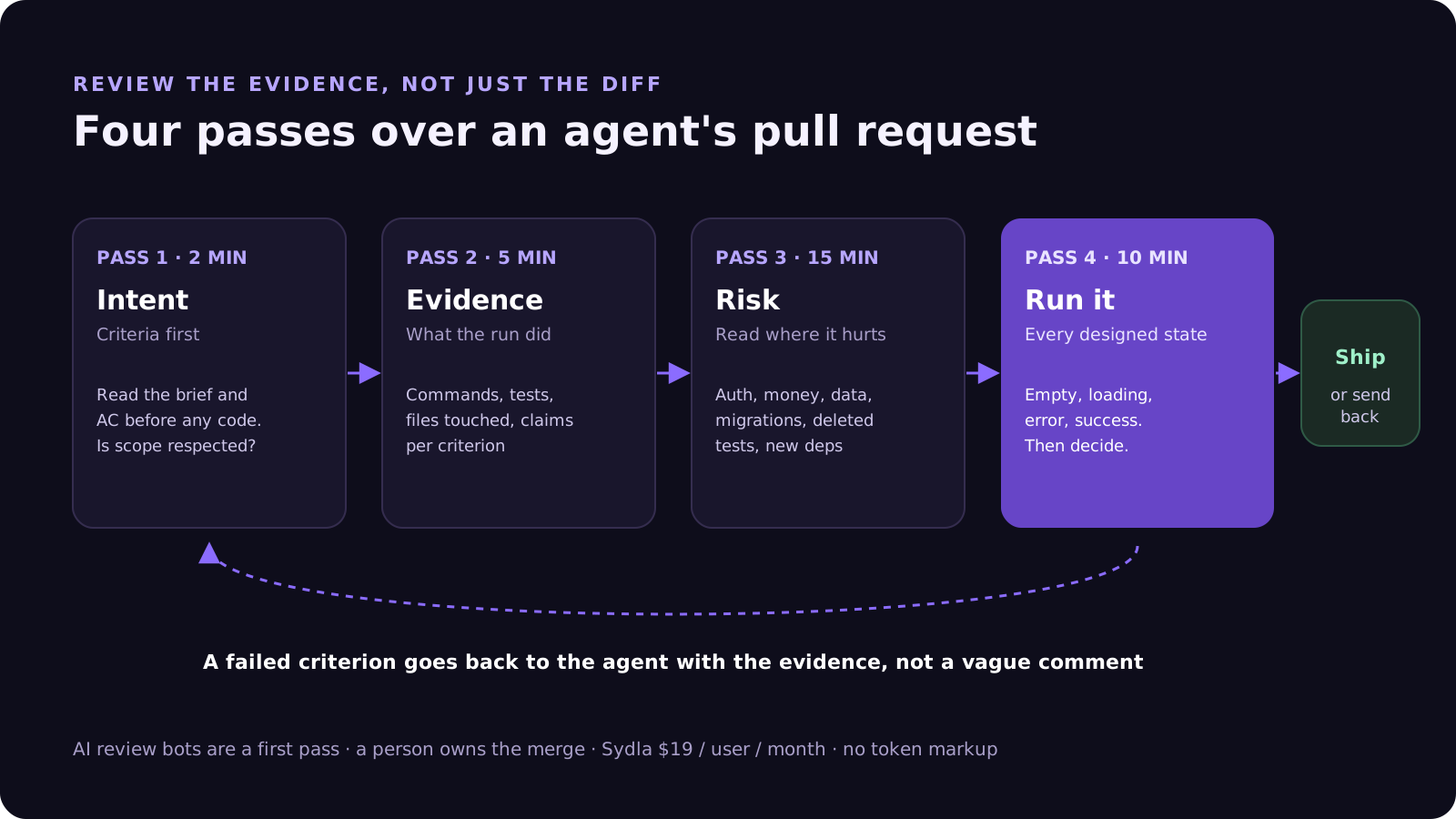
When a criterion fails, send it back to the agent with the evidence: which criterion, what you did, what happened. "AC3 fails: export times out after 30 seconds and the page shows a blank table instead of the error state" gets fixed in one run. "Error handling looks off" starts a guessing game. One more rule from our acceptance criteria guide: verify in a separate session from the one that wrote the code, so the reviewer, human or agent, does not inherit the builder's assumptions.
What the agent should hand the reviewer
Most of the review time saved comes from what the agent leaves behind. Ask your agent, through your CLAUDE.md or AGENTS.md instructions, to finish every run with the same package:
- A criterion-by-criterion report. For each acceptance criterion: met, not met or not verified, and how it was checked.
- The commands and their output. Test runs, type checks and builds, with real results rather than a summary sentence.
- A scope statement. The files it changed and why, and any change outside the ticket called out explicitly, including edited or removed tests.
- Open questions. Every place it had to guess because the brief or the designs were silent.
- The cost of the run. Tokens or plan usage, so the team learns which tickets are cheap to build and which need a better brief.
A reviewer who gets that package spends their time on judgement instead of archaeology. A reviewer who gets a diff and "all requirements implemented" has to rebuild the context the agent already had.
What AI review bots cost in 2026
Automated review is a good first pass, and every major vendor now sells one. All of them moved to usage-based billing this year, which makes the cost per pull request harder to predict than a seat price.
- Claude Code Code Review runs a team of agents on each pull request and bills on token usage through usage credits, separately from your plan's included usage. Launch coverage in March 2026 put the average at $15 to $25 per review. Repositories added from the admin page review after every push by default, so set a monthly spend limit.
- Codex code review reviews pull requests when you comment "@codex review" or on every pull request if enabled. Reviews on GitHub draw on Codex's code review usage, while a local /review counts against your general Codex limits.
- GitHub Copilot code review moved to usage-based billing on 1 June 2026: each review consumes GitHub AI Credits and, on private repositories, GitHub Actions minutes.
- Atlassian Code Reviewer, formerly Rovo Dev code review, comes with paid Jira plans from November 2026. Each review uses a variable number of Rovo credits, taken from the pull request author's allocation, with credit billing starting on 3 December 2026.
None of these bots knows your brief or your designed states unless you wire them in, and none of them decides whether the change ships. Run one if it fits your budget; treat its comments as input to Pass 3, not as the review.
Six tools, six partial views of the same change
The real cost of reviewing agent work in a sprawling stack is not the bot. It is the reviewer opening six tools to reconstruct what the change was meant to do. The ticket is in Jira, the criteria in Confluence, the states in Figma, the edge case in a Miro board, and the launch asset in Canva.
| Tool and plan | Seat / month | AI in 2026 | What the reviewer needs from it | In Sydla |
|---|---|---|---|---|
| Jira Standard | $9.70 | Rovo, 25 credits per user per month, pooled; Code Reviewer billed in Rovo credits from 3 December | The ticket and its scope | Tickets on one line: spec, design, build, prove, ship |
| Confluence Standard | $7.15 | Same pooled Rovo allowance | The brief and acceptance criteria | Docs and briefs linked to tickets |
| Notion Plus | $12.00 | Custom Agents need Business or Enterprise; $10 per 1,000 credits | Decisions and notes | Docs spaces |
| Figma Professional, Full seat | $20.00 | 3,000 AI credits per Full seat per month; MCP calls limited by seat | Every designed state | UX Studio screens and states |
| Miro Starter | $10.00 | 25 AI credits per member per month | The edge cases from the workshop | UX transitions and diagrams |
| Canva Business | $25.00 | Monthly AI usage per member | The release announcement | Sydla Studio creatives |
| Six-tool total | $83.85 | Six meters, plus a review bot | Six tabs open per review | |
| Sydla | $19.00 | No Sydla AI credits: your own Claude Code or Codex does the work | One workspace, one MCP connection |
That is $64.85 per person per month, before counting the review minutes lost to tab-switching. The comparison overview covers each tool, and the pricing section lists the source for every price. We covered the meters in more depth in AI credit fatigue.
Review is where the context gap shows
An agent can only be as right as the context it read, and a reviewer can only be as fast as the context they can find. When the brief, the states and the run live in different tools, both halves suffer: the agent builds from what someone pasted into a prompt, and the reviewer checks it against what they remember from the planning meeting.
How evidence-backed review works in Sydla
In Sydla, the review happens in the same context as the work. Every ticket moves along one line, and "prove" is a column of its own: the place where a person checks the run against the criteria before anything ships.
- Write the intent once. The brief and its acceptance criteria live in Sydla Docs, linked to the ticket. Pass 1 is a click, not a search.
- Design the states the reviewer will check. UX Studio holds each screen's empty, loading, error and success states. The agent builds from that handoff, and the reviewer walks the same states in Pass 4. Our design-to-code handoff guide explains why states beat screenshots.
- Run your own agent. In Sydla Desktop, a thread starts the Claude Code or Codex CLI on your machine, signed in with your own Anthropic or OpenAI account. The agent reads the ticket, brief, criteria and UX handoff through one Sydla MCP connection.
- Get the evidence attached. The run records its commands, changed files, test results and cost against the work item, so Pass 2 starts from facts.
- Decide per criterion. The reviewer marks each criterion met or not, with the evidence beside it, and requests a gate. A failed criterion goes back to the agent with its evidence. Agents can request a gate; only a person decides it.
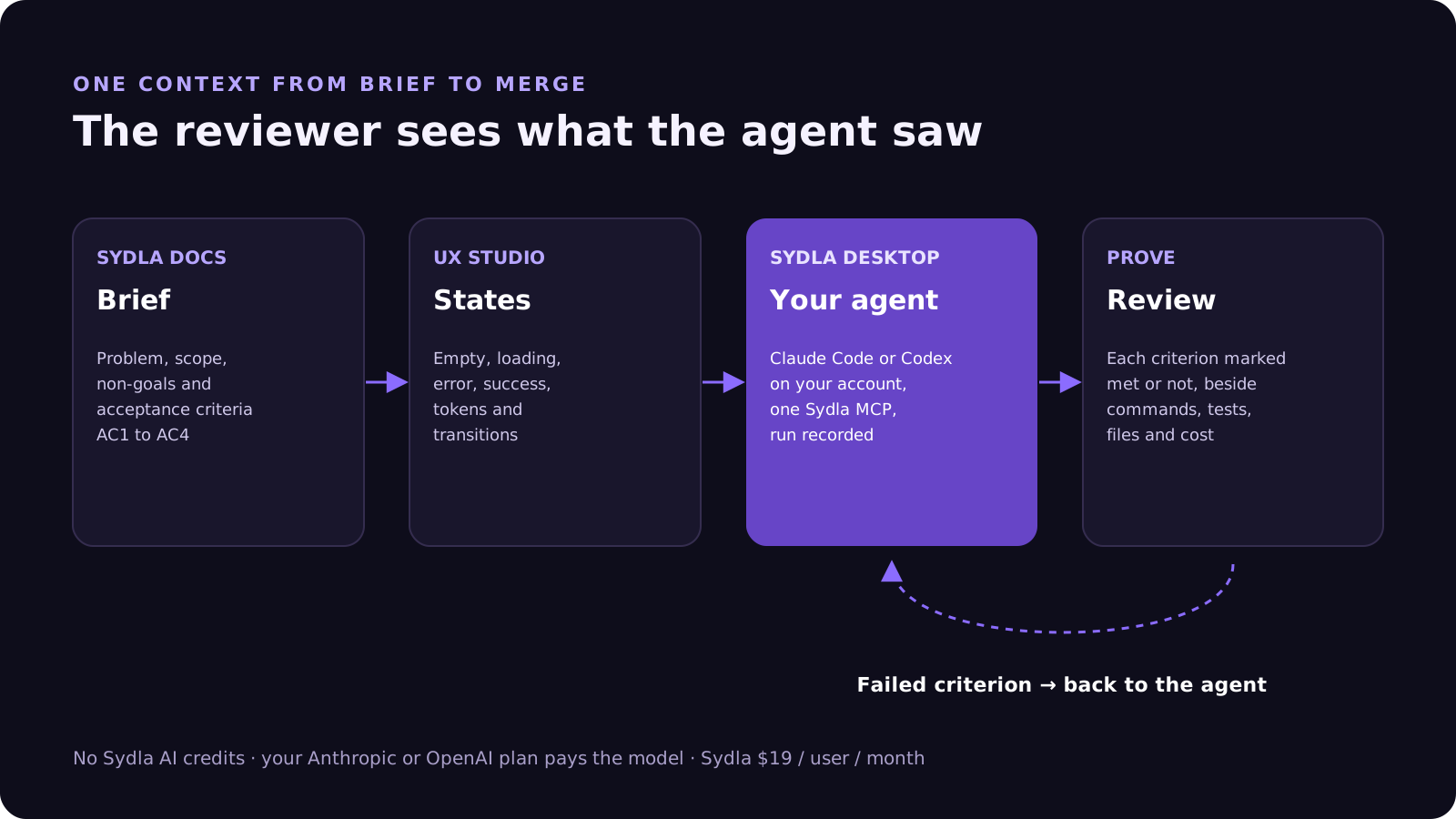
None of this uses a Sydla AI credit. Your provider plan pays for the model; Sydla's $19 pays for the workspace around it. If you also run an AI review bot, it becomes one more input to the same review. Choosing between agents? Read Claude Code vs Codex for product teams.
When to add a review bot, and when to fix the brief
If your reviewers keep finding style problems and obvious bugs, a review bot pays for itself: it takes the first pass so people can focus on risk. If they keep finding that the change does the wrong thing, no bot will help. The problem is upstream, in a brief without checkable criteria or a design without its error state. Fix that first, and the review gets shorter for every agent run that follows.
Frequently asked questions
How do you review a pull request written by an AI coding agent?
Review it in four passes: read the brief and acceptance criteria first, check the run's evidence (commands, test output, changed files and proof per criterion), read the risky code closely (auth, money, data, migrations, deleted tests, new dependencies), then run the change through every designed state. A person decides whether it ships.
Can AI review AI-generated code?
Yes, as a first pass. Claude Code Code Review, Codex, GitHub Copilot and Atlassian Code Reviewer all comment on pull requests and catch real bugs. They do not know your brief or designed states unless you provide them, and they should not approve the merge. Treat their comments as input to a human review.
How much does Claude Code Code Review cost per pull request?
It is billed on token usage through usage credits, separately from your Claude plan's included usage, so cost varies with the size of the change. Launch coverage in March 2026 put the average at $15 to $25 per review. Reviewing after every push multiplies that, so set a monthly spend limit.
What should an AI coding agent include in its pull request?
A criterion-by-criterion report saying what is met, not met or unverified and how it was checked; the commands it ran with their real output; the files it changed and anything outside scope, including edited tests; the places it had to guess; and the cost of the run.
How much does Sydla cost compared with Jira, Confluence, Notion, Figma, Miro and Canva?
Sydla costs $19 per user per month. One paid seat each of Jira Standard, Confluence Standard, Notion Plus, Figma Professional Full, Miro Starter and Canva Business costs $83.85 per user per month in USD before tax, so Sydla saves $64.85 per user per month. Sydla sells no AI credits and adds no token markup.












