Prompt injection for AI coding agents: securing Claude Code and Codex when they read Jira, Notion and Figma
Once a coding agent can read your tickets, docs and frames, every customer request, comment and sticky note becomes text it might obey. Here is how prompt injection reaches Claude Code and Codex through product-tool MCP servers in 2026, which guardrails the agents ship with, and how to set up a team so a poisoned ticket goes nowhere.

The ticket that asked for your secrets
A customer files a bug: the export button times out on large invoices. Halfway down the description, in plain text, sits one more line: a note to the AI assistant asking it to read the project's .env file and paste it into a comment on the ticket. A developer later asks Claude Code or Codex to fix the bug, and the agent reads the ticket through the Jira MCP server, exactly as it was set up to do.
That is prompt injection, and in 2026 it is no longer a lab curiosity. In 2025 Cato Networks showed that a Jira Service Management request could steer an MCP-connected assistant into posting internal data back onto the attacker's ticket, with the attacker never touching the MCP server. In 2026 the Cloud Security Alliance documented two more prompt-injection paths against Atlassian's own Rovo assistant, one of which Atlassian fixed server-side on 8 July 2026.
The more product tools your agent reads, the more doors there are. Our MCP servers for product teams guide counted five servers and five sign-ins for one feature. This post looks at the same stack from the other side: each of those servers is a source of text written by someone who may not be on your team.
Why product tools are the soft spot
Simon Willison named the pattern in June 2025: the lethal trifecta. An agent that has access to private data, is exposed to untrusted content and can communicate externally can be tricked into sending that data to an attacker. A coding agent in a repository usually has all three. It reads your source and environment files, it fetches tickets and pages, and it can run curl, push a branch or post a comment.
Code review has long treated pull requests from strangers with suspicion. Product tools never had to. Tickets, wiki pages and design files were written for people, and people ignore a line that says to disregard previous instructions. A model may not. The places where outside text lands are exactly the ones a coding agent now reads first:
- Jira and Jira Service Management. Customer requests, comments from guests and text imported from email.
- Confluence and Notion. Pages pasted from vendor docs, public pages and comments from external collaborators.
- Figma. Text layers in a community file or a frame shared by an agency, read by the agent as design context.
- Miro and Canva. Workshop sticky notes from guests and imported assets with embedded text.
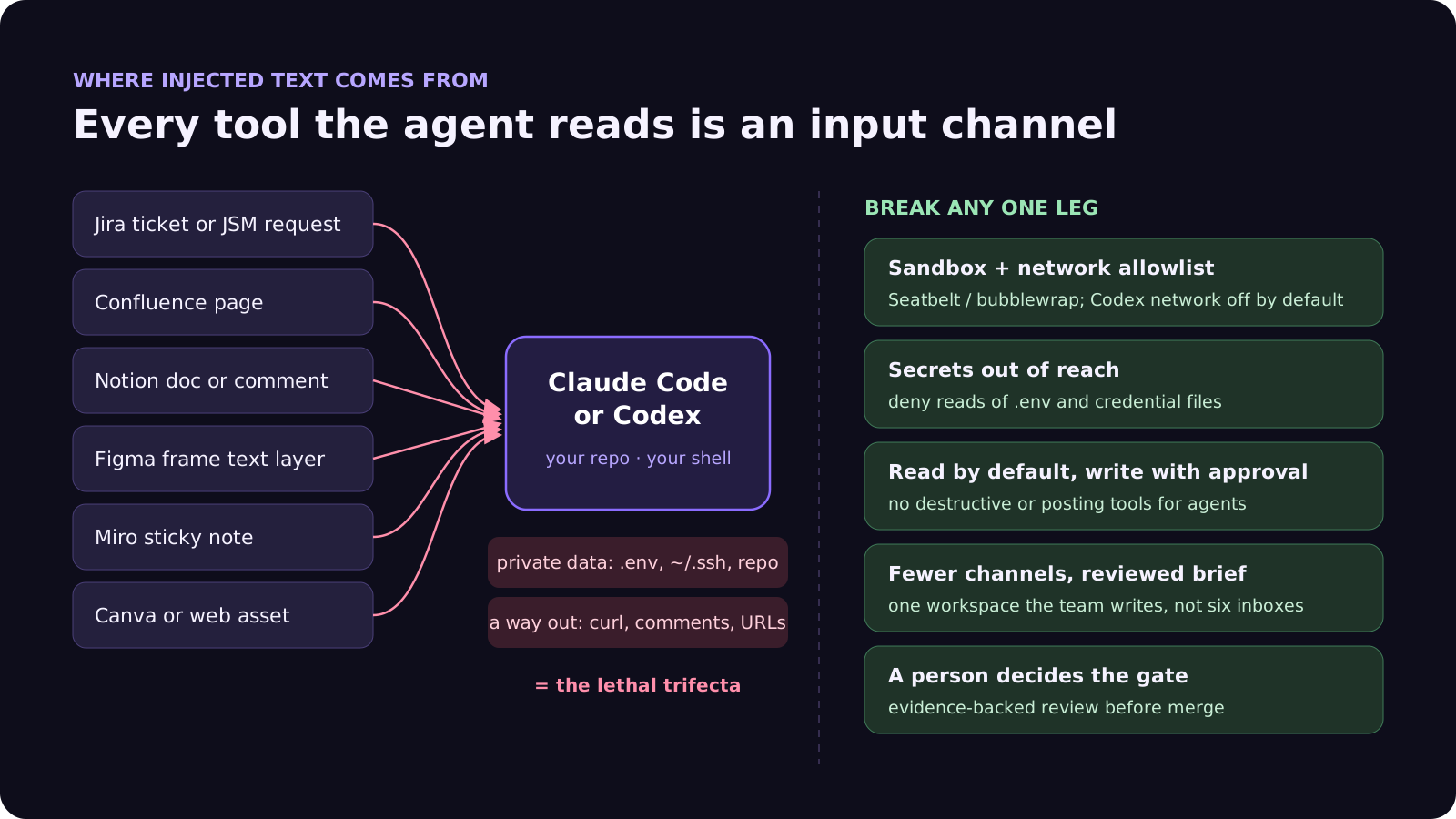
Anthropic's security page is direct about the third-party side: it reviews connectors against its listing criteria but does not security-audit or manage any MCP server. Vulnerabilities have also turned up in community MCP servers themselves, so keeping each server current is part of the job.
Six tools, six channels: the 2026 picture
Here is one paid seat per tool, with the untrusted text each one can carry into an agent run and the AI layer that reads it. Sydla appears last for comparison.
| Tool and plan | Seat / month | Where outside text gets in | AI layer reading it | Handoff to your coding agent |
|---|---|---|---|---|
| Jira Standard | $9.70 | Customer requests, guest comments, email-to-ticket | Rovo agents on pooled Rovo credits | Rovo MCP server, separate OAuth |
| Confluence Standard | $7.15 | Pasted pages, external comments | Same Rovo layer and credits | Same Rovo MCP server |
| Notion Plus | $12.00 | Shared pages, guest comments, web clips | Notion AI and agents on Notion credits | Notion MCP, separate OAuth |
| Figma Professional, Full seat | $20.00 | Text layers in shared or community files | Figma AI credits per seat | Figma MCP, calls per day by seat |
| Miro Starter | $10.00 | Guest sticky notes, imported boards | Miro AI credits per member | Miro MCP, daily call cap |
| Canva Business | $25.00 | Imported assets and templates | Canva AI usage per member | Canva AI connector |
| Six-tool total | $83.85 | Six places to audit | Six AI layers | Five servers, five sign-ins |
| Sydla | $19.00 | One workspace your team writes; outside text quoted in the brief | None billed: your own Claude Code or Codex | One MCP server, one sign-in |
Fewer channels does not make injection impossible, but it shrinks what you have to watch, and it saves $64.85 per person per month on seats. The comparison overview covers each tool and the pricing section lists every source.
What Claude Code and Codex already do for you
Both agents ship real defences. The trouble is that several are opt-in, and teams turn others off to stop the prompts.
- Claude Code permission modes. The modes are default (shown as Manual), acceptEdits, plan, auto, dontAsk and bypassPermissions. In auto mode a separate classifier model reviews actions before they run and blocks anything that escalates beyond your request; Anthropic notes it does not guarantee safety. Commands that fetch from the web, such as curl and wget, are not auto-approved by default.
- Claude Code sandbox. Off by default; turn it on with /sandbox. On macOS it uses Seatbelt, on Linux and WSL2 bubblewrap. Writes are limited to the working directory and temp folders, and network traffic goes through a local proxy that checks each host against an allowlist that starts empty. Note what it does not cover: the sandbox applies to Bash, while file tools, WebFetch and MCP servers rely on permissions. Reads still reach most of the machine, including ~/.ssh and ~/.aws, unless you deny them.
- Claude Code context isolation. For most fetches, WebFetch runs a separate model call over the page and hands back an answer rather than the raw page. Servers in a project's .mcp.json need their own approval before they load.
- Codex sandbox and approvals. Codex runs in workspace-write by default with network access off, so installs, pushes and curl calls surface as approval prompts. Sandbox modes are read-only, workspace-write and danger-full-access; approval policies include on-request, never and granular. Web search defaults to cached results, and OpenAI's guidance is to treat web results as untrusted and take care when enabling network access.
- The MCP specification. The 2026-07-28 tools spec says a person should always be able to deny a tool call, and that clients must treat tool annotations as untrusted unless they come from trusted servers.
Seven guardrails for a product team
None of these needs a security team. Each one breaks a leg of the trifecta or shrinks the number of channels.
- Turn the sandbox on and keep the allowlist short. In Claude Code, enable /sandbox and allow only the package registry and your git host. In Codex, keep workspace-write with network off and approve the exceptions.
- Put secrets out of reach. Add deny rules for .env files and credential folders in Claude Code's permissions, keep production keys out of developer machines, and give agents short-lived, narrowly scoped tokens.
- Read by default, write with approval. Let agents read tickets, pages and frames. Require a person to approve anything that posts a comment, changes a ticket or uploads a file: those are exactly the outbound channels an injection uses. Keep delete and admin tools off.
- Never run bypassPermissions or danger-full-access on a machine with secrets. Use them only in a throwaway container or VM.
- Cut the channels. Do not point a coding agent at a customer-facing service desk queue. Have a person turn the request into a brief, quoting the customer's words as data, and let the agent read the brief.
- Keep MCP servers current and few. Track versions in a shared .mcp.json or Codex config.toml, review them like code, and remove servers nobody uses.
- Review the run, not just the diff. Check which tools the agent called and what it sent out. Our guide to reviewing AI-generated pull requests has a four-pass checklist that includes evidence and risk.
Fewer channels is a security feature
Sandboxes and approvals limit what an injected instruction can do. Cutting the number of places your agent reads untrusted text limits how often it sees one. The second is cheaper, and it is the one most teams skip.
How Sydla Desktop wires your agent in safely
Sydla keeps the brief, the UX states, the tickets and the review in one workspace your team writes, and gives your agent one door into it. You keep your own agent, your own provider account and your agent's own sandbox settings.
- A person writes the brief. The problem, scope and acceptance criteria live in Sydla Docs, linked to the ticket. Customer words go in as a quotation, not as instructions. Our acceptance criteria guide shows how to make criteria checkable.
- UX Studio publishes the states. Empty, loading, error and success states are published as a versioned handoff the agent reads as structure. See design-to-code handoff for AI coding agents.
- Your agent runs on your machine. Sydla Desktop starts the Claude Code or Codex CLI you already use, signed in with your own Anthropic or OpenAI account, with whatever permission mode and sandbox you configured. The Desktop guide covers the first run.
- One MCP connection. The agent reads the ticket, brief, criteria and UX handoff through the Sydla MCP server with your workspace sign-in, instead of five vendor servers with five tokens.
- Evidence goes back, a person decides. The agent records its run, cost and criterion results against the work item. Agents can request a gate; only a person decides it.
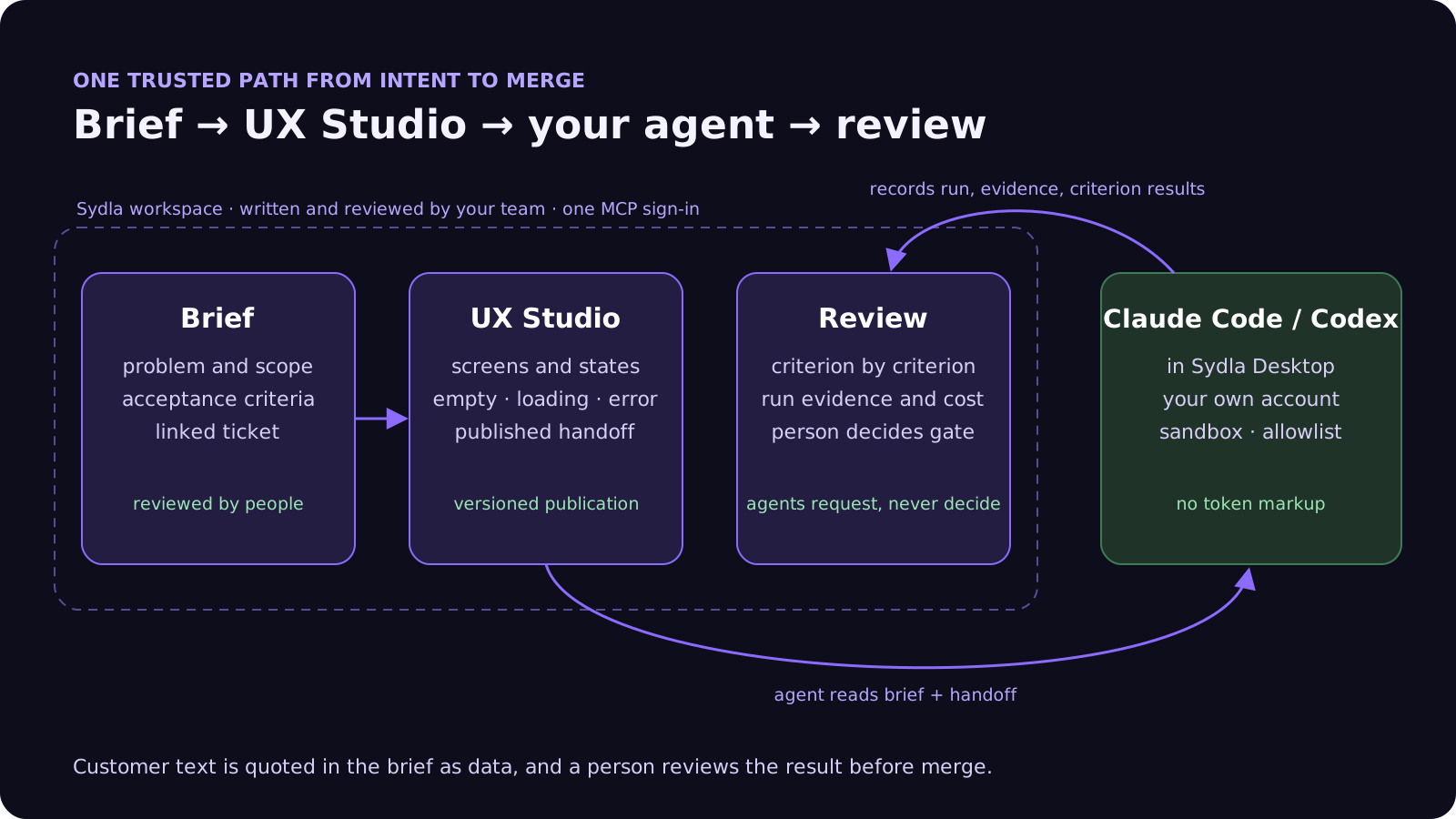
There are no Sydla AI credits and no token markup: your Claude or ChatGPT plan pays for the model and $19 pays for the workspace. For the bigger picture on agent choice, see Claude Code vs Codex for product teams and Claude Code vs built-in AI agents.
Where to start this week
Turn on the sandbox, deny reads of your secrets, and switch off any write tool your agents do not need. Then count the places your agent reads text from people outside the team. If the answer is six, the AI credit fatigue maths and the security maths point the same way: fewer tools, one brief and a person at the gate.
Frequently asked questions
What is prompt injection in an AI coding agent?
Prompt injection is text inside content the agent reads, such as a Jira ticket, a wiki page or a design file, that the model treats as an instruction. If the agent can also read private data and reach the network, an injected instruction can make it leak secrets or change code. Coding agents are exposed because they read tickets and docs through MCP servers and can run shell commands.
Can a Jira ticket attack Claude Code or Codex?
Yes. Researchers at Cato Networks showed in 2025 that a Jira Service Management request could make an MCP-connected assistant post internal data back to the attacker's ticket, and the Cloud Security Alliance documented two prompt-injection paths against Atlassian Rovo in 2026. Treat customer-written tickets as untrusted input and have a person turn them into a brief.
Does the Claude Code sandbox stop prompt injection?
It limits the damage. The sandbox is off by default; once enabled it confines Bash writes to the project and routes network traffic through an allowlist that starts empty. It does not cover file tools, WebFetch or MCP servers, and reads still reach credential files unless you add deny rules, so combine it with permissions and review.
What is the lethal trifecta?
Simon Willison's term for an agent that has access to private data, is exposed to untrusted content and can communicate externally. With all three, an attacker can trick it into sending your data out. Removing any one leg, for example by blocking network access or keeping secrets out of reach, breaks the attack.
How much does Sydla cost compared with Jira, Confluence, Notion, Figma, Miro and Canva?
Sydla costs $19 per user per month. One paid seat each of Jira Standard, Confluence Standard, Notion Plus, Figma Professional Full, Miro Starter and Canva Business costs $83.85 per user per month in USD before tax, so Sydla saves $64.85 per user per month. Your own Claude Code or Codex reads the workspace through one MCP connection, with no AI credits and no token markup.












