Localization with AI coding agents: i18n briefs, plural rules and translation gates for Claude Code and Codex
A coding agent translates 400 strings into eight languages overnight. Then the German button is cut off, the Polish invoice count is wrong, the Arabic screen reads left to right and the word invoice has three translations. This playbook gives agents an i18n brief, a glossary, plural rules and CI gates, and leaves the wording to people who speak the language.
Eight languages overnight. Then somebody opened the German screen
The ticket says: translate the billing settings into French, German, Spanish, Polish and Arabic. A coding agent pulls every hardcoded string into message files, translates them, opens a merge request with 400 new keys and a green build. It looks like a week of work done in one night.
Then people start clicking. The German Save changes button is cut off after two words. The Polish screen says the equivalent of 5 invoice, because the code only knows singular and plural. The Arabic screen has right-to-left text in a left-to-right layout. The date reads 11/03 and nobody outside the US knows whether that is March or November. And invoice is translated three different ways across three pages, because the agent translated each file on its own.
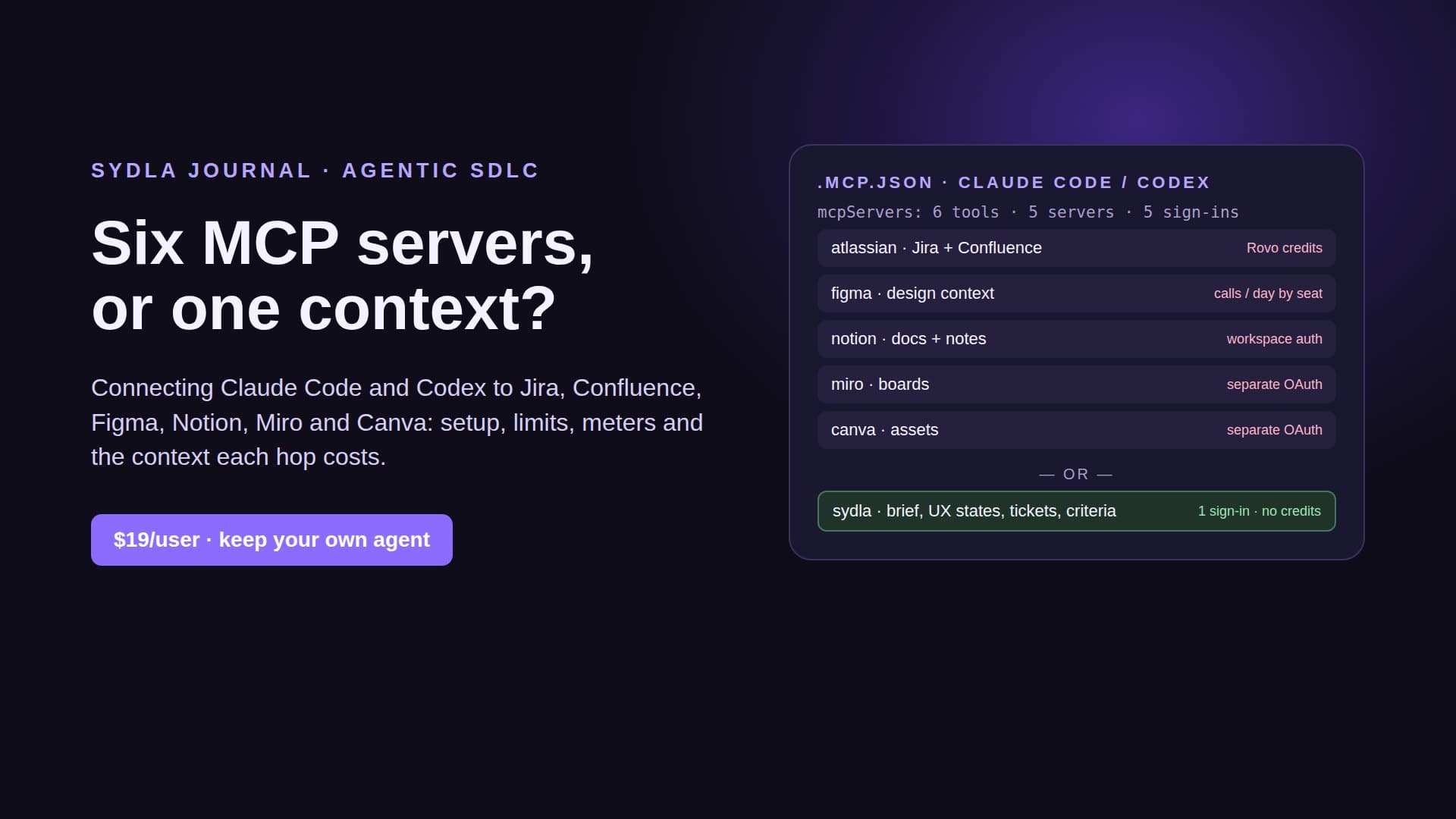
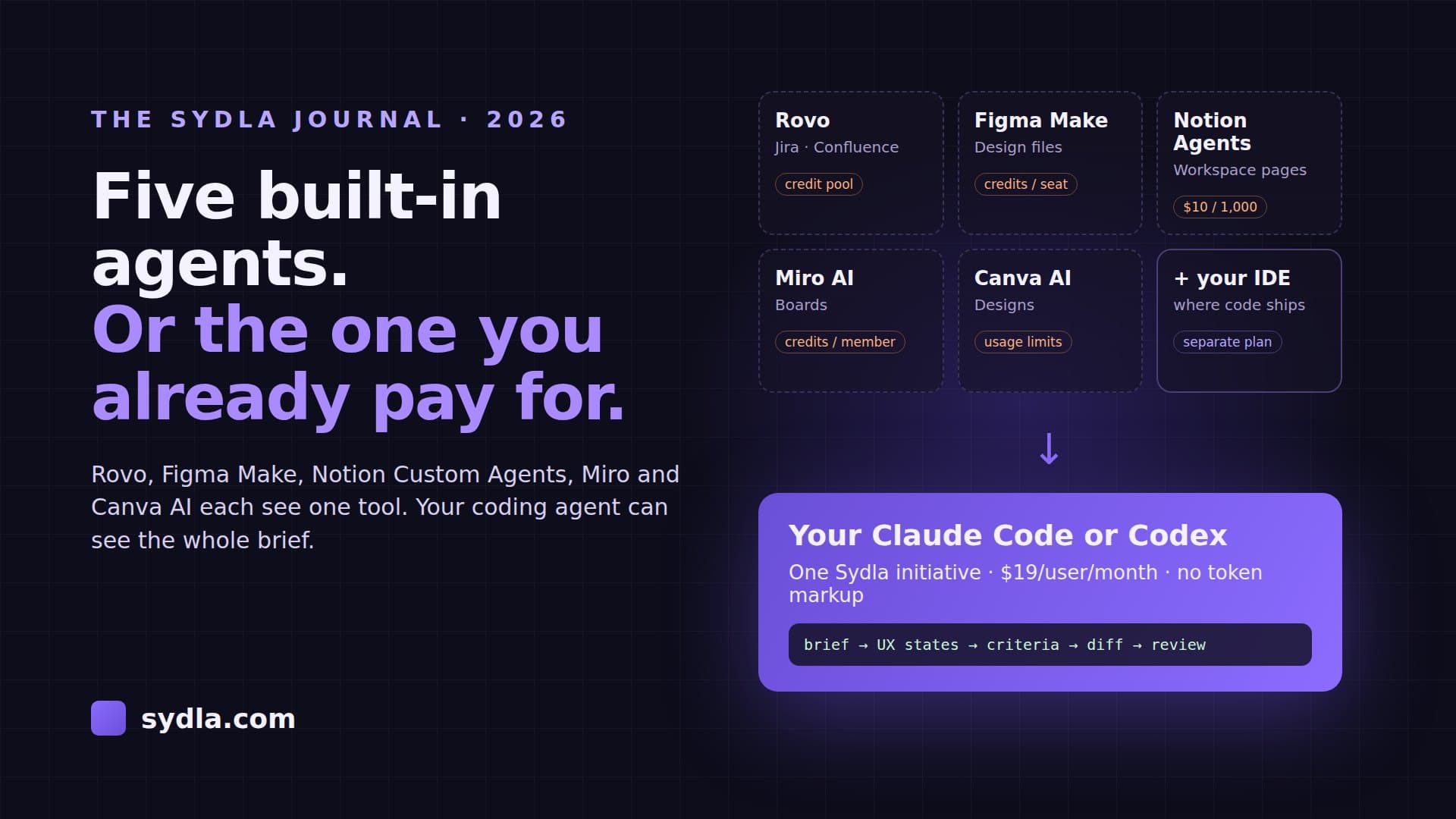
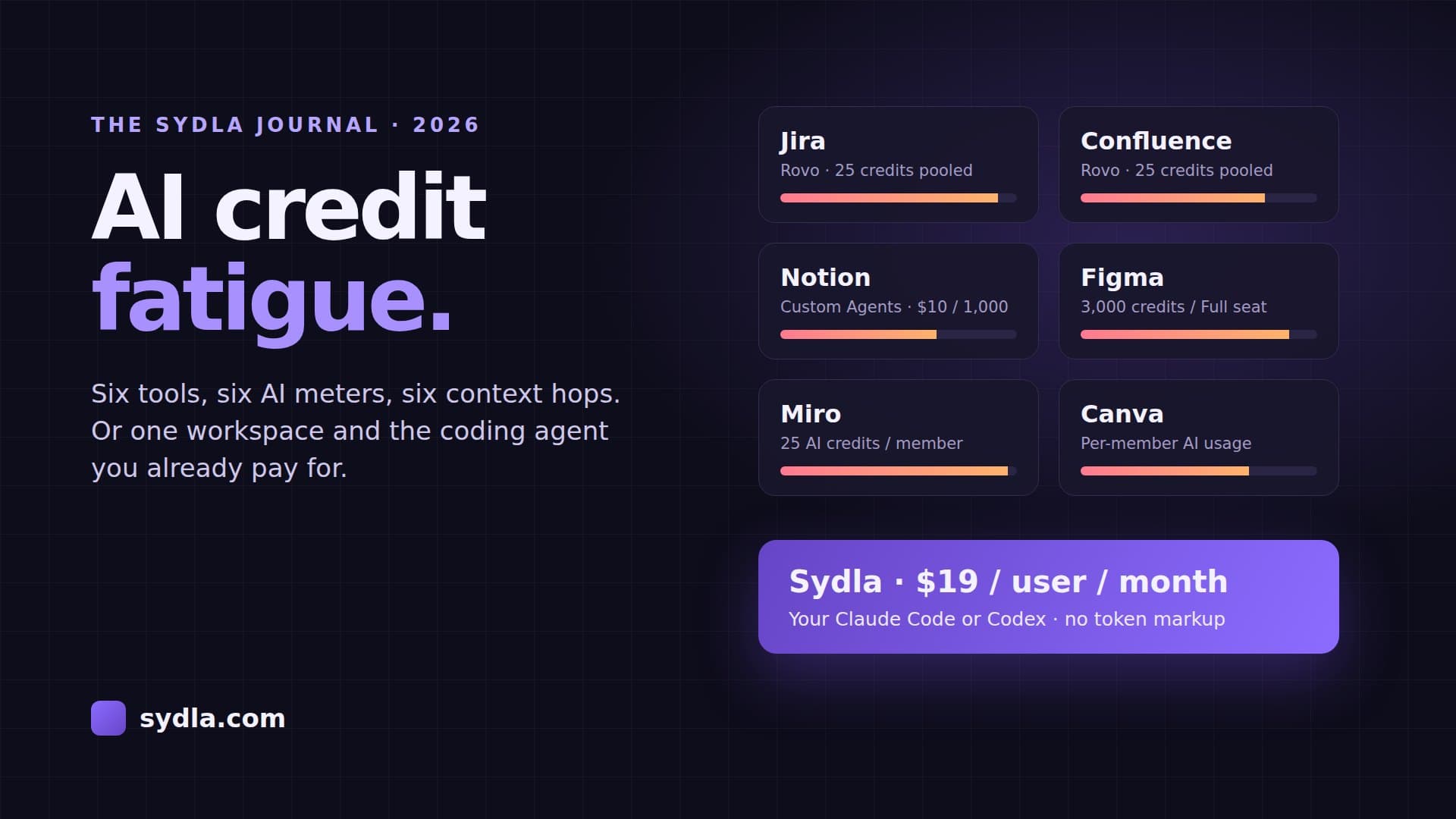
None of these are translation problems. They are engineering problems the brief never mentioned, and the context that would have caught them is scattered. The ticket lives in Jira, the list of supported markets in a Confluence page, the glossary in Notion, the screens in Figma, the market launch plan on a Miro board and the localized launch visuals in Canva. Six tools, six context hops for the agent, up to six AI credit meters. Our AI credit fatigue piece adds up what that costs.
This playbook does four things: it sorts localization work by risk, writes an i18n brief the agent can check itself against, makes CI catch the mechanical failures, and keeps native speakers in charge of what the words actually say.
What changed for localization in 2026
Translation management systems started talking to coding agents directly this year, and the AI inside design tools started to cost real money. The facts worth knowing:
- Crowdin ships an MCP server and agent skills. The Crowdin MCP Server V2 connects Claude Code, Cursor, VS Code, ChatGPT and other clients to a Crowdin account, with OAuth or a personal access token, and headers to limit the agent to read-only access or to a few of its 25 tool sets. In September 2026 Crowdin added four Skills, i18n-setup, glossary-generation, crowdin-cli and github-action, packaged with the server as one plugin for Claude Code, Codex, Gemini CLI, Cursor and GitHub Copilot. The i18n-setup skill moves hardcoded strings into synced message files; its first version supports Lingui only.
- Lokalise has one too. The Lokalise MCP server is cloud-hosted, signs in with OAuth or an API key, and comes as two toolkits: one for project management and one for software development work such as keys and translations.
- Translation platforms repriced. According to Locize, a competitor, Lokalise moved to plans billed by processed words with AI translation bundled in, and Phrase dropped its entry Starter plan. Check current pricing before you plan a big batch.
- Design tool AI now has a hard ceiling. Figma enforces seat AI credit limits since 18 March 2026: 3,000 credits a month on a Professional Full seat, 500 on other seats. Extra credits cost $120 a month for 5,000 as a subscription, or $150 pay as you go. Translating mockups in the design tool spends from that pool.
- Atlassian meters Rovo. Jira and Confluence plans include 25, 70 or 150 Rovo credits per user per month, and extra credits cost $0.01 each from 3 December 2026.
The short version: an agent can now read and write your translation platform as easily as your repository. That makes a written brief more important, not less, because the agent will happily push 400 machine translations straight into review.
Step 1: sort localization work into four lanes
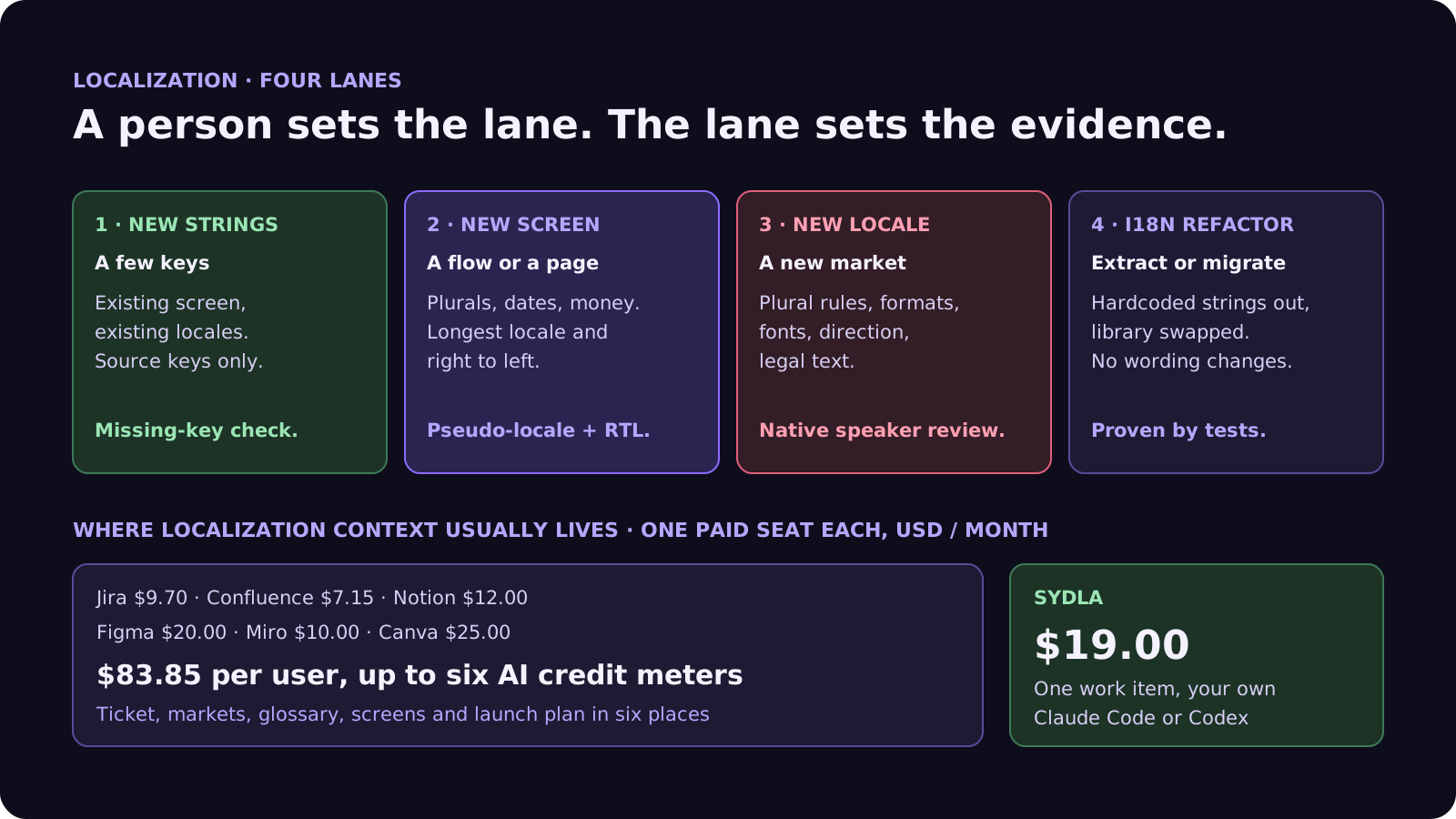
Not every new string needs a native speaker in the loop on day one. A person picks one of four lanes when the ticket is written, and the lane decides what evidence the agent owes:
- New strings. A few keys added to an existing screen in locales you already support. The agent adds source keys only, the translation platform or translators do the rest, CI checks that nothing is missing.
- New screen or flow. Many strings, plurals, dates and money. Every state checked in the longest locale and in a right-to-left locale if you ship one.
- New locale. A language or market you have never shipped. Plural rules, formats, fonts, layout direction and legal text all change. A native speaker reviews every string before launch.
- i18n refactor. Moving hardcoded strings into message files, or changing the i18n library. No wording should change at all, and that is exactly what the tests must prove.
Agents underestimate the new locale lane in a predictable way: adding Arabic looks like adding one more file. It is a layout change, a plural change and a review change. Make the lane a field on the ticket, let the agent suggest raising it, and only let a person lower it.
Step 2: the seven-field i18n brief
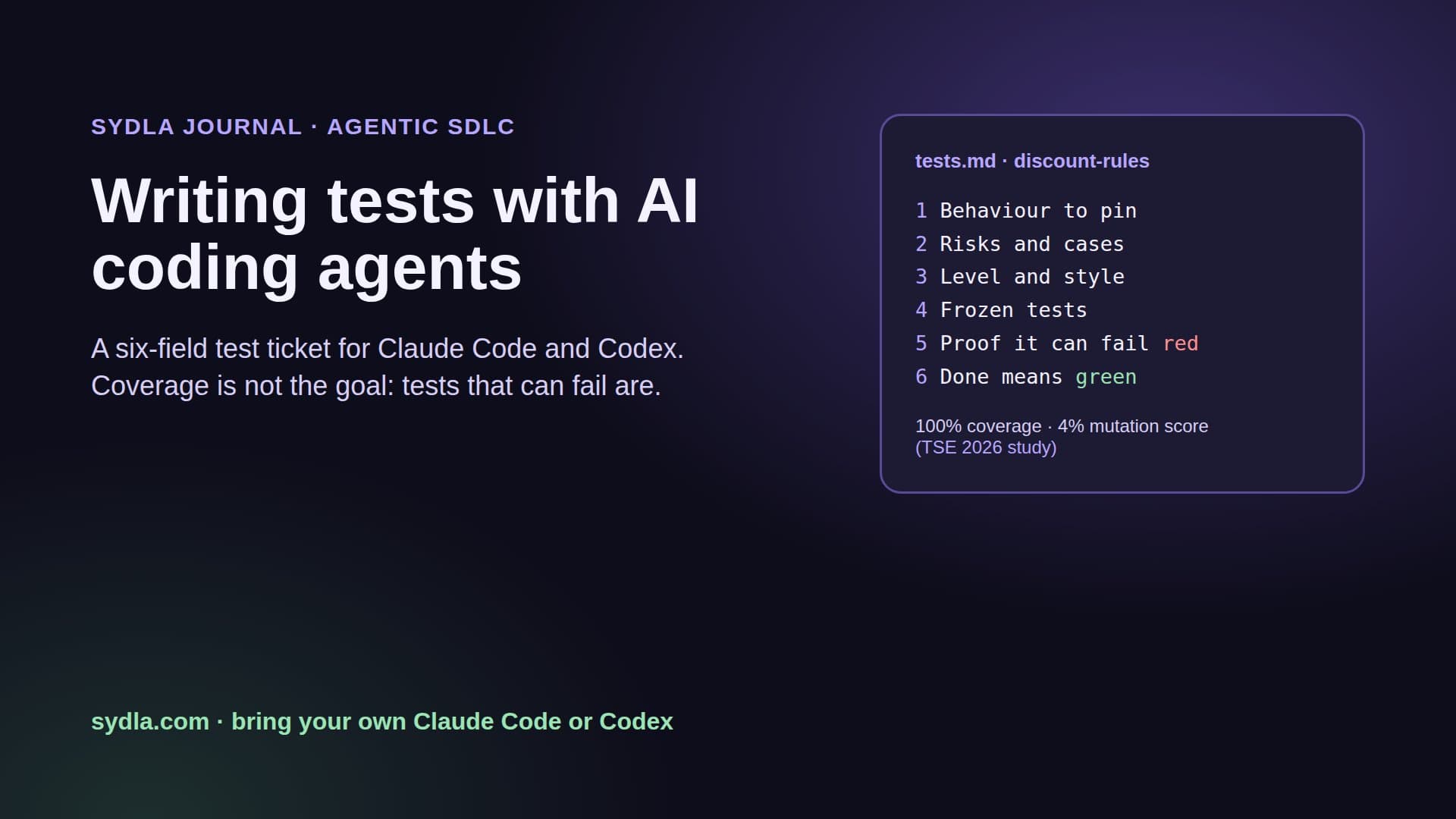
For anything beyond a couple of new strings, add these seven fields next to the acceptance criteria:
- 1. Locales and fallback. The exact list, such as fr-FR, de-DE, es-ES, pl-PL and ar, the source locale, and what happens when a key is missing: fall back to English, never show the raw key.
- 2. Message format. ICU MessageFormat or your library's equivalent, with real plural categories. English has two plural forms, Polish four and Arabic six. A message written as count plus the word invoices is wrong in most languages.
- 3. Glossary and do-not-translate list. Product names, plan names and the ten to thirty terms that must stay consistent. Invoice, workspace and seat get one translation per language, decided once.
- 4. States to cover. Every state in the longest locale, usually German or French, at the narrowest supported width, plus one right-to-left run if you ship Arabic or Hebrew.
- 5. Formats. Dates, numbers and currency through the platform's Intl APIs with the user's locale, never string templates. Time zones stated, currency never converted silently.
- 6. Out of bounds. No string concatenation to build sentences, no translated text in code, no editing translated files by hand outside the translation platform, no machine translation for legal, pricing or safety text without review.
- 7. Done means. Gates green, screenshots of every state in the longest and the right-to-left locale attached, and a native speaker's review recorded for each new locale.
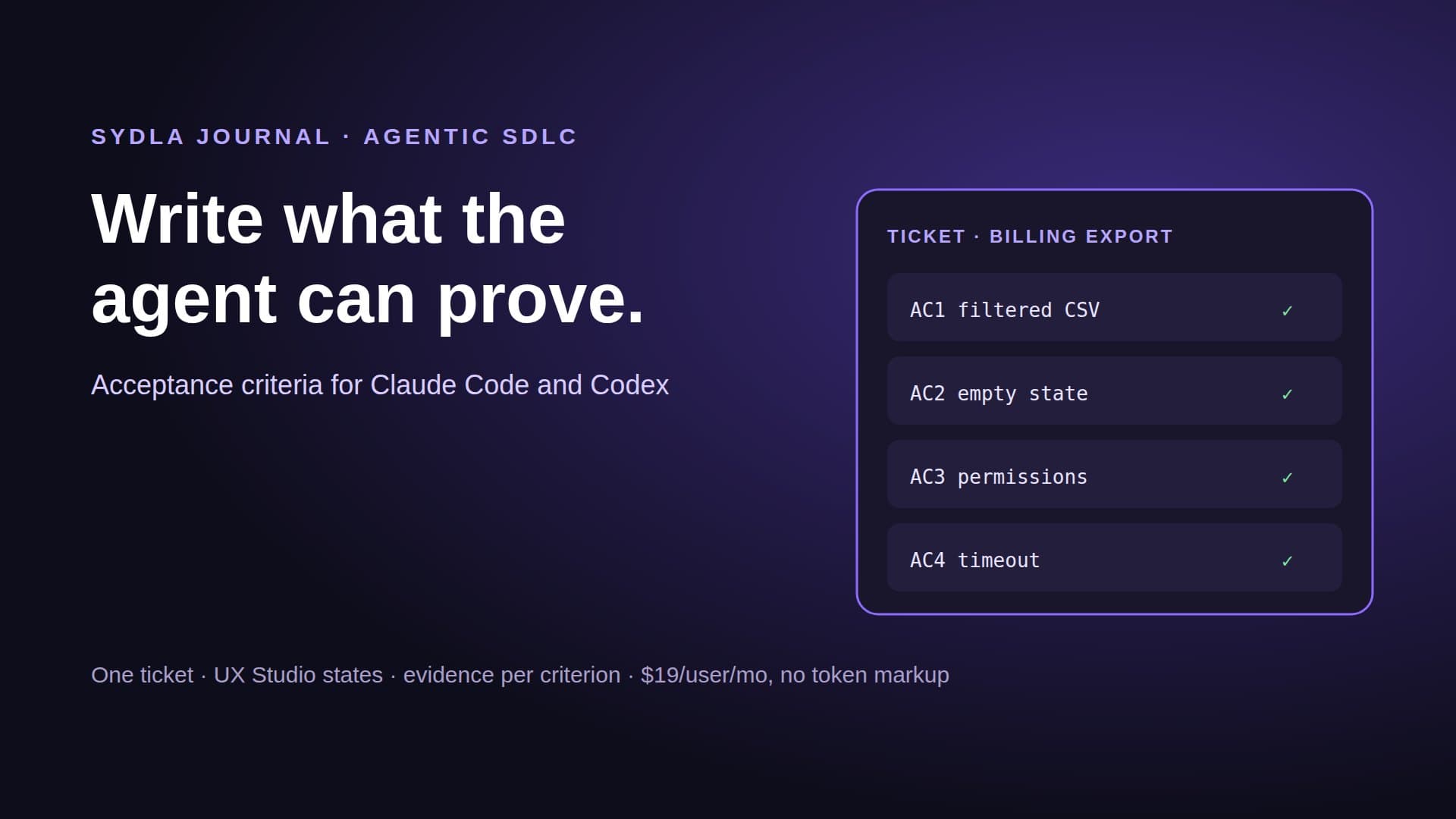
Field 6 matters more with agents than with people. A model told to make a sentence work will glue three translated fragments together, and the word order will be wrong in German and Polish. Write the forbidden shortcuts down. Our acceptance criteria guide explains why agents need criteria they can check, and the PRD template shows where the brief sits.
Step 3: let CI catch the mechanical failures
Most localization bugs are mechanical, and machines are good at mechanical. Five checks catch them before a person ever looks:
- Missing and unused keys. Every key in the source exists in every locale or has an explicit fallback; keys nobody uses get flagged.
- Message syntax. Every message parses as valid ICU, and every plural message covers the categories its language needs.
- Hardcoded strings. A lint rule fails the build on user-facing text written straight into components.
- Pseudo-localization. A fake locale that makes every string about 40% longer and wraps it in accented characters. Run the end-to-end tests in it and take screenshots: truncation, overlap and untranslated text jump out at once.
- Right-to-left run. The same screenshots with the direction set to right to left. Icons that point the wrong way and margins that don't flip show up here.
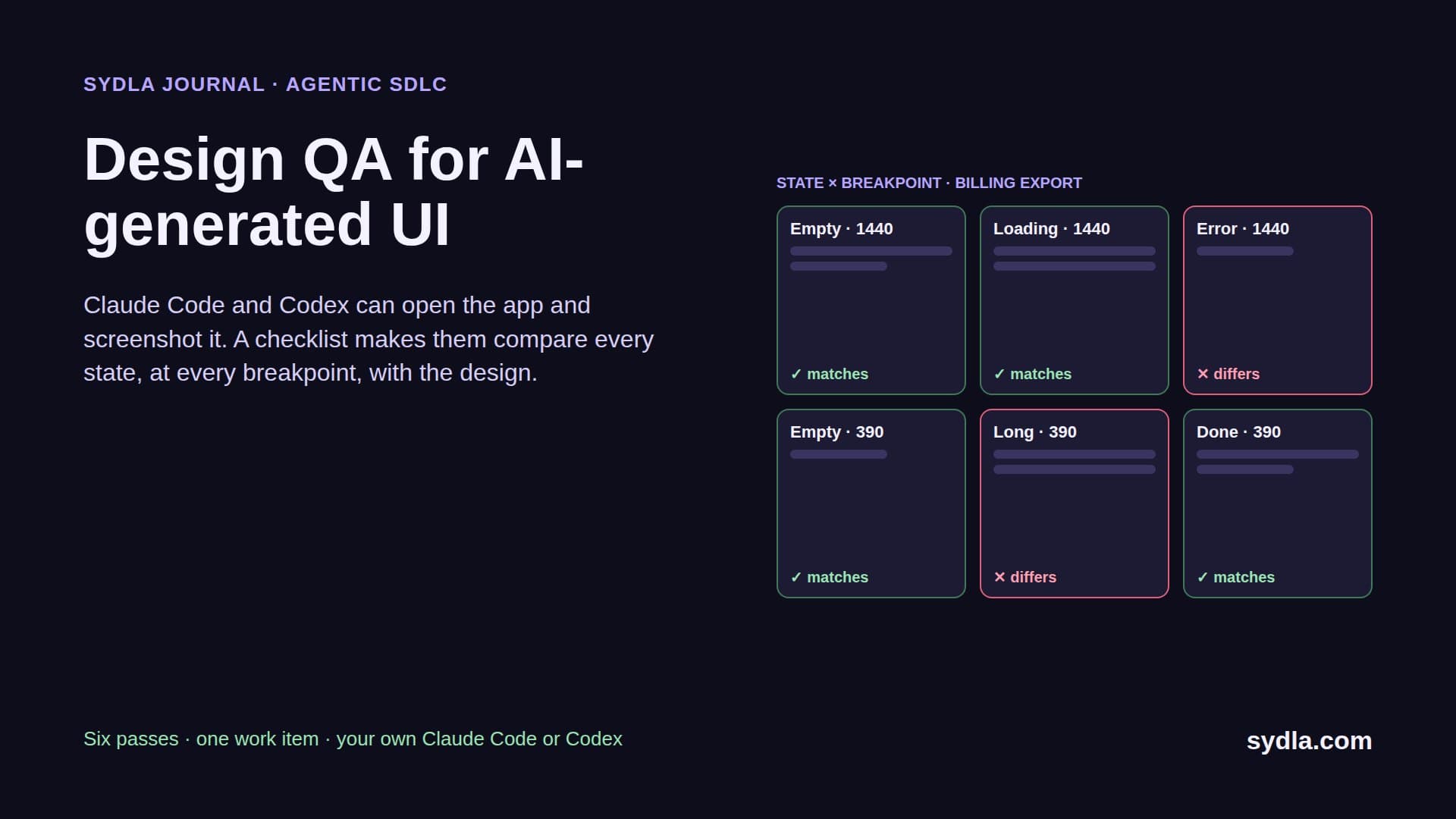
Give the agent the commands, not just the rules. Claude Code and Codex both run your test suite and read the output, so an agent that can run the pseudo-locale screenshots will fix its own truncation before it asks for review. Our design QA guide covers comparing those screenshots with the intended states, and the accessibility audit playbook covers the lang attribute and screen reader side.
Where localization context lives today, and what it costs
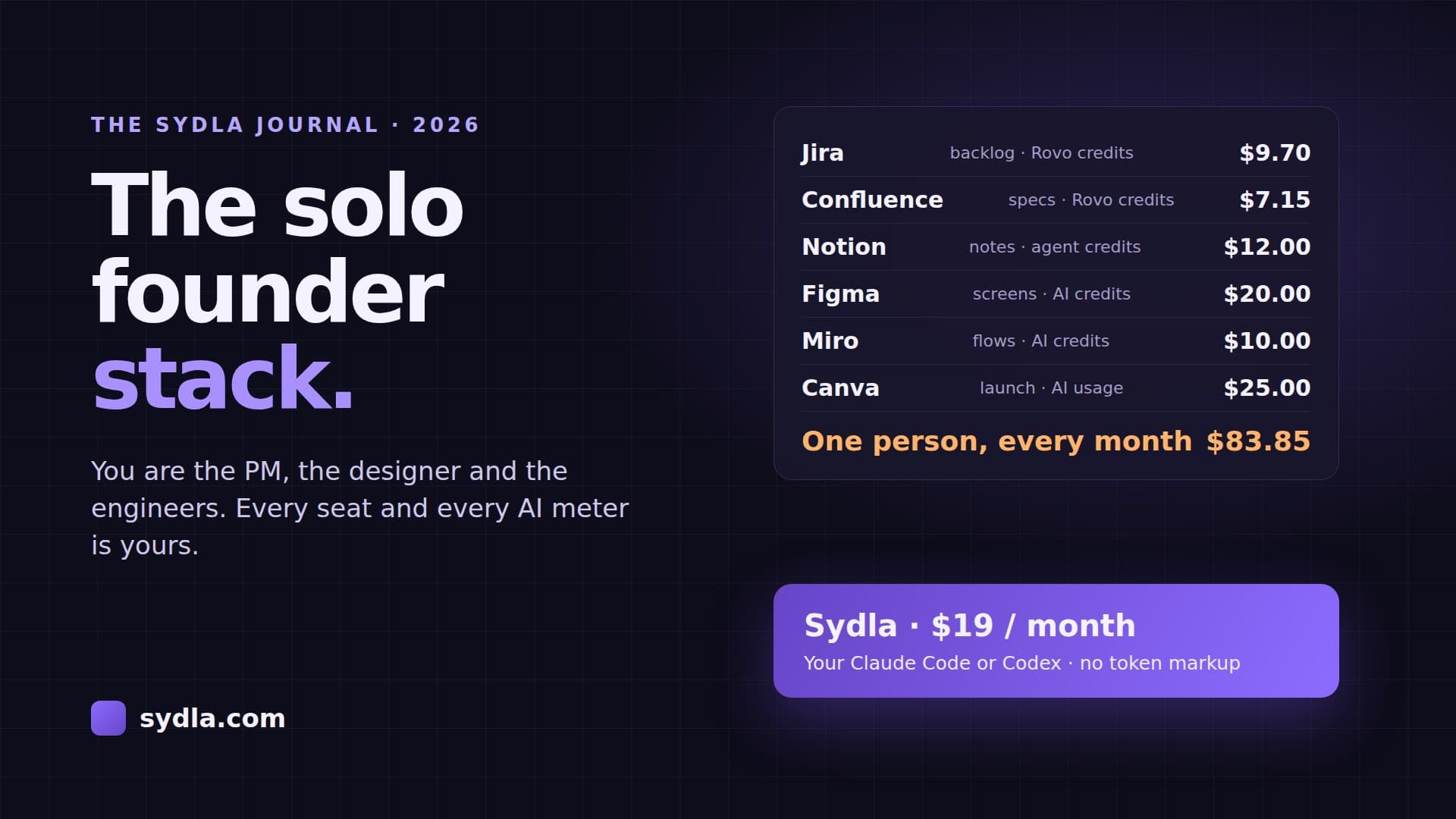
The agent's raw material is spread across the usual stack. Here is one paid seat of each tool next to Sydla. Compare them one by one on our comparison pages.
| Tool and plan | Seat / month | Built-in AI billing | Localization context it holds |
|---|---|---|---|
| Jira Standard | $9.70 | Rovo credits: 25 per user per month on Standard, 70 on Premium, 150 on Enterprise; $0.01 per extra credit from 3 December 2026 | The ticket, rarely with locales |
| Confluence Standard | $7.15 | Rovo, same credit pool | Supported markets and style guides |
| Notion Plus | $12.00 | Notion AI and Custom Agents on Notion credits | The glossary and translator notes |
| Figma Professional, Full seat | $20.00 | 3,000 AI credits a month, extra 5,000 for $120 a month | The screens, usually in English only |
| Miro Starter | $10.00 | Create with AI on Miro credits | The market launch plan |
| Canva Business | $25.00 | Canva AI usage per member | Localized launch visuals |
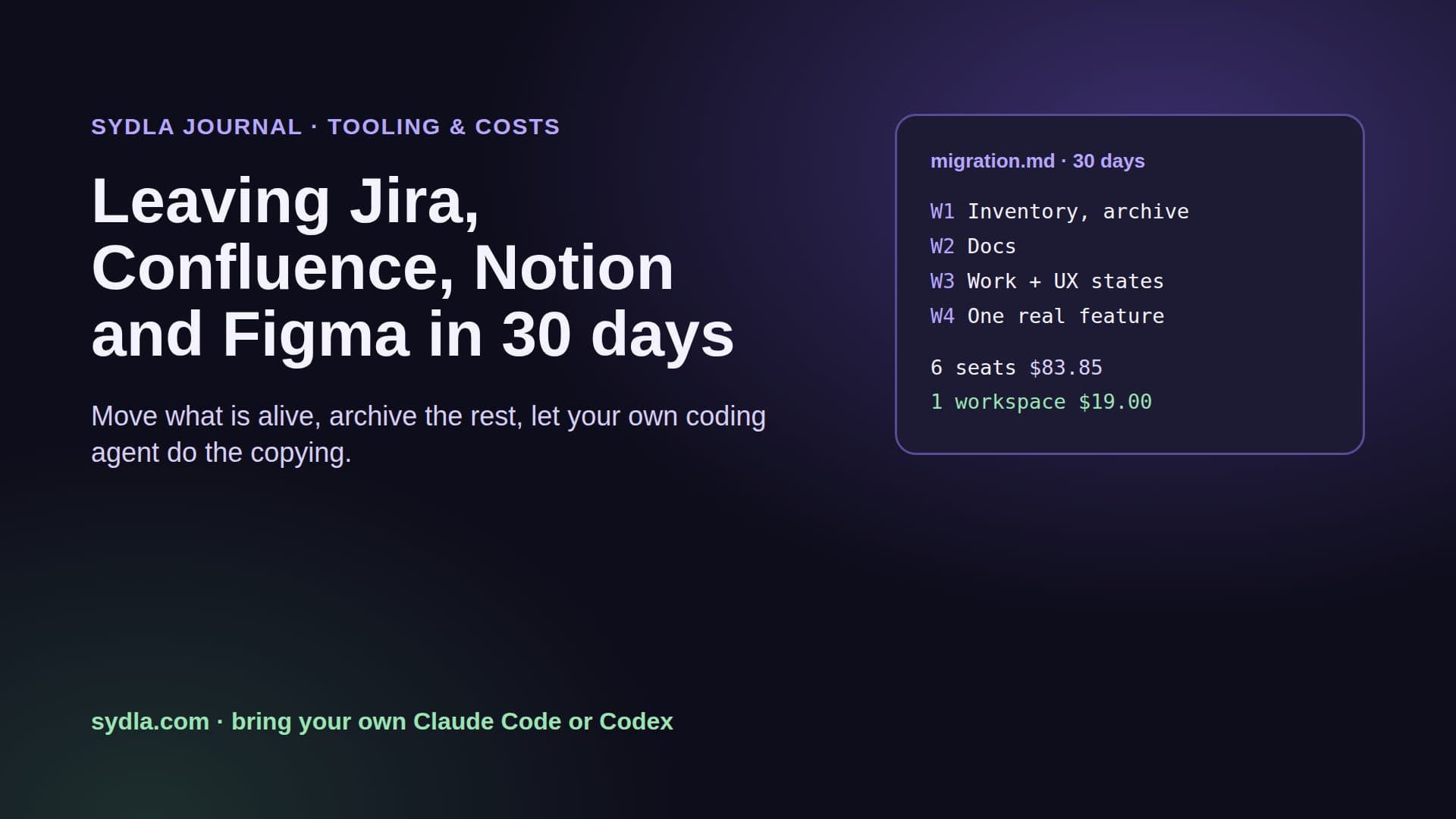
| Six-tool total | $83.85 | Up to six meters, plus your coding agent and translation platform | Six places to look |
| [Sydla](/) | $19.00 | None: your own Claude Code or Codex plan pays for the model, with no markup | One work item: brief, glossary, states, runs and evidence |
That is $64.85 per user per month less than the six-tool stack, before any AI overage. Your translation platform stays where it is: the agent reaches it through its own MCP server. The pricing section has the details.
Walkthrough: brief, UX Studio, your agent in Sydla Desktop, review
Here is how a localized change moves through Sydla on one work item, with the coding agent you already pay for.
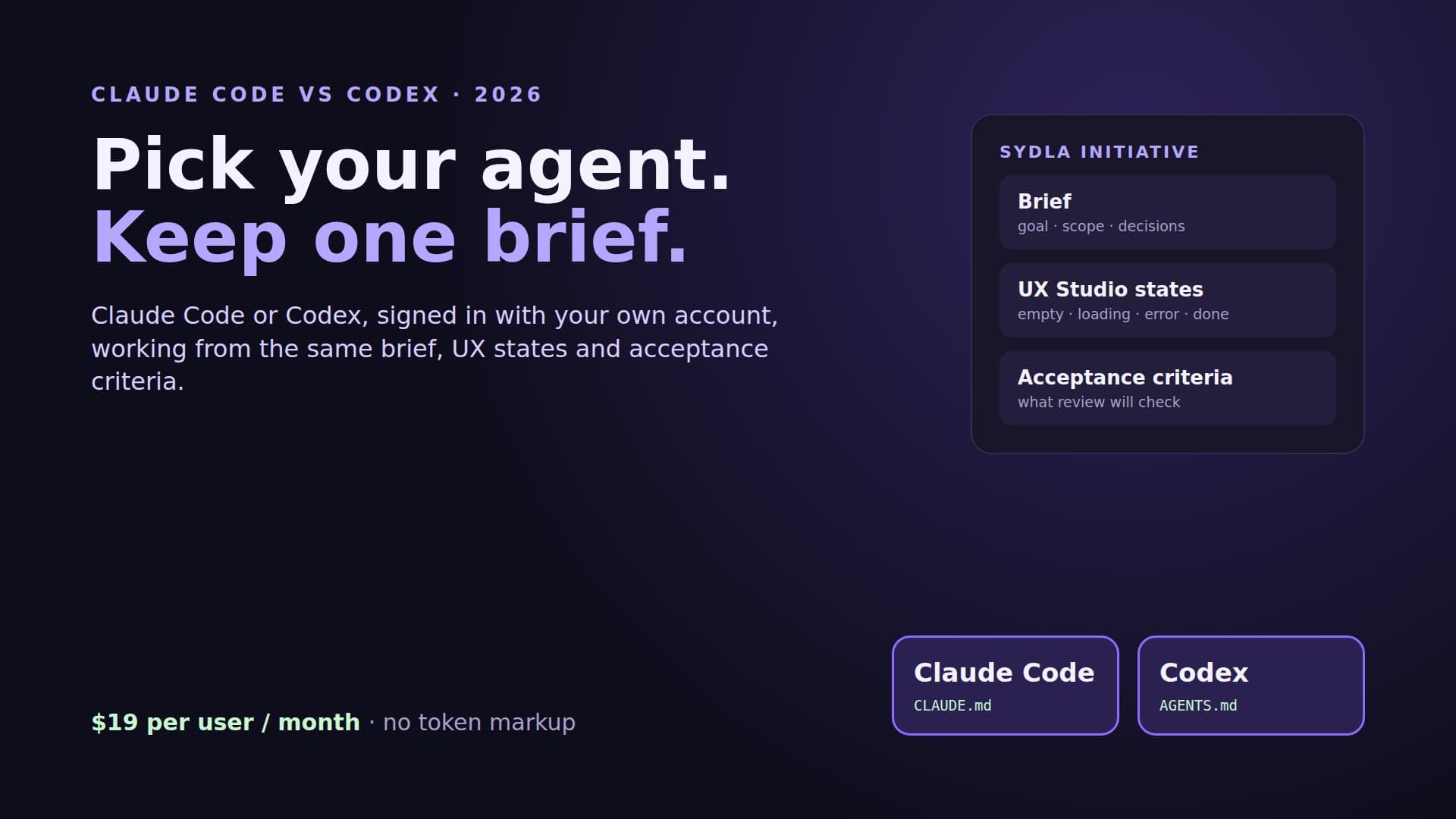
- Brief on the work item. The ticket carries the lane, the acceptance criteria and the seven i18n fields, written once and read by every agent and person.
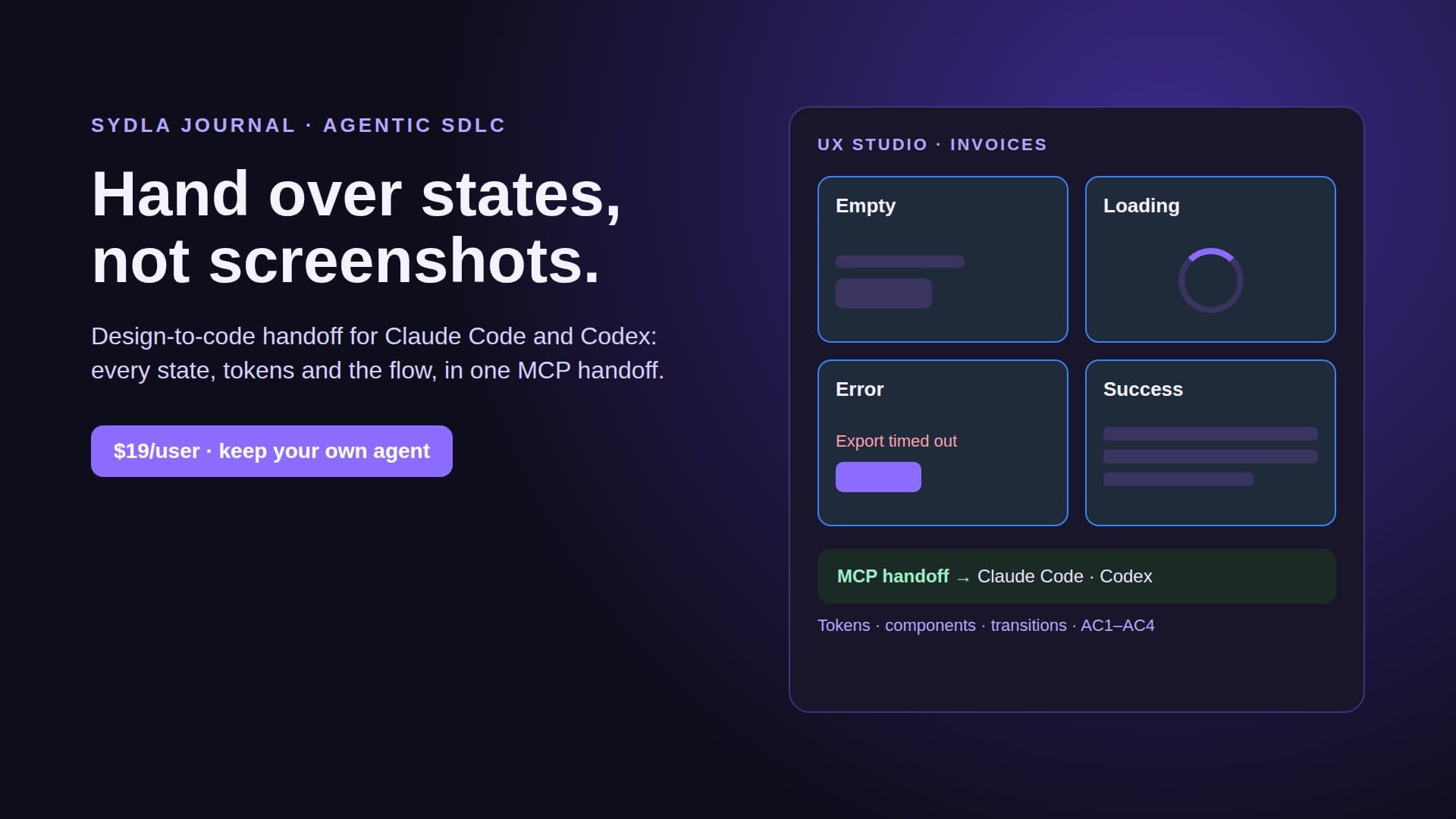
- States in UX Studio. Text length and direction change layouts, so the states are designed with the longest text and in right-to-left, not only in English. Our design handoff guide explains why states beat screenshots.
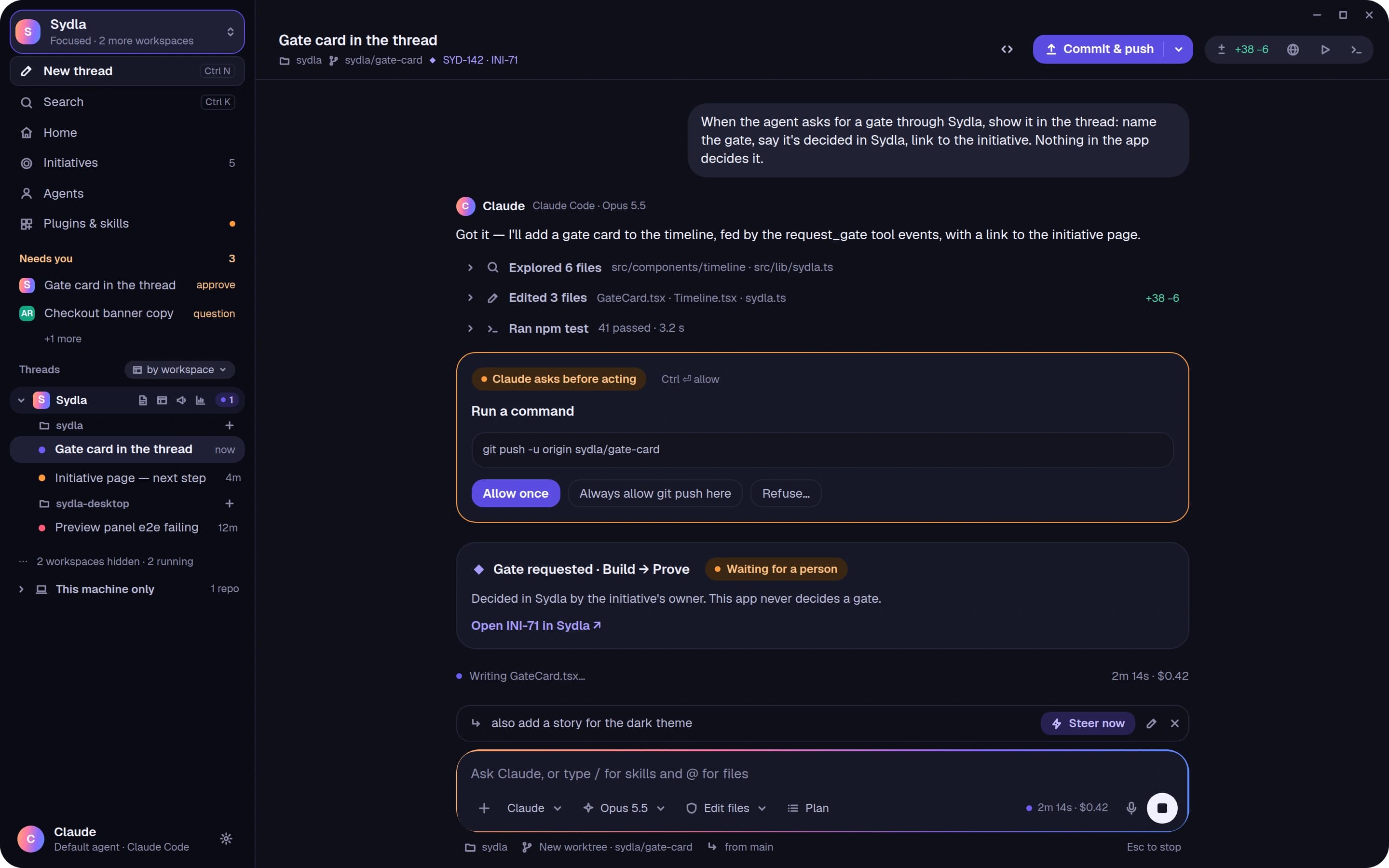
- Run in Sydla Desktop with your own agent. Sydla Desktop launches the Claude Code or Codex CLI on your machine, signed in with your own Anthropic or OpenAI account. The agent reads the work item through the Sydla MCP server, and, if you connect them, your translation platform through its own MCP server. It extracts strings, writes plural messages, opens each state in the thread's headless browser in the pseudo-locale and right to left, fixes what breaks and attaches the screenshots to the run. There are no Sydla AI credits and no token markup. The Desktop guide walks through the first run.
- Review and sign-off. The CI gates run, a native speaker reviews the new wording in the translation platform, and the owner records the result on the work item before the merge.
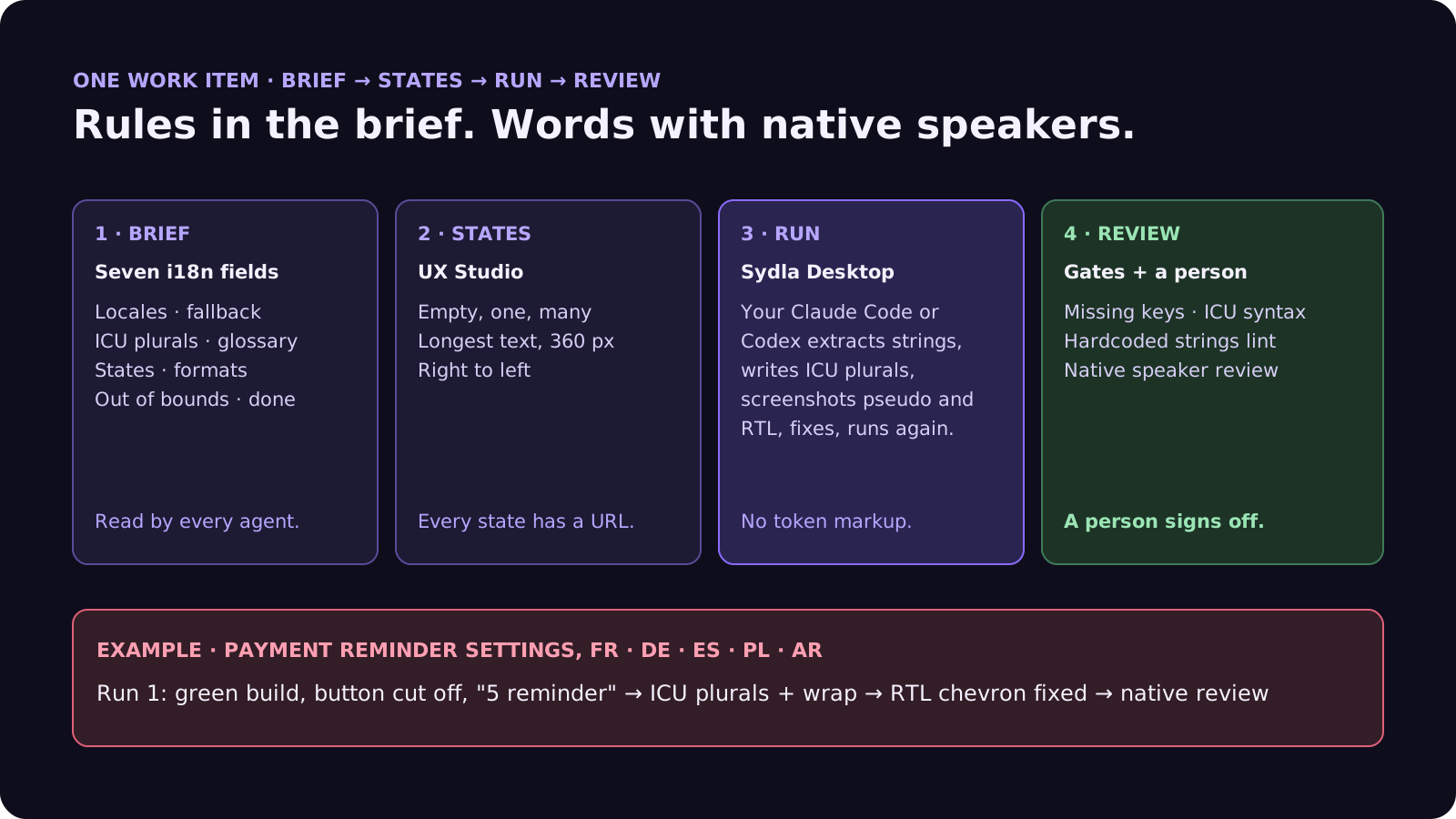
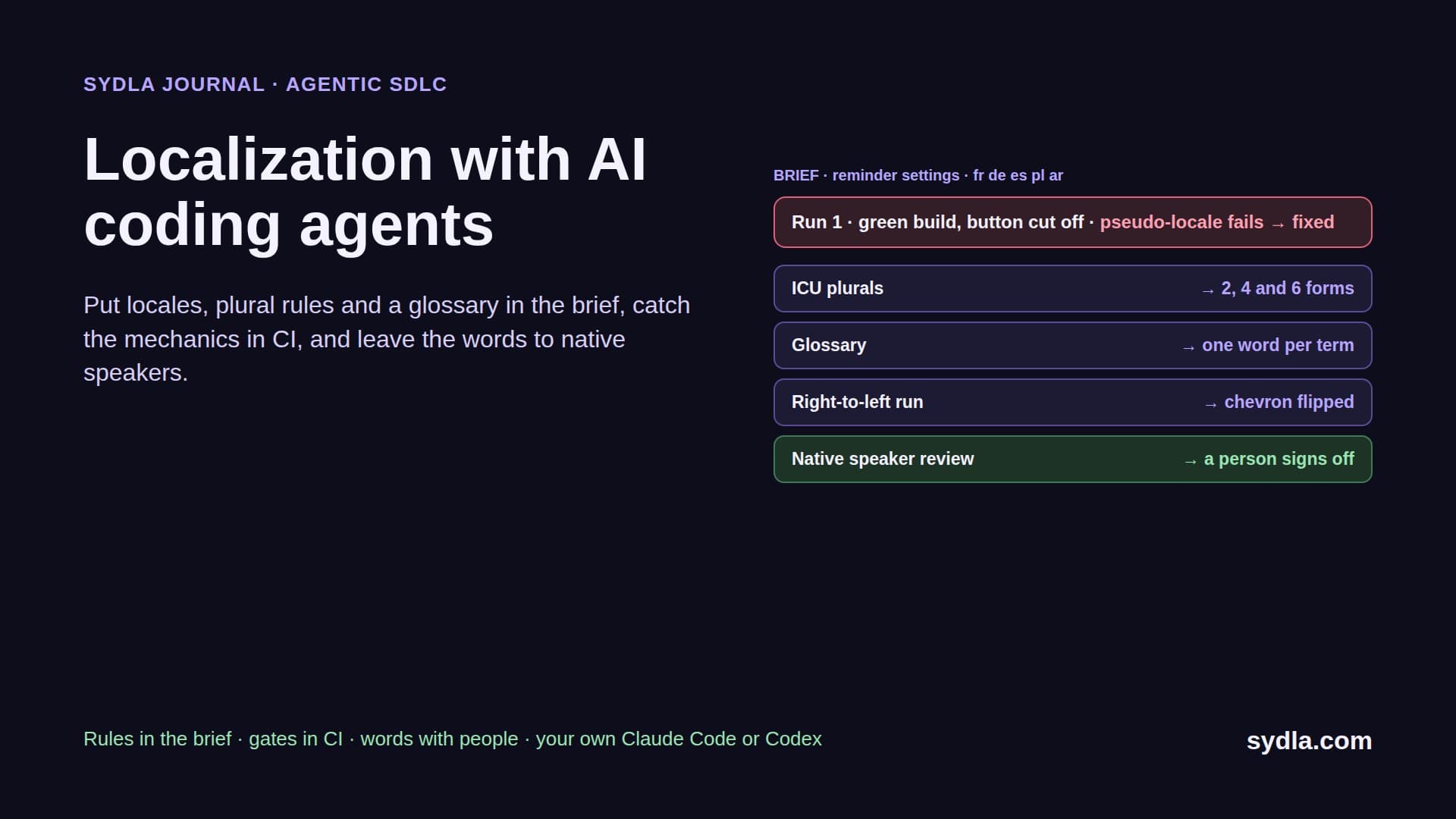
Agents move strings and check mechanics. CI enforces the rules. People who speak the language decide what the product says.
A filled-in example: the payment reminder settings
Here is the opening ticket, rewritten as an i18n brief. The screen and details are illustrative:
- Lane: New screen, plus a new locale (Arabic).
- Locales: en source; fr-FR, de-DE, es-ES, pl-PL, ar; missing keys fall back to English.
- Message format: ICU; the reminder count message covers one/other in English and French, one/few/many/other in Polish, and all six forms in Arabic.
- Glossary: invoice, reminder, workspace and seat fixed per language; Sydla and plan names never translated.
- States: empty, one reminder, many reminders, error, saved; each in German at 360 pixels wide and in Arabic right to left.
- Formats: due dates and amounts through Intl with the workspace locale and currency.
- Out of bounds: no sentence concatenation, no edits to translated files outside the translation platform, no machine translation of the late fee wording.
In this example the agent's first run does what the agent in the opening did: clean extraction, a green build. The pseudo-locale screenshots fail at once, because the Save changes button truncates and the reminder count reads 5 reminder. The agent switches the button to wrap, rewrites the count as an ICU plural with the Polish and Arabic forms, and the right-to-left run catches a chevron that points the wrong way. Gates green. The native speaker review then changes the German word for reminder, which sounded like a debt collection letter, and rewrites the Arabic late fee text by hand. The owner approves with the screenshots and the review on the work item. Our bug report template shows how to brief a translation bug that slips through anyway.
Frequently asked questions
Can AI coding agents localize an app?
They can do the engineering half well. Claude Code and Codex reliably extract hardcoded strings, write ICU plural messages, wire up date and currency formatting and fix layouts that break in long or right-to-left text, when the brief lists the locales and rules. Whether the wording is right for a market still needs a native speaker.
What is pseudo-localization?
A fake locale that replaces every string with a longer, accented version of itself, such as [Śàvé çĥàñĝéś ~~~]. Running the app or tests in it shows truncated text, hardcoded strings and broken layouts before any real translation exists, which makes it a cheap CI gate for agent-made UI.
How many plural forms does a language need?
It depends on the language, following the Unicode CLDR plural rules. English and French use one and other, Polish uses one, few, many and other, and Arabic uses six forms: zero, one, two, few, many and other. ICU MessageFormat lets one message cover all of them.
Can Claude Code or Codex connect to Crowdin or Lokalise?
Yes. Crowdin's MCP Server V2 and its agent plugin support Claude Code and Codex, and the Lokalise MCP server works with any MCP client using OAuth or an API key. Limit the agent to the tool sets it needs and keep it read-only where you can.
How much does Sydla cost compared with Jira, Confluence, Notion, Figma, Miro and Canva?
Sydla costs $19 per user per month. One paid seat each of Jira Standard, Confluence Standard, Notion Plus, Figma Professional Full, Miro Starter and Canva Business costs $83.85 per user per month, so the saving is $64.85 per user per month. You bring your own Claude Code or Codex account, so your Anthropic or OpenAI plan pays for the model with no markup.