Google Antigravity vs Claude Code and Codex in 2026: Jules shuts down, quotas reset every five hours, and who pays for the run
Google is closing Jules on 31 December 2026 and moving its coding agent users to Antigravity, where paid quotas refresh every five hours up to a weekly limit and overage runs on AI credits. We read Google's pricing page, plan docs and changelogs to compare an Antigravity run with a Claude Code or Codex run on the plan you already pay, and to show where the brief and the design states come from.
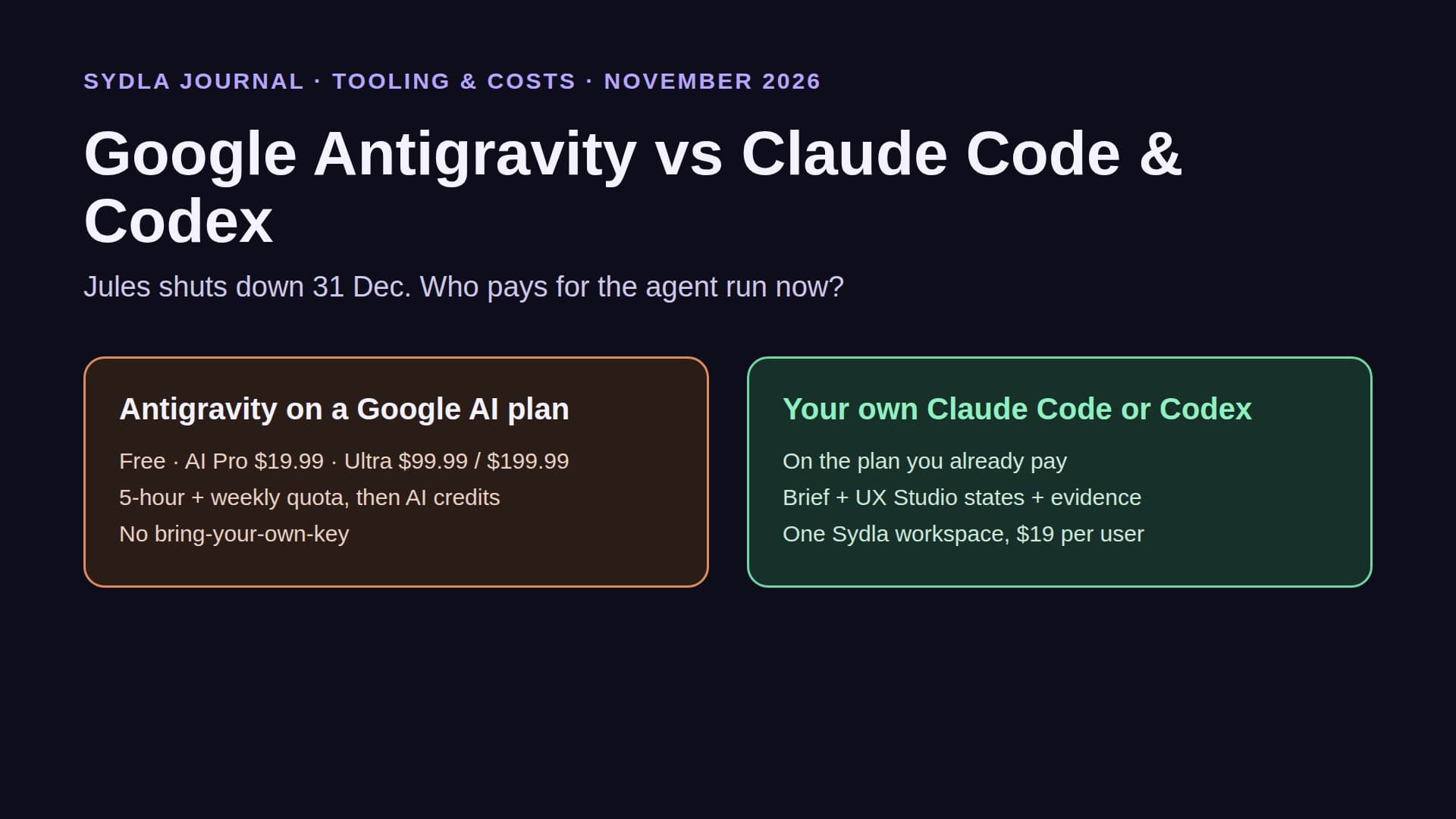
Jules is closing, and the bill moves to a Google AI plan
On 29 October 2026 Google posted a short note in the Jules changelog: Jules will wind down on 31 December 2026. Sessions could run until 11 November; since then Jules is read-only until the end of the year. The note sends users to Google Antigravity, which Google calls its agent-first platform. Your code, branches and pull requests stay in GitHub, so nothing is lost, but the habit is: fifteen free tasks a day, or a hundred on Google AI Pro, now becomes an Antigravity quota.
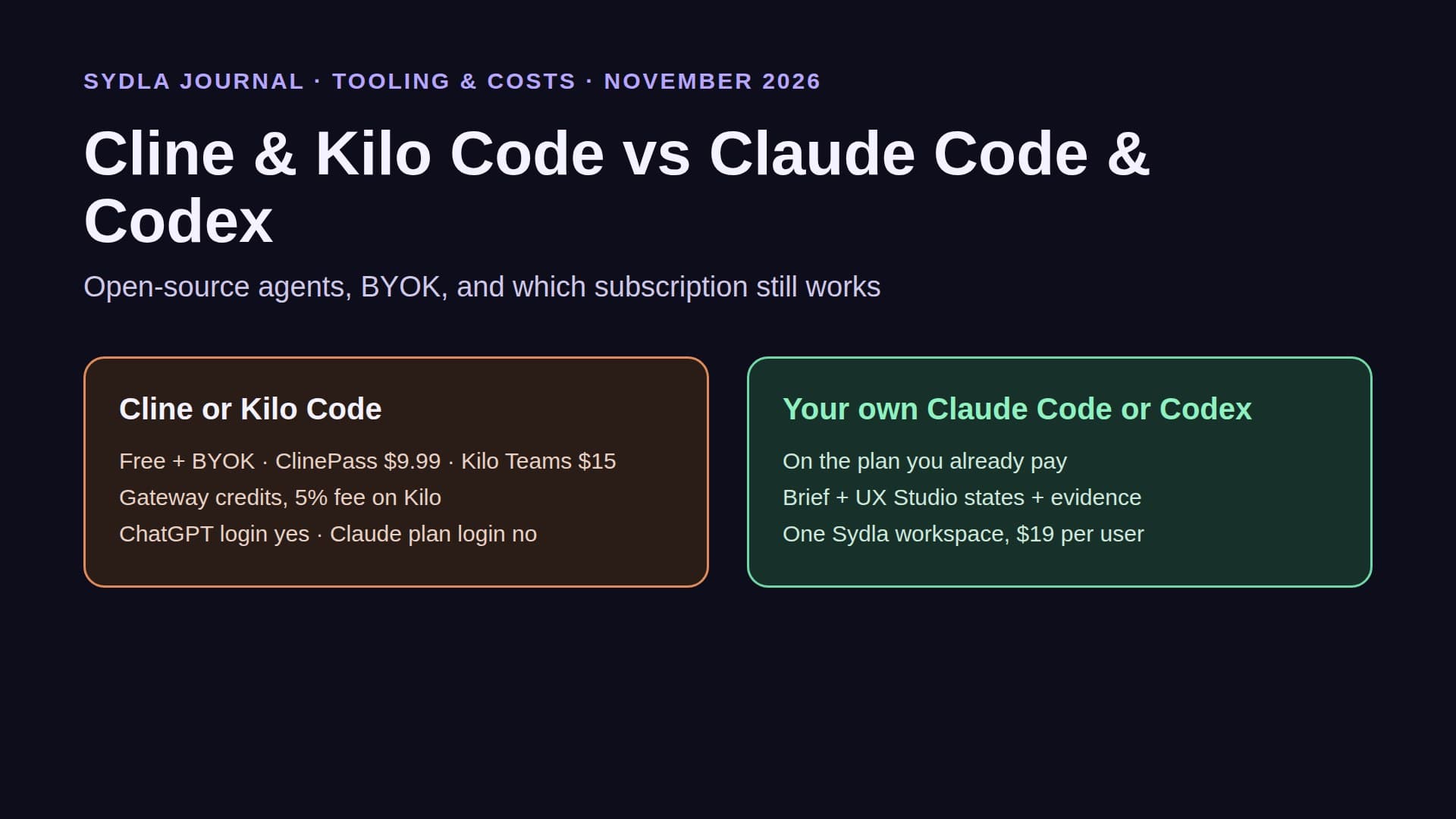
That is a good moment to ask a wider question. Many small product teams already pay for a coding agent. An engineer has a Claude plan for Claude Code, or a ChatGPT plan that includes Codex. Moving the Jules habit to Antigravity is fine. Paying for a third agent plan on top of the other two, plus six tools with six AI meters, is how AI credit fatigue starts.
For most teams the slow part is not the agent anyway. It is the brief in Confluence, the spec in Notion, the states in Figma and the decision on a Miro board, each one an MCP hop and a separate meter away from the run. This guide compares Antigravity with Claude Code and Codex from Google's pricing page, plan docs and changelogs, checked on 22 November 2026.
How Antigravity charges in November 2026
Antigravity has no standalone subscription. Individual quota comes with a Google AI plan, and Google does not publish the quota as a number of tasks or tokens. The plan docs say limits are primarily determined by available capacity and may change.
- Free, $0. A baseline agent quota that refreshes weekly, unlimited Tab completions, and Gemini 3.8 Flash. Claude Sonnet 4.6, Claude Opus 4.6 and GPT-OSS-120b are still listed for free users but will be removed on 30 November 2026.
- Google AI Pro, $19.99 a month in the US. A larger quota that refreshes every five hours until a weekly limit is reached, Gemini 4 Neon as the default model since 18 November, and Claude Sonnet 5.5 and Claude Opus 5.5 on paid, non-trial subscriptions.
- Google AI Ultra, $99.99 or $199.99 a month. The highest five-hour quota and weekly limits, full access to third-party partner models, and the most capable Gemini 4 models.
- Overage. Pro and Ultra can buy AI credits to keep working past the quota, consumed at Gemini Enterprise prices. A setting decides whether overage is used Never or Always.
- No bring-your-own-key. The plan docs say plainly that BYOK is not supported. A Claude Max or ChatGPT Pro plan does not lift your Antigravity limit.
- Teams. Google Workspace plans do not include Antigravity plans. Business use goes through Google Cloud, from $30 per seat per month on Standard or Plus, or pay as you go with no seat fee. Claude models there need an admin to opt in and bill per token.
The model list is the surprise. Google AI Pro now gives you Claude Opus 5.5 inside Antigravity, on Google's quota. That is useful if you have no Claude plan. If you already pay Anthropic for Claude Code, it means paying twice for the same model, through two meters that refresh on different clocks.
Antigravity, Claude Code and Codex side by side
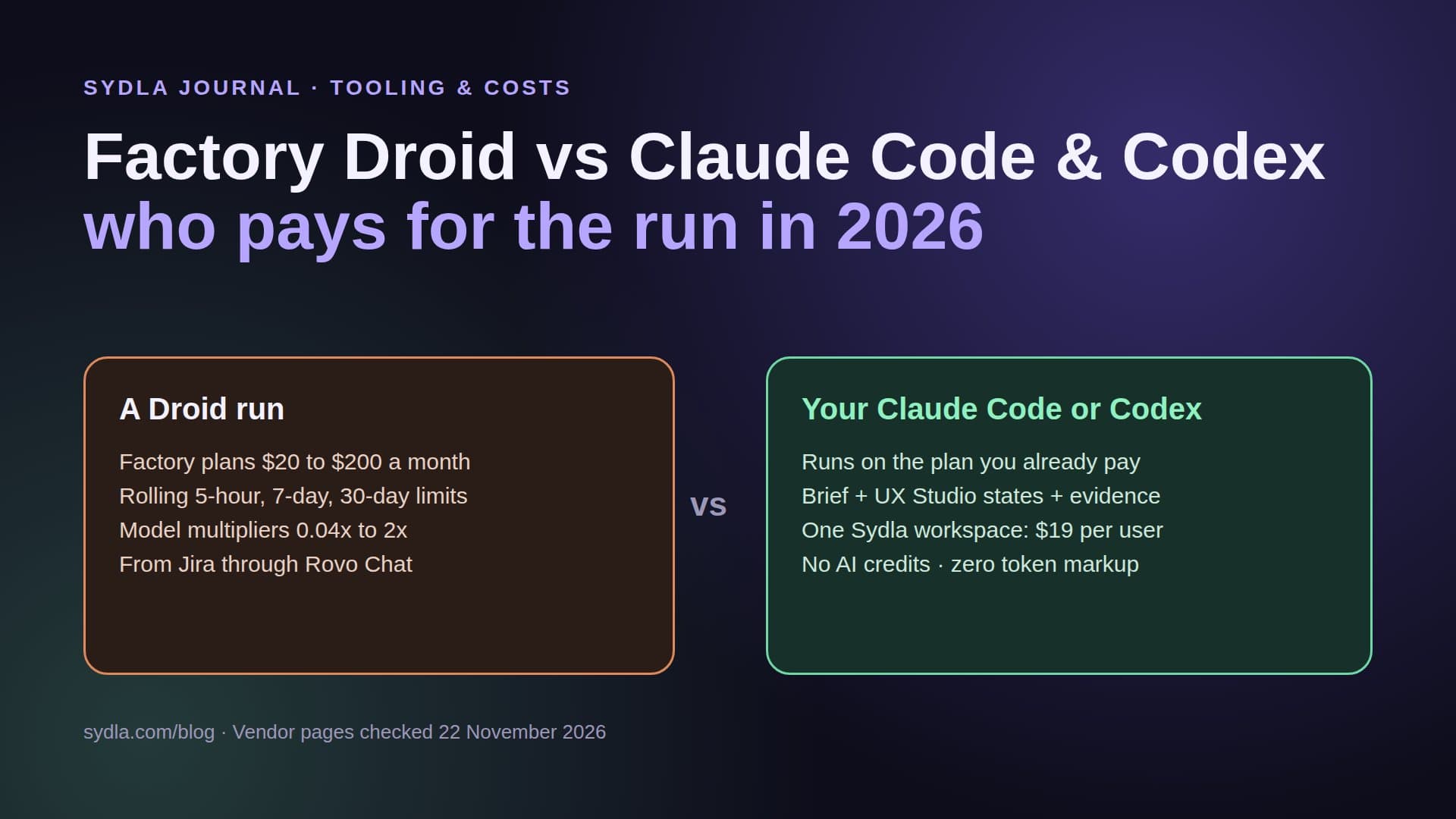
All three read a repository, plan, edit files, run tests and open a pull request. Since 9 November, Antigravity can also run remote agents for paid Pro and Ultra users. They differ in who sells the model access and how the limit is measured.
| Agent | Plans | How a run is metered | Where it reads the work |
|---|---|---|---|
| Google Antigravity | $0; AI Pro $19.99; Ultra $99.99 or $199.99 | Five-hour quota up to a weekly limit; AI credit overage; no BYOK | Repo, rules and skills, MCP servers and MCP Apps |
| Google Jules | Read-only; ends 31 Dec 2026 | Was 15, 100 or 300 tasks a day | GitHub repo; MCP for Linear, Supabase and a few others |
| Claude Code | Claude Pro $20, Max $100, Ultra $200 | Your Claude plan's usage limits; API key sessions billed as API usage | Repo, CLAUDE.md, any MCP server you add |
| Codex | ChatGPT Plus, Pro, Business plans | Your ChatGPT plan's limits; API key sessions billed separately | Repo, AGENTS.md, MCP servers in config.toml |
| Sydla workspace | $19 per user | No AI credits: it drives your own Claude Code or Codex, zero token markup | Brief, criteria, UX Studio states and evidence in one MCP connection |
Antigravity version 2.30 added an import for MCP servers, skills and instructions from Claude Code, Codex and Cursor, and version 2.34 on 20 November added MCP App support. Google clearly expects people to switch between agents. That is the right instinct, and it points to the real question: if every agent can read MCP, the context should live in one place that all of them read, not in the agent you happen to pay for this month. Our context engineering guide explains why.
The six-tool stack around any agent
Whichever agent you pick, it still needs a ticket, a brief, designed states, decisions and a launch visual. In a typical 2026 stack those sit in six tools, each with its own seat and AI meter.
| Tool | Seat price | Bundled AI and its limit | Handoff to a coding agent |
|---|---|---|---|
| Jira Standard | $9.70 | Rovo: 25 credits per user per month, pooled; PAYG $0.01 per credit from 3 Dec 2026 | Atlassian MCP or a pasted ticket |
| Confluence Standard | $7.15 | Same Rovo pool, 25 credits per user | Atlassian MCP; enriched calls 1 to 10 credits |
| Notion Plus | $12.00 | Custom Agents on Business and Enterprise; extra credits $10 per 1,000 | Notion MCP server |
| Figma Professional Full | $20.00 | 3,000 AI credits per Full seat, no rollover | Figma MCP: 200 calls a day on Full or Dev |
| Miro Starter | $10.00 | 25 AI credits per license, pooled per team | Miro MCP: daily call limits by plan |
| Canva Business | $25.00 | Personal AI allowance per member | Outside the build loop |
| Sydla workspace | $19.00 | No AI credits: bring your own Claude Code or Codex | One MCP connection or a Sydla Desktop thread |
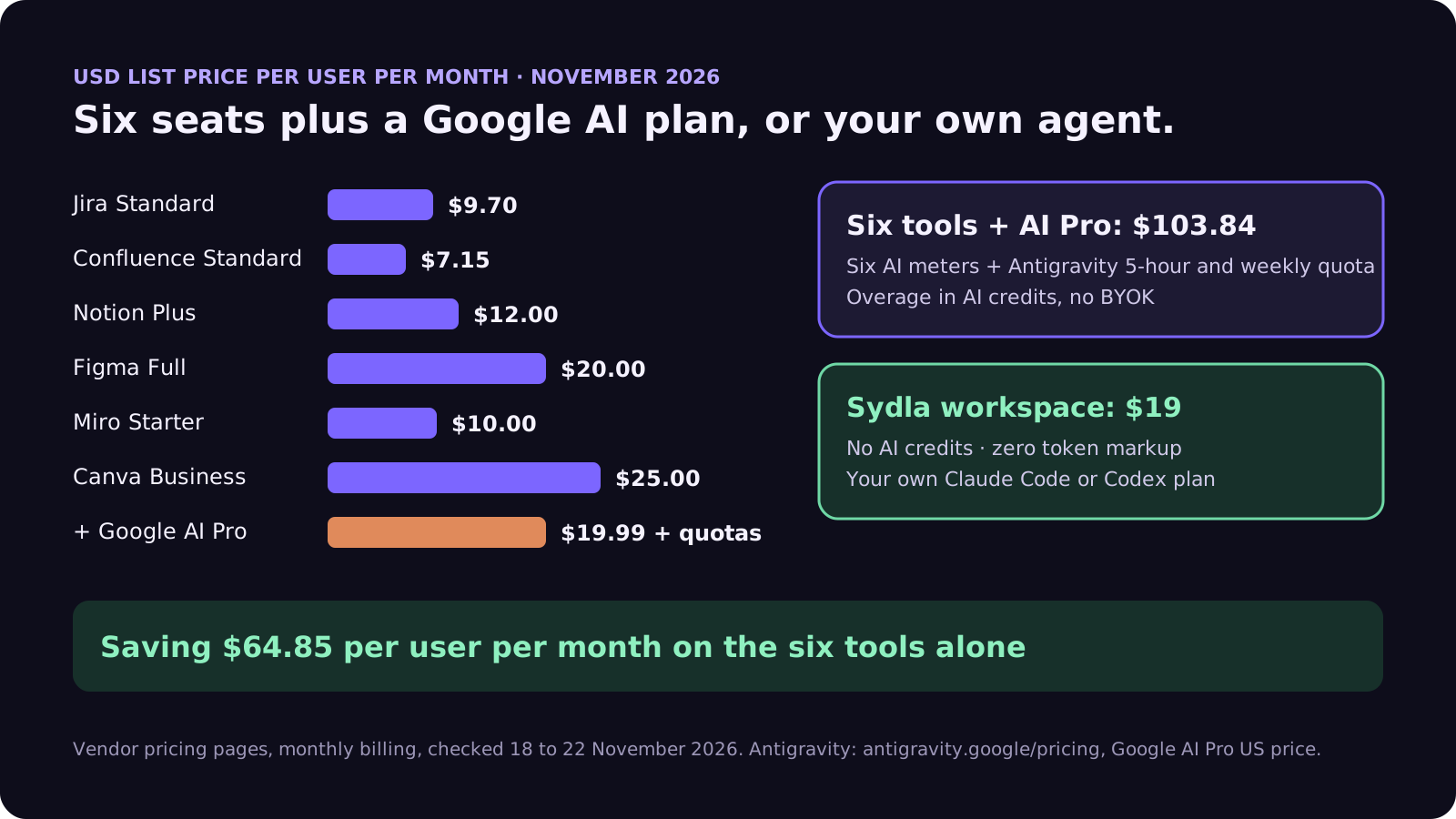
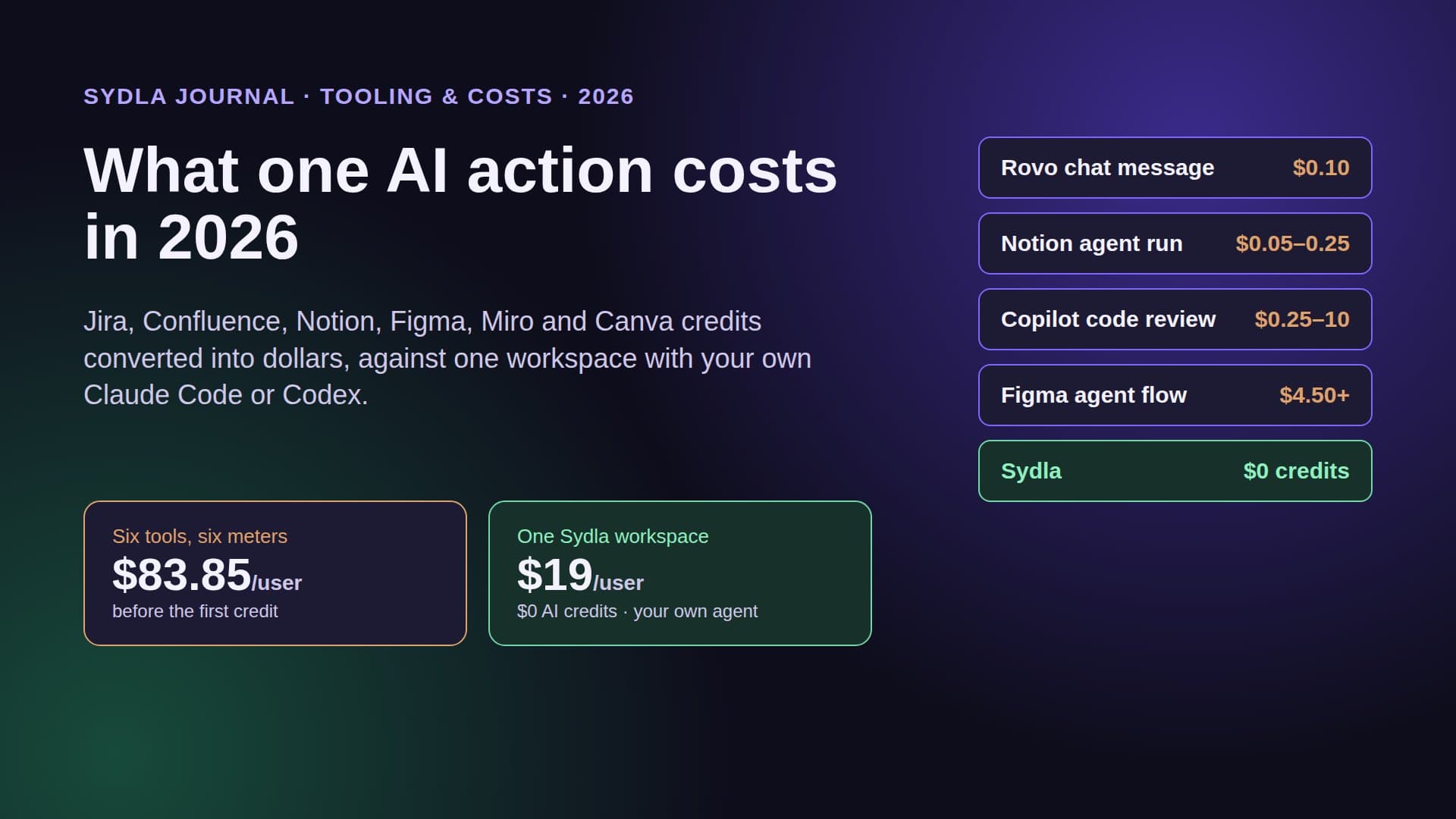
The six tools come to $83.85 per user per month before any overage, against $19 for Sydla, a saving of $64.85. Add Google AI Pro for Antigravity and the stack passes $100 per person before a single AI credit. The stack cost guide works through 5, 10 and 25 people, and the comparison overview covers each tool.
Technical walkthrough: your own agent on a shared brief and UX Studio states
Sydla takes a different route from renting another agent. The context lives in one workspace, and the agent you already pay for reads it on your machine.
- Brief. Each ticket sits in an initiative with a versioned brief, numbered acceptance criteria and a done-means line. Every save is signed by its author, a person or an agent.
- UX Studio. Screens and their states, empty, loading, error and success, are designed next to the ticket and published as a handoff with tokens and a URL per state.
- Run. In Sydla Desktop you open the ticket, start a thread and choose claude or codex. Desktop drives the CLI you are already signed in to, so the model, the limits and the bill stay on your Claude or ChatGPT plan. Each thread has an access level, Read only, Edit files or Full access, with a Preview panel and a Changes view.
- Review. The agent records evidence against each criterion: test output, screenshots of each state and the diff. A person reviews it and decides the merge and release gates. An agent can request a gate but never approve one.
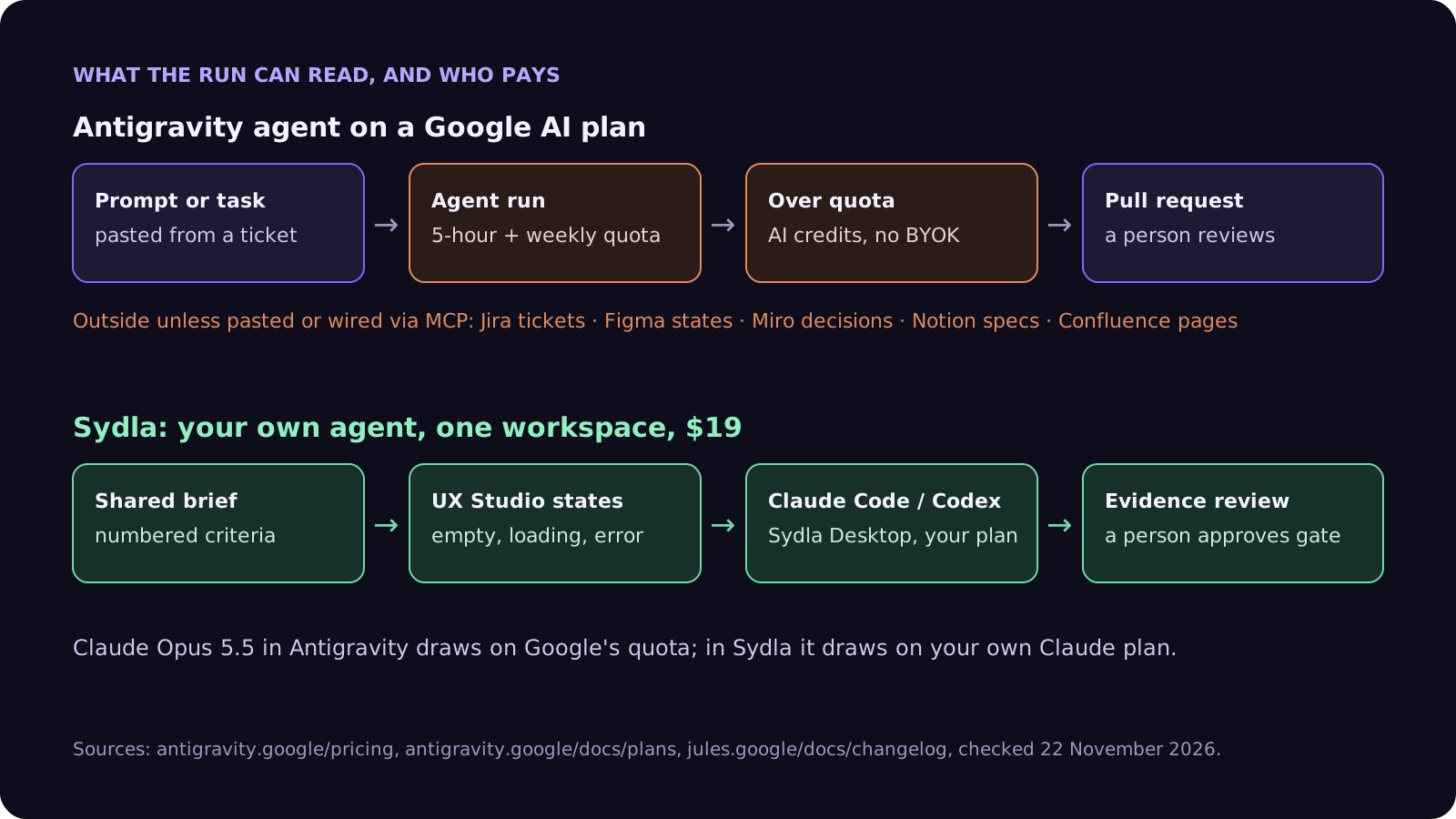
Outside Desktop, the same context is one MCP connection away. For Claude Code, run claude mcp add with the HTTP transport and the sydla.com/mcp URL. For Codex, add an mcp_servers.sydla table to config.toml with the same URL and your key in the headers. Antigravity reads MCP servers too, and can import them from your Claude Code or Codex setup, so an engineer who keeps Antigravity for Gemini work can point it at the same brief and states. Keep the first prompt short: read the work item, list the criteria and states you will build, work on a branch and record evidence per criterion. The Desktop setup guide has every step, and the brief to pull request walkthrough follows one feature end to end.
Moving off Jules without adding a meter
If your team used Jules for chores such as dependency bumps, test fixes or small refactors, here is a migration that keeps the bill flat.
- Export what is running. Code, branches and pull requests already live in GitHub. Note any scheduled tasks you set up in Jules, because they will not move on their own.
- Decide by the plan you already pay. If an engineer already has Google AI Pro, Antigravity is the natural home for those chores. If they pay for Claude or ChatGPT, run the same chores in Claude Code or Codex instead of starting a new quota.
- Turn chores into tickets. Write each recurring chore as a ticket with criteria, so any agent can pick it up and a person can check the result. Our guides on dependency upgrades and fixing failing CI have templates.
- Cap overage. Set Antigravity AI credit overage to Never until you know your usage, and note that Rovo pay as you go starts on 3 December. The December pricing checklist lists the dates.
- Keep one source of truth. Whatever agent runs the chore, it should read the brief and write evidence back to the same place.
When Antigravity is the right choice
Be fair to Google. Antigravity is a capable product with a real free tier, a quota that refreshes every five hours instead of once a month, remote agents, and a model list that includes Gemini 4 and Claude Opus 5.5 on one bill. If your engineers already pay for Google AI Pro for storage and Gemini, the coding agent comes at no extra cost, and that is hard to beat.
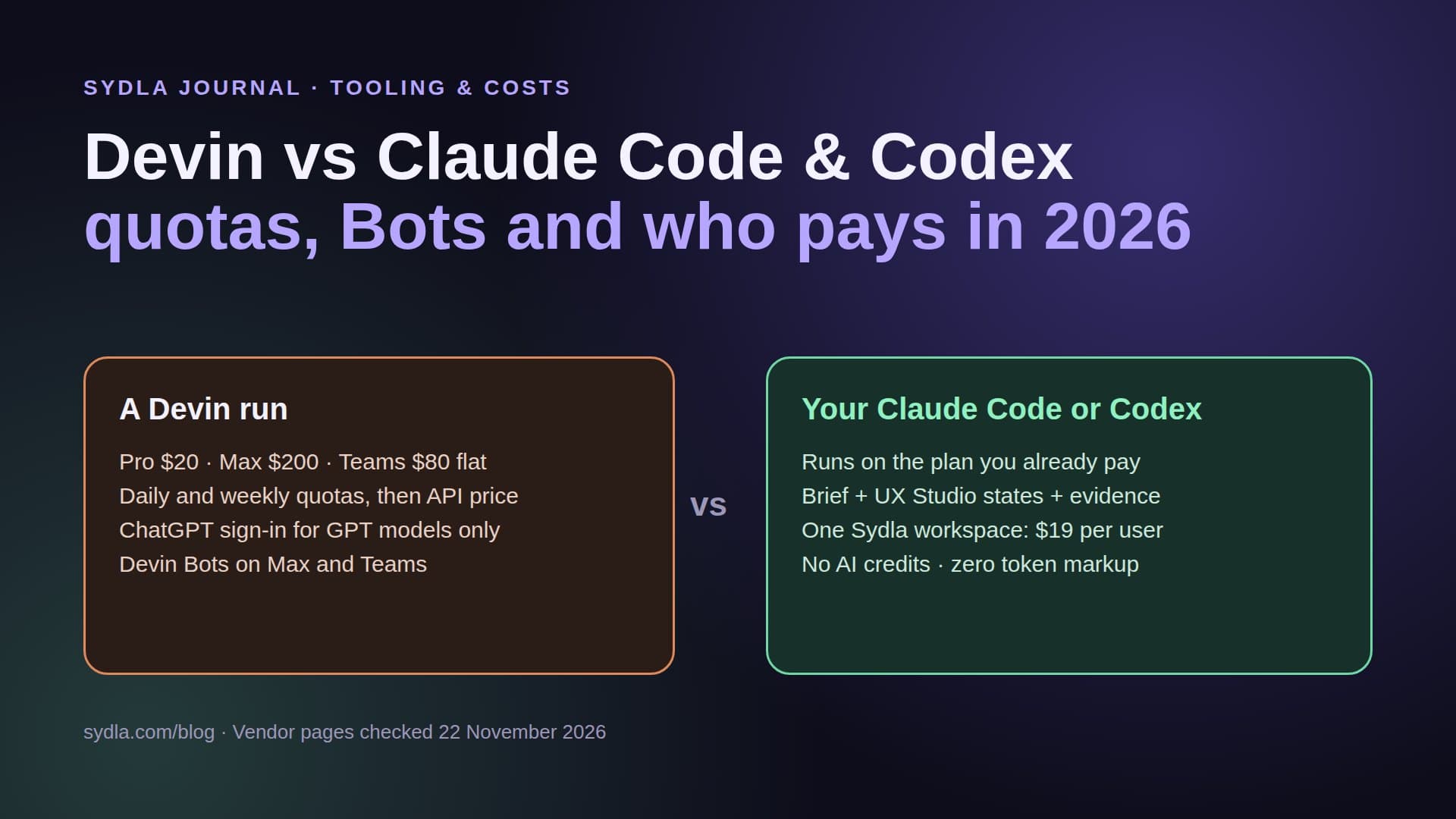
It is a weaker fit if your engineers already pay for a Claude or ChatGPT plan, because without BYOK those plans do nothing inside Antigravity. It is also a weak fit for teams that need a predictable number: Google does not publish the quota, and it moves with capacity. And like any agent, it cannot fix a brief that lives in five places. Our Claude Code vs built-in AI agents guide, the Devin comparison and the AI SDLC buyer's checklist give a way to score each option.
Try it on your next ticket
Sydla is $19 per user per month with every feature included and no AI credits to buy. Your Claude Code or Codex plan does the coding, and the brief, the states and the evidence live with the ticket. See the pricing section, read how Sydla works, then start your workspace and keep your Claude Code and Codex accounts.
Frequently asked questions
Is Google Jules shutting down?
Yes. Google's Jules changelog announced on 29 October 2026 that Jules will wind down on 31 December 2026. Sessions could continue until 11 November 2026, and Jules is read-only after that. Google points Jules users to Antigravity. Code, branches and pull requests stay in GitHub.
How much does Google Antigravity cost in 2026?
Antigravity has a free tier with a weekly agent quota. Paid quota comes with a Google AI plan: Pro at $19.99 a month in the US, and Ultra at $99.99 or $199.99. Paid quotas refresh every five hours up to a weekly limit, and Pro and Ultra can buy AI credits for overage. Business access goes through Google Cloud from $30 per seat.
Can I use my Claude or ChatGPT subscription in Antigravity?
No. Google's plan docs state that bring-your-own-key is not supported. Claude Sonnet 5.5 and Claude Opus 5.5 are available on paid Google AI Pro and Ultra plans, but they draw on Google's quota, not on a Claude plan you already pay.
What is the best Jules alternative?
If you already pay for Google AI Pro, Antigravity is the closest replacement. If you pay for Claude or ChatGPT, Claude Code or Codex can run the same chores on your existing plan. Writing each chore as a ticket with acceptance criteria makes it portable between agents.
Is there a cheaper way to run Claude Code or Codex on product tickets?
Yes. Sydla replaces Jira, Confluence, Notion, Figma, Miro and Canva in one $19 per user workspace, against $83.85 for the six tools, and runs your own Claude Code or Codex through Sydla Desktop or one MCP connection with zero token markup. The agent reads the brief, criteria and UX Studio states in one place and records evidence for a person to review.